Buying Guide
Choosing the best polymer holsters starts with the firearm rather than the shell material. A holster should be evaluated against the exact model, generation, barrel or slide configuration, accessory setup, carry hand, and intended mounting position. The products above are compared from listing specifications, not from hands-on testing. Compatibility statements can vary by generation, so treat a model list as a starting point and verify the manufacturer’s current fit information before use.
Match the holster to the firearm
Model-specific molding generally provides a clearer fit path than a universal design. The Glock Sport Combat covers a broad group of Glock 9mm,.40, and.357 models, while the GUN & FLOWER Taurus G2C/G3C OWB model is shaped around a narrower Taurus family. The Watchdog Tactical option is similarly focused on Polymer 80 and Glock 19/23-related platforms. A narrow fit can be useful when the listing explicitly names your firearm, but it can also exclude a different generation or an attached accessory.
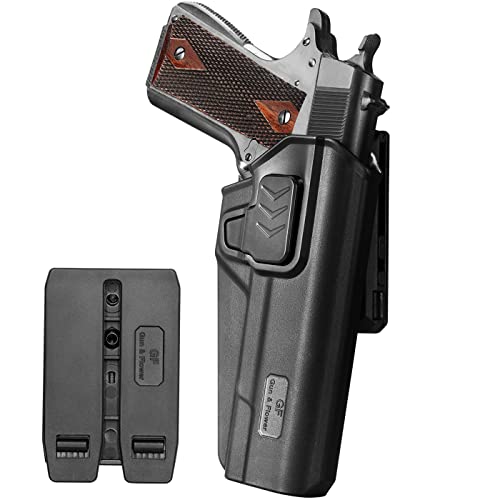
The 1911 option deserves particular attention because its documentation specifies full-size five-inch, non-railed pistols. A railed 1911 may not match that design. The Blade-Tech Ruger LCR model is also specific to the LCR in.38 or 9mm. Before ordering, compare the exact firearm designation and check whether the holster is right- or left-hand. The Watchdog Tactical model is listed as left-hand, while several other selections specify right-hand carry.
Inside-waistband designs prioritize concealment and include the Watchdog Tactical P80/G19 model and Blade-Tech Klipt Ruger LCR. The Watchdog adds a full sweat guard and RMR cut, whereas the Klipt uses a compact one-piece form with a 1.5-inch clip. IWB users should check clip size, cant, sweat-guard height, and whether an optic or tall sight is supported.
Outside-waistband designs generally offer more room for paddles, belt loops, and active retention. The Taurus OWB model uses a rotating paddle, and the BLACKHAWK Serpa CQC includes both a paddle and belt-loop platform. The Blade-Tech Total Eclipse Ruger American can convert between IWB and OWB positions, which makes it a useful option when the same holster needs more than one documented carry mode.
The HQDA model is different from the other selections because it is a drop-leg platform. Its adjustable thigh strap and quick-release buckle suit the listed tactical and training applications, but the format is not intended to provide the same concealment as an IWB design. The Orpaz T41 is also specialized, using a modular OWB attachment approach and a more elaborate retention system.
Compare retention systems
Retention features range from molded or passive friction to active locking mechanisms. The Orpaz T41 documents Level 3 retention, a hood guard, magnetic support, and an included Level 2 converter. That makes it the most feature-heavy choice for users who specifically need multiple retention modes. The HQDA and Taurus models document Level II systems, while the GUN & FLOWER 1911 option uses an index-finger release.
A positive click or audible seating signal appears in several listings, including the Taurus, GUN & FLOWER 1911, Watchdog Tactical, Blade-Tech Total Eclipse, and BLACKHAWK Serpa CQC. These are specification claims about the design, not independent performance findings. Active releases may add security but also create another control to understand during training. Passive tension can be simpler, but the amount of adjustment varies by product.
Trigger-guard coverage is another important specification. The Taurus, Watchdog Tactical, and GUN & FLOWER listings explicitly describe trigger-guard coverage or protection. The Glock Sport Combat lists a trigger-guard retention device, while the Blade-Tech designs document positive-lock trigger-guard features. Match the retention approach to your intended use and follow the manufacturer’s handling guidance.
Check adjustment and mounting details
Adjustability can refer to cant, retention, body position, belt width, or leg circumference. The Taurus paddle rotates 360 degrees and supports several belt widths. The GUN & FLOWER 1911 model also documents 360-degree mounting adjustment and includes a MOLLE adapter. The Orpaz T41 adjusts for different slide heights and barrel lengths, while the HQDA leg system adjusts for an 18- to 28-inch leg circumference.
A holster with more adjustment is not automatically better for every user. Additional hardware can make the setup more specialized, and a compact IWB design may be preferable when minimal bulk is the priority. The Blade-Tech Klipt intentionally keeps the configuration simple, while the Total Eclipse Ruger American provides a broader conversion path. Read the mounting description carefully rather than assuming that all polymer holsters use the same attachment pattern.
Consider optics and accessories
Optic clearance is explicitly documented for the Orpaz T41, Watchdog Tactical P80/G19, Blade-Tech Total Eclipse Ruger American, and Blade-Tech Polymer 80 G19 products. The Taurus G2C/G3C IWB candidate, by contrast, states that it does not fit attachments such as lasers or lights. The 1911 GUN & FLOWER model is specifically for non-railed pistols. These distinctions make accessory compatibility a central buying check, not a minor detail.
Final recommendation
Blade-Tech Total Eclipse Ruger American Holster ranks first overall in this specification-based comparison under the published weighted criteria.
The Orpaz T41 Pro Level 3 Polymer Holster is the first overall specification-based choice among these best polymer holsters because it combines adjustable fit, optic protection, multiple retention levels, and modular OWB compatibility. It is most appropriate for a duty-oriented setup rather than a minimalist concealed-carry role.
For a convertible setup, the Blade-Tech Total Eclipse Ruger American is one of the top polymer holsters because its listing documents IWB, OWB, and FBI-canted configurations. The Watchdog Tactical model is the more focused choice for left-hand optic-ready IWB carry, while the Glock Sport Combat keeps the setup straightforward for a broad range of Glock models. Taurus owners should consider the GUN & FLOWER OWB model for its documented Level II retention and rotating paddle. Each recommendation depends on confirming the precise firearm and accessories first.
Frequently Asked Questions
Among the best polymer holsters, are polymer holsters suitable for concealed carry?
Yes, the category includes IWB designs such as the Watchdog Tactical P80/G19 and Blade-Tech Klipt Ruger LCR. Suitability depends on the listed firearm fit, carry hand, clip, cant, sweat guard, and accessory clearance. The best polymer holsters for concealment are not necessarily the same as duty or drop-leg designs.
What is the difference between IWB and OWB polymer holsters?
IWB holsters are designed to sit inside the waistband, while OWB holsters sit outside it. IWB products in this comparison emphasize compact carry, such as the Klipt, or sweat and optic management, such as the Watchdog Tactical model. OWB products may provide more room for paddles, belt loops, active retention, or MOLLE adapters.
Do polymer holsters fit every handgun?
No. Most products here document specific firearm families. The Glock Sport Combat lists many Glock models, while the Orpaz T41 uses adjustable dimensions and the GUN & FLOWER 1911 model is limited to most full-size five-inch non-railed 1911 pistols. Confirm the exact model, generation, barrel or slide length, and accessory configuration.
Does an optic require a special holster?
Often, yes. The Orpaz T41, Watchdog Tactical P80/G19, and selected Blade-Tech models explicitly document optic compatibility. Other listings exclude lights, lasers, or railed configurations. Do not assume an optic-ready firearm will fit a holster unless the product evidence specifically supports that setup.
What should I verify before using a polymer holster?
Verify firearm compatibility, carry hand, trigger-guard coverage, retention operation, belt or platform dimensions, and any optic or accessory clearance. Also confirm that the mounting hardware is appropriate for the intended belt, MOLLE platform, thigh position, IWB placement, or OWB setup. Use the manufacturer’s instructions for fitting and safe handling.