Buying Guide
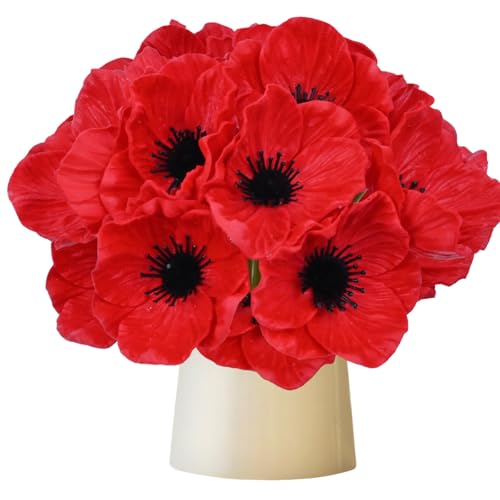
Choosing the best artificial poppy flowers starts with the arrangement you want to build. A compact kitchen vase needs a different stem length from a tall wedding centerpiece, and a remembrance display may call for a traditional red palette rather than mixed spring colors. The products above are compared from public listing specifications, including materials, dimensions, bloom counts, stem construction, colors, and stated uses. This is not a hands-on test and does not summarize customer opinions.
Match stem length to the container
Stem length is one of the clearest practical differences in this category. The Leoyoubei set lists approximately 13-inch stems, making it a sensible scale for small vases, tabletop displays, and compact arrangements. Tikroom lists branches of about 11 inches, which places it in an even shorter format. These options can be easier to position in a low container without leaving excessive stem above the vase.
For a more versatile everyday height, CISDUEO, IPOPU, INSUNSIX, and Wbartplant list stems in the roughly 22- to 24-inch range. That length can work in taller vases or be bent and trimmed for shorter arrangements when the construction supports it. ICBOX and muafho move into a taller-display category, with listed lengths of approximately 27.55 and 30 inches respectively. Those longer stems are useful when flowers need to rise above a large vase or create a more vertical silhouette.
Before ordering, compare the listed flower length with the vase height and opening. A long stem can usually be shortened when the listing documents cuttable construction, but a short stem cannot be extended. ATFL is especially specific about a suggested vase range, while the other listings provide stem dimensions that can be used as a starting point for planning.
Compare bloom and bud structure
Head count affects how quickly a bundle can form a full display. Wbartplant lists three blooms and one bud on each of its 12 stems, for 36 total poppy heads and 12 buds. ATFL lists four flower heads and four leaves per stem, also offering a high-fullness format. These are useful choices when the goal is a substantial arrangement from one pack.
Several mid-sized options use three blooms and one bud per stem. That structure is documented for muafho, Fqueelvys, INSUNSIX, IPOPU, and CISDUEO. It creates a repeatable pattern for a bouquet and gives each stem a combination of open blooms and a smaller accent. ICBOX lists three blooms per stem, while Tikroom emphasizes its flower-head material and 10-piece quantity rather than a multi-bloom stem design.
Head diameter also changes the visual balance. muafho lists approximately 3.93-inch heads, Fqueelvys approximately 3.5-inch heads, and ICBOX approximately 3.15-inch heads. Leoyoubei lists heads around 3 inches, while Tikroom lists approximately 2.6-inch heads. Larger heads can provide a stronger focal point, but smaller heads may be easier to combine with other flowers or fit into a narrow arrangement.
Choose silk or PU construction
Silk is the most common material in this selection. Wbartplant, muafho, ATFL, Fqueelvys, ICBOX, INSUNSIX, IPOPU, and CISDUEO all describe silk or silk-like flower construction. Listings also mention details such as flocked stems, fuzzy leaves, petal texture, or layered shapes. These details can influence the surface appearance and the handling experience, but the supplied evidence does not establish a measured realism comparison.
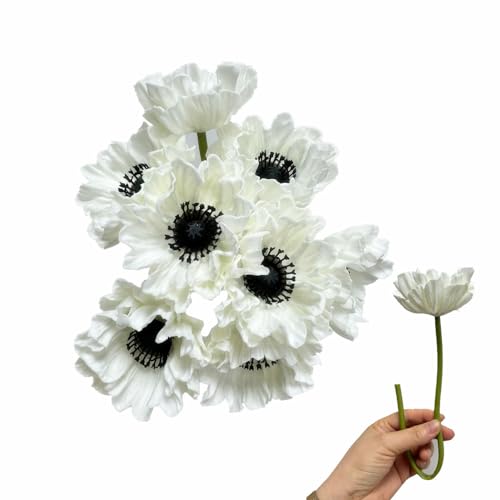
Tikroom and Leoyoubei document polyurethane, or PU, flower heads. Tikroom specifically describes a real-touch, rubbery texture and slightly ruffled petal edges. Leoyoubei describes environmentally friendly PU heads with approximately 3-inch blooms. PU may be worth considering when tactile texture is a priority, while silk can be appealing for traditional fabric-petal arrangements.
Flocking deserves separate attention. ATFL, Fqueelvys, ICBOX, INSUNSIX, and Wbartplant describe flocked or fuzzy stems and leaves. Some listings caution that fibers may shed during unpacking or arranging. In either case, gently reshape compressed stems and petals rather than pulling at the surface.
Prioritize bendable stems for DIY work
A bendable stem gives you more control over the final angle and height. muafho, ATFL, Fqueelvys, ICBOX, INSUNSIX, IPOPU, Leoyoubei, and Wbartplant document wire-supported stems that can be bent, shaped, or cut. This is helpful when arranging flowers in containers with different heights or when building bouquets, centerpieces, and backdrops.
The amount of adjustment may vary by design, and the listing evidence does not provide force or durability testing. Treat cuttable stems as a customization feature rather than proof of long-term performance. If you need to change the shape frequently, keep the original stem length until the arrangement is established, then trim only after confirming the desired height.
Select color and pack size together
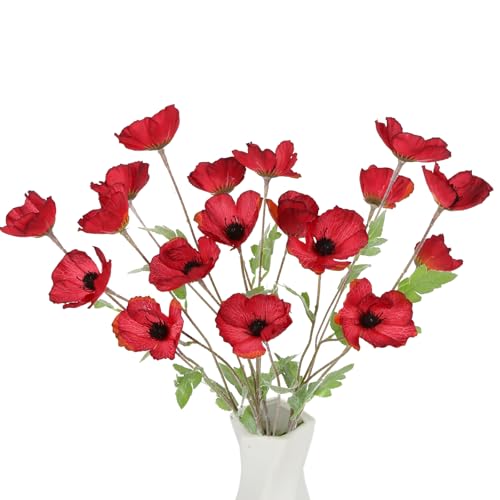
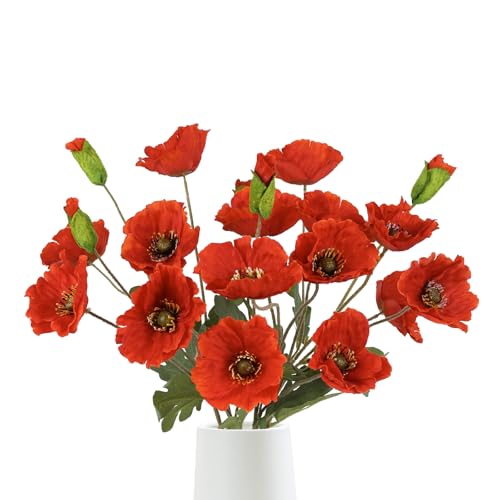
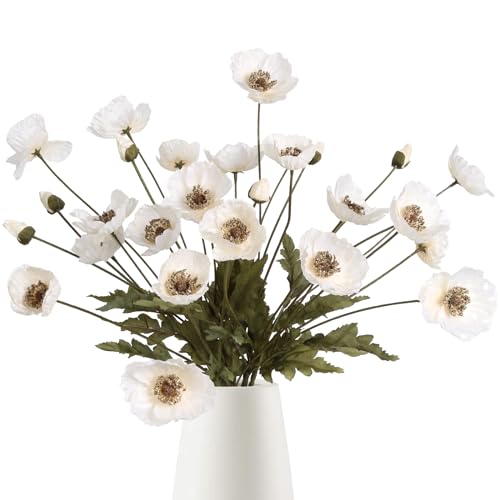
Color should fit the setting as well as the number of flowers required. INSUNSIX supplies pink stems, IPOPU supplies white, and ICBOX supplies vintage red. Tikroom and Fqueelvys offer red formats that suit remembrance displays, weddings, or strong color accents. CISDUEO provides orange, white, and yellow in one bundle, which can simplify a mixed-color arrangement without buying separate sets.
Pack size matters when the flowers will be spread across several containers. ATFL and Wbartplant list 12-stem packs, while Tikroom and Leoyoubei provide 10 and eight pieces respectively. Smaller six-stem sets from CISDUEO, IPOPU, ICBOX, and muafho can work well when you want one defined bouquet or a restrained centerpiece. A larger quantity is not automatically better; it is most useful when the display needs coverage or when stems will be divided between locations.
Plan for unpacking and maintenance
Many listings state that the flowers may arrive bent, squeezed, or misshapen for shipping. Straightening the wire-supported stems and adjusting petals by hand is part of the setup described for several products. Some listings also mention using gentle warmth or allowing the flowers to regain shape, but follow the specific product directions rather than applying heat automatically.
Artificial flowers do not require watering, pruning, or sunlight according to the supplied listings. They can still collect dust, so use the care method stated by the product details; Tikroom specifically mentions wiping with a damp cloth. Outdoor suitability is not identical across every product, so rely on a listing’s stated indoor or outdoor use instead of assuming all faux flowers have the same weather resistance.
Final recommendation
Wbartplant 22.4-Inch Silk Poppy Stems ranks first overall in this specification-based comparison under the published weighted criteria.
The final choice among the best artificial poppy flowers depends on the documented features that match your intended use.
Wbartplant 22.4-Inch Silk Poppy Stems is the highest-scoring returned product and the first overall specification-based choice. Its documented combination of 12 stems, three blooms and one bud per stem, flexible wire cores, and long length gives it the broadest practical arrangement profile among the selected options. For the top artificial poppy flowers in a tall vase, muafho is the specialist pick because its stems reach approximately 30 inches and its heads are listed at approximately 3.93 inches. Choose ATFL when a fuller 12-stem pack or divided arrangement matters, Fqueelvys or ICBOX when larger red blooms and taller styling are priorities, and INSUNSIX, IPOPU, or CISDUEO when color selection is more important. Tikroom and Leoyoubei are better matched to shorter displays, real-touch PU petals, or compact containers.
Frequently Asked Questions
Among the best artificial poppy flowers, what stem length is best for artificial poppy flowers?
It depends on the container and the intended silhouette. The selected products range from approximately 11 inches for Tikroom and 13 inches for Leoyoubei to approximately 30 inches for muafho. Around 22 to 24 inches, as documented for Wbartplant, IPOPU, INSUNSIX, and CISDUEO, is a flexible middle range for vases and centerpieces. Measure the container before choosing, and favor a cuttable or bendable stem when you need more control.
Are silk or PU poppies the better choice?
Neither material is universally best from the supplied specifications. Silk is documented across most of the selected sets and is often paired with flocked or textured details. Tikroom and Leoyoubei use PU heads; Tikroom specifically describes a real-touch rubbery texture. Choose based on the surface feel, head size, color, and stem design that suit your arrangement rather than treating material alone as a guarantee of appearance.
Which selected poppies are suitable for a wedding centerpiece?
IPOPU, INSUNSIX, muafho, ICBOX, Fqueelvys, and Wbartplant all document wedding, bouquet, or centerpiece uses. White IPOPU can suit a neutral display, pink INSUNSIX can provide a softer palette, and muafho offers unusually long stems for taller designs. Wbartplant and ATFL are practical when a fuller pack is needed. These recommendations are based on listed specifications and stated applications, not event-use testing.
Do artificial poppy stems need to be cut?
No. Cutting is optional and depends on the vase or project. Several selected products document bendable or cuttable stems, including IPOPU, ICBOX, Leoyoubei, Fqueelvys, and muafho. First position the flowers at their original length, then trim only if the finished arrangement sits too high. A wire-supported stem can also be bent when you need to preserve its full length.
How should compressed artificial poppy flowers be prepared?
Straighten the stems carefully and reshape the petals and leaves by hand. Multiple selected listings note that flowers may be bent or squeezed during shipping. Flocked designs may shed some fibers during handling, and some products mention that slight leaf or bud movement can occur. Let the arrangement settle after reshaping, and use only the care instructions supplied for the specific product.