Buying Guide
Choosing the best portable dog food storage starts with the kind of trip you are planning. A flexible bag is usually easier to compress into a car, RV, or backpack, while a rigid bin can make pouring and measuring more controlled. The products in this comparison range from a six-cup integrated feeder to a large wheeled container, so capacity and packing style matter as much as the closure.
Match capacity to the trip
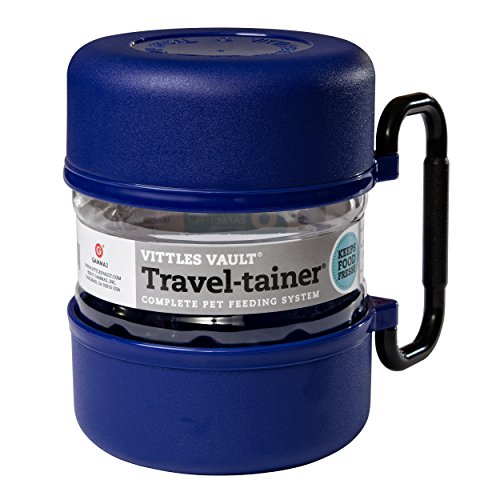
For a short outing, a compact container can reduce bulk. The Gamma2 Travel-Tainer stores six cups and adds two bowls, while the Aosnare holds 14 cups in a narrow flexible format. These sizes may be practical when you need a few meals rather than a full supply.
The selected products with midrange capacity include the 32-cup Callieco bag and the 40-cup (re)zip bag. The 42-cup FXW and NEECONG bags are better suited to longer trips or multiple dogs, based on their listed capacities. Always treat cup and pound figures as approximate because kibble density differs.
Choose a closure that fits the conditions
Roll-top closures appear throughout the flexible-bag group. (re)zip specifies rolling the top three times for an airtight closure, while Callieco, FXW, Kurgo, and CynosCape also document roll-down designs. These closures can adjust as food is consumed and avoid leaving a large rigid container partly empty.
Hard containers use a different approach. TIOVERY lists four snap-lock latches and a silicone gasket, and ZOMISIA lists four buckles with a clear lid. The Gamma2 listing describes BPA-free plastic but does not provide a detailed latch description in the supplied evidence. If moisture and pests are your main concern, compare the specific seal language rather than assuming every container protects food in the same way.
Consider material and cleaning details
Material claims are useful when they are specific. The (re)zip bag is described as BPA-free, lead-free, PVC-free, food-safe PEVA and water resistant. FXW uses 420D nylon ripstop outside with a polyester taffeta interior. Callieco combines waterproof nylon ripstop with a PEVA liner, while CynosCape specifies a waterproof PVC lining and wipe-clean surface.
Cleaning information varies. (re)zip provides machine-washing instructions, with hand washing and air drying recommended for best results. Aosnare and CynosCape describe wipe-clean surfaces. Several other listings identify water resistance or food-safe materials without giving a full care method. That difference is important if you expect repeated outdoor use.
Decide whether you need accessories
A storage bag alone may be the lightest option, but integrated accessories can simplify packing. NEECONG includes two collapsible bowls. Callieco includes a one-cup scoop and a side pocket that can hold a bowl and other supplies. TIOVERY includes a measuring cup and collapsible bowl, while Gamma2 includes two bowls but only six cups of storage. ZOMISIA includes a scoop rather than bowls.
Kurgo and CynosCape emphasize attachment points and pockets, allowing you to carry selected accessories without placing them inside the food compartment. FXW has an interior pocket and fold-out pour spout. Check whether the listing says an accessory is included or merely compatible; CynosCape, for example, explicitly states that its bowl is not included.
Compare flexible and rigid designs
Flexible bags generally compress as food is used. The (re)zip listing specifically describes flat compression, and Aosnare says its flexible design fits narrow spaces. That can be useful when packing space changes during a trip. Soft bags may provide less structure when pouring, so features such as FXW’s pour spout or Callieco’s scoop can be helpful.
Rigid containers hold their shape and can support controlled dispensing. TIOVERY has a large pour spout, measuring cup, and slim profile. ZOMISIA adds wheels for moving a heavy supply, but its large dimensions and listed weight make it a different proposition from a hiking bag. Gamma2 is rigid and compact, with feeding bowls built into the travel system.
Use the scoring method appropriately
The editorial score uses five category-specific criteria: capacity and portability, closure and food protection, materials and cleanability, travel organization, and feeding convenience. The weights prioritize capacity and closure because those features directly determine whether a carrier fits the journey and protects dry food. Materials, organization, and feeding features remain important secondary considerations.
This is a specification-based comparison using supplied public listing information. It is not a hands-on test, and it does not summarize customer opinions. Where a listing does not state a capacity, cleaning method, or accessory, the comparison does not assume one.
Final Recommendation
Callieco Dog Food Travel Bag, 32 Cups ranks first overall in this specification-based comparison under the published weighted criteria.
The final choice among the best portable dog food storage depends on the documented features that match your intended use.
(re)zip 40-Cup Roll-Top Pet Food Storage Bag is the highest-scoring returned product and the first overall specification-based choice. Its 40-cup capacity, adjustable airtight roll-top, compressible shape, food-safe PEVA, water resistance, and documented washing guidance create the most specification-aligned balance for general travel.
For a larger supply, FXW and NEECONG both list 42 cups, with FXW emphasizing its pocket and pour spout and NEECONG adding two bowls. Callieco is a strong organized alternative because it includes a measuring scoop and waterproof side pocket. For rigid dispensing, TIOVERY is the clearest fit, while Gamma2 is a compact feeding system for shorter outings. ZOMISIA is the specialist choice for large-volume transport where wheels matter. Together, these are the top portable dog food storage options for different packing and feeding priorities rather than a single universal design.
Frequently Asked Questions
What capacity is suitable for a road trip?
That depends on the dog’s portion size, trip length, and kibble density. The selected listings range from six cups in Gamma2’s Travel-Tainer to 42 cups in FXW and NEECONG. A 14-cup bag such as Aosnare may suit a shorter trip, while the 32- to 42-cup bags provide more room for extended travel. Convert your planned meals into approximate cups, then allow for differences between the listed capacity and the actual food volume.
Is a roll-top bag better than a hard container?
Neither format is automatically better. Roll-top bags such as (re)zip, Callieco, FXW, Kurgo, and CynosCape can adjust as food is consumed, and some compress for packing. Hard containers such as TIOVERY, Gamma2, and ZOMISIA retain their shape and may make pouring easier. Choose the format that matches your available space, preferred dispensing method, and desired accessory setup.
Which best portable dog food storage option includes bowls?
NEECONG includes two collapsible bowls, Gamma2 includes two three-cup bowls, and TIOVERY includes a collapsible bowl. Other selected products focus on storage and may provide pockets, straps, or attachment points instead. Verify the included contents before packing, particularly because CynosCape states that its bowl is not included.
Are these containers suitable for wet food?
The supplied evidence centers on dry food, kibble, treats, and dry-food storage. Water-resistant, waterproof, or airtight descriptions should not be treated as a guarantee that a product is intended for wet food. For this comparison, use the products according to the documented dry-food purpose and follow the care instructions provided by the manufacturer.
What should I check before buying?
Confirm the listed capacity, closure type, dimensions, carrying method, material information, and cleaning instructions. Also check whether a scoop or bowl is included. A large wheeled container may be useful for high-volume transport but too bulky for hiking, while a small flexible bag may pack easily but require more frequent refilling.