Buying Guide
Choosing among the best reception clock radios starts with deciding what “reception” means for your routine. Some models focus on conventional AM/FM bedside listening, while others add NOAA Weather, shortwave, aviation, Bluetooth, or internet-based audio. The most suitable specification profile depends on the bands you need, how you will power the radio, and how much alarm flexibility matters.
Start with the radio bands
AM/FM remains the core combination for many clock radios. The FUHONGYUAN CR01, Emerson CKS1900, Sangean RCR-5BK, JEUJUG Digital Radio Clock, and Audiocrazy Portable AM/FM Radio all document AM/FM operation. The ROCAM CR1025 and Mesqool CR1033 are FM-focused, so they may be less appropriate if AM programming is essential.
For additional broadcast coverage, the C. Crane CC Skywave 2 is the most expansive documented option. It includes AM, FM, NOAA Weather, shortwave, and VHF aviation bands. The Tendak Portable AM/FM/SW Radio adds shortwave to AM and FM, while the C. Crane CC Pocket adds NOAA Weather to its compact AM/FM design. NOAA Weather can be useful for receiving weather broadcasts, but the supplied evidence does not establish local signal performance in every location.
Look at tuning and station storage
Digital tuning can make frequency selection easier to repeat. The CC Skywave 2 lists direct frequency entry, auto scan, selectable fast or fine tuning, and 400 memories. The Emerson CKS1900 provides digital PLL tuning and 20 presets. The Sangean RCR-5BK offers 10 presets split between AM and FM. The FUHONGYUAN CR01 lists automatic scanning for up to 200 stations and 12 favorite positions.
A physical control layout can matter just as much as memory capacity. The JEUJUG and Audiocrazy portable radios document large tuning knobs, while the ROCAM uses rotary tuning and volume controls. These designs may be easier to operate when you do not want to navigate multiple menus. The CC Pocket keeps access simple with five one-touch presets.
Match the alarm system to your schedule
A basic single alarm may be enough for one daily routine. For households or changing schedules, dual alarms are more useful. The FUHONGYUAN CR01, Emerson CKS1900, and Mesqool CR1033 document dual alarms. The Sangean RCR-5BK goes further with weekday, weekend, daily, and one-time timer selections.
Also check the wake choices. Emerson supports radio or buzzer wake-up, while FUHONGYUAN lists beep, music, and radio modes. Mesqool documents buzzer or FM radio wake-up. The JEUJUG, Audiocrazy portable model, and C. Crane models document clock and alarm functions, but their listings provide fewer scheduling details than the dedicated bedside units.
Sleep timers are useful when you listen at bedtime. The selected CC Skywave 2 and CC Pocket also document sleep-timer functionality without a supplied duration.
Consider power and portability
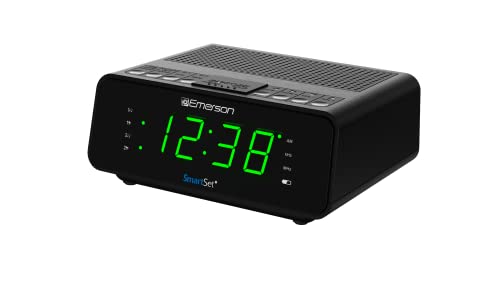
AC-powered models such as the Sangean RCR-5BK and Emerson CKS1900 are natural nightstand choices. Emerson includes a backup battery for time and alarm settings, while the Sangean listing identifies AC power as its source. The ROCAM similarly documents battery backup for settings but states that its display and alarm sound require AC.
Portable listeners have more options. The CC Skywave 2 uses two AA batteries and lists approximately 60 hours with its built-in speaker. The CC Pocket also uses two AA batteries. The Tendak combines a rechargeable battery, USB-C charging, and four AA batteries. JEUJUG offers a rechargeable battery, AC operation, and four D-cell batteries. Audiocrazy documents AC, a built-in rechargeable battery, and four AA batteries. These choices trade outlet independence against battery size and replacement convenience.
Check audio and extra connections
Bluetooth is documented on the JEUJUG, Audiocrazy Portable AM/FM Radio, Mesqool, and ROCAM models. The CC Skywave 2 and CC Pocket instead emphasize radio listening with headphone support or included earbuds. Mesqool adds AUX and microSD playback, while ROCAM includes Bluetooth and charging ports. A headphone jack is particularly relevant for private listening on the CC Pocket and Tendak.
Speaker descriptions vary. JEUJUG lists a 5-watt speaker, Mesqool an 8-watt speaker, and the Tendak a 3-watt speaker. These are published specifications, not independent sound measurements, so they should be treated as configuration details rather than guarantees of room-filling performance.
Prioritize display and controls
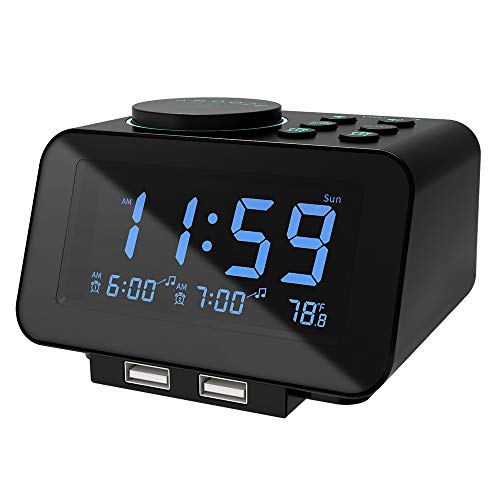
A dimmable display can be important beside a bed. Emerson lists a four-level dimmer, FUHONGYUAN a stepless full-range dimmer, and ROCAM adjustable brightness. Mesqool uses a color display with adjustable backlight, while the CC Skywave 2 and CC Pocket list lighted or backlit displays. The JEUJUG has a backlit LCD that shows time, station, and alarm settings.
For small spaces, compare physical dimensions as well as features. The CC Pocket, at 4.25 by 2.5 by 1 inch, is especially compact. The CC Skywave 2 is also small at 4.75 by 3 by 1.1 inches. Larger tabletop or bedside models may provide bigger displays and more controls, but the supplied listings do not provide dimensions for every selected product.
Final Recommendation
C. Crane CC Skywave 2 ranks first overall in this specification-based comparison under the published weighted criteria.
C. Crane CC Skywave 2 is the highest-scoring returned product and the first overall specification-based choice among the best reception clock radios. Its documented AM, FM, NOAA Weather, shortwave, and aviation coverage gives it the broadest reception profile, while 400 memories, direct entry, a clock, alarm, and portable battery operation add practical range.
For a smaller everyday carry option, choose the C. Crane CC Pocket when NOAA Weather and compact size matter more than broad band coverage. For a dedicated bedroom, the FUHONGYUAN CR01, Emerson CKS1900, and Sangean RCR-5BK are the most alarm-focused selections. The FUHONGYUAN emphasizes station scanning and dual alarms; Emerson emphasizes automatic time setup; Sangean emphasizes schedule choices.
The Audiocrazy Portable AM/FM Radio, JEUJUG Digital Radio Clock, and Tendak Portable AM/FM/SW Radio are better aligned with flexible power needs. Mesqool CR1033 and ROCAM CR1025 suit listeners who want modern extras such as Bluetooth, charging, or a color display. These are the top reception clock radios in this comparison based on documented specifications, not hands-on reception testing.
Frequently Asked Questions
What makes the best reception clock radios different from basic alarm clocks?
They include a radio receiver as well as clock and alarm functions. The selected products range from AM/FM models to multiband designs with NOAA Weather, shortwave, or aviation reception. Some also add station presets, digital tuning, Bluetooth, headphone output, or sleep timers.
Which selected model covers the most radio bands?
The C. Crane CC Skywave 2 documents AM, FM, NOAA Weather, shortwave, and VHF aviation reception. The Tendak Portable AM/FM/SW Radio documents AM, FM, and shortwave. The C. Crane CC Pocket documents AM, FM, and NOAA Weather.
Which model is most suitable for two people or different schedules?
The FUHONGYUAN CR01, Emerson CKS1900, and Mesqool CR1033 all document dual alarms. The Sangean RCR-5BK is also a strong scheduling choice because its listing specifies weekday, weekend, daily, and one-time timer selections.
Do these radios keep working during a power outage?
Power behavior varies. The JEUJUG, Audiocrazy portable model, Tendak, and CC Skywave 2 document battery-based operation. Emerson documents a backup battery for the clock and alarm settings. ROCAM states that its backup preserves settings, but its display and alarm sound require AC power.
Which selected model includes Bluetooth?
Bluetooth is documented on the JEUJUG Digital Radio Clock, Audiocrazy Portable AM/FM Radio, Mesqool CR1033, and ROCAM CR1025. The CC Skywave 2 and CC Pocket emphasize radio reception and headphone or earbud listening instead.