Buying Guide
The best ruby hoop earrings are easier to compare when the stone, setting, hoop scale, and closure are treated as separate decisions. Listing language can use “ruby” for natural, lab-created, or simulated stones, and those distinctions matter because they describe different materials. The selected products include all three categories, so check the exact wording before choosing.
Natural, lab-created, or simulated ruby?
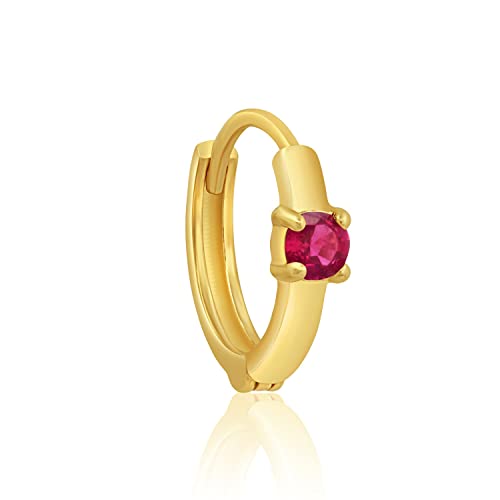
Natural ruby is explicitly documented for the MAX + STONE 21mm Diamond and Ruby Hoops, the MAX + STONE Natural Ruby 14K Gold Huggie, and the MAX + STONE 10K Gold 12mm Natural Ruby Hoops. Those listings also provide useful supporting details such as stone count or ruby size. Natural stones may vary in shade, as the 10K gold 12mm listing notes.
Lab-created ruby appears in the MAX + STONE 1-Inch Created Ruby Inside-Out Hoops, Gem Stone King 2.66 Cttw Created Ruby Hoops, and both CYW designs. The supplied descriptions characterize created rubies as chemically, physically, and optically similar to natural rubies in some listings, but this guide does not add claims beyond the product evidence. Simulated ruby is explicitly used by the AFFY five-stone pair and the MAX + STONE 0.9-Inch Created Ruby Hoops. If stone origin is important, compare these labels rather than treating them as interchangeable.
Solid gold is represented by the 14K and 10K MAX + STONE designs. The listings identify these as solid gold and provide yellow-gold finishes. Sterling silver appears across the remaining selected products, including 925 sterling silver, rhodium-plated silver, and yellow- or rose-gold-plated silver. A plated finish can change the visual tone without changing the underlying silver setting, so read the metal description carefully.
Several products state hypoallergenic or sensitive-skin positioning. The 21mm diamond and ruby pair, 10K gold baguette huggies, and 10K gold natural ruby huggie all make relevant claims in their listings. Sterling silver options also describe nickel-free, lead-free, or hypoallergenic construction in some cases. These are listing specifications, not an independent skin-sensitivity test.
Match the hoop size to the intended look
Compact huggies include the 11mm natural ruby 14K gold single hoop and the 11mm CYW ruby-and-moissanite design. The 12mm natural ruby pair and 12.5mm baguette huggies remain close-fitting but provide slightly more space. These sizes are useful when a subtle profile or secondary-piercing placement is the goal.
Medium and larger options create a more visible circle. The MAX + STONE 0.9-inch hoops, one-inch inside-out hoops, CYW 20mm bling hoops, and MAX + STONE 21mm diamond and ruby hoops document their diameters. The Gem Stone King rose-gold design also lists 20mm dimensions. Diameter alone does not describe thickness or weight, so use the supplied size and weight details together where available.
Compare gemstone layout and setting
A traditional hoop can use a single visible ruby, while an inside-out layout distributes stones around more of the circle. The MAX + STONE one-inch design specifically documents an inside-out created-ruby arrangement. The CYW 20mm pair uses a channel setting with 60 small rubies, while the AFFY design uses a five-stone prong setting. These layouts produce different visual patterns and should not be compared only by diameter.
The Gem Stone King rose-gold hoops use two ruby sizes, 4mm and 3mm, for a varied arrangement. The CYW 11mm huggies alternate rubies and moissanites, and the MAX + STONE 21mm pair adds six natural diamonds beside genuine rubies. Look for the number, size, and placement of stones when you want a particular level of decoration.
Inspect the closure details
Closure information is especially useful for hoops because it affects how the pair is put on and secured. The MAX + STONE natural-ruby designs specify hinged posts or a hidden hinged clip, while the 0.9-inch created-ruby pair uses click tops. The one-inch inside-out hoops and AFFY five-stone design document notched-post locking systems. The 21mm diamond and ruby pair also specifies click tops.
Some listings do not provide closure information, including the Gem Stone King 2.66 Cttw hoops and both CYW selections. That omission does not establish that a closure is unsuitable; it simply means the supplied evidence gives less to compare.
Most selected products specify a unit count of two or describe a pair. The MAX + STONE Natural Ruby 14K Gold Huggie is different because the listing says the style is available as either a pair or a single hoop, and the selected ASIN has a unit count of one. Confirm the intended quantity before ordering any style, especially when shopping for matching earrings.
Final recommendation
MAX + STONE Natural Ruby 14K Gold Huggie ranks first overall in this specification-based comparison under the published weighted criteria.
The final choice among the best ruby hoop earrings depends on the documented features that match your intended use.
MAX + STONE Diamond and Ruby 21mm Hoops are the first overall specification-based choice among these selections. They document genuine ruby stones, six natural diamonds, 925 sterling silver, a 21mm diameter, click tops, and a lightweight design in one listing. For the top ruby hoop earrings with a compact solid-gold profile, the MAX + STONE Natural Ruby 14K Gold Huggie is the clearest alternative, but its single-hoop format must be noted. The MAX + STONE 10K Gold Baguette Ruby Huggies are another focused choice for a modern 12.5mm silhouette, while the MAX + STONE 1-Inch Created Ruby Inside-Out Hoops suit shoppers who want gemstone coverage around the circle.
Frequently Asked Questions
Are these the best ruby hoop earrings for a July birthstone gift?
Several selected products identify ruby as the July birthstone, including the MAX + STONE natural-ruby hoops, the MAX + STONE created-ruby styles, the AFFY design, and the Gem Stone King options. Choose based on whether the recipient prefers natural, lab-created, or simulated ruby and whether a compact or larger hoop is more appropriate.
What is the difference between natural and created ruby in these hoops?
Natural ruby is identified in three MAX + STONE selections. Created ruby is identified in the MAX + STONE one-inch hoops, the Gem Stone King rose-gold hoops, and the CYW designs. Simulated ruby is stated for the AFFY five-stone pair and the MAX + STONE 0.9-inch pair. These are distinct listing descriptions, so review the stone terminology rather than assuming every red gemstone is natural.
Which selected ruby hoops are the smallest?
The smallest documented diameters are the 11mm MAX + STONE Natural Ruby 14K Gold Huggie and the 11mm CYW Ruby and Moissanite Huggies. The MAX + STONE 12mm natural-ruby pair and 12.5mm baguette huggies are also compact. The 14K gold style is listed as a single hoop, while the CYW listing states a unit count of one.
Which ruby hoops show gemstones around more of the hoop?
The MAX + STONE 1-Inch Created Ruby Inside-Out Hoops explicitly use an inside-out layout. The CYW 20mm Red Ruby Bling Hoops document 60 round rubies in a channel setting, while the AFFY pair uses five stones in a prong setting. These descriptions provide the clearest evidence for broader gemstone distribution or a multi-stone arrangement.
Should I choose click tops, hinged posts, or a notched post lock?
The selected listings document all three styles. Click tops appear on the MAX + STONE 21mm and 0.9-inch hoops; hinged posts or a hidden hinged clip appear on the MAX + STONE natural-ruby huggies; and notched post locks appear on the one-inch inside-out and AFFY designs. Compare the closure language with your preferred way of putting on and removing hoops, while remembering that this guide does not independently test closures.