Buying Guide
The best scratch-resistant skillets are not a single material category. The selected products use hard-anodized aluminum, ceramic coatings, hybrid textured surfaces, tri-ply stainless steel, and uncoated or coating-free titanium. Scratch resistance is therefore presented here as a documented design feature or listing claim, not as an independently verified test result. Compare the construction details with the way you cook before choosing.
Start with the cooking surface
Coated pans focus on easy release and convenient cleanup. The OXO uses diamond-reinforced ceramic, while PRICUSIS uses ceramic nonstick and lists both scratch and stain resistance. Emura specifies a triple-layer nonstick coating, and THE ROCK SOHO lists a three-layer PPG Quantum2 coating. These designs may suit eggs, pancakes, vegetables, and other foods where release is a priority.
Hard-anodized pans use a treated aluminum body rather than relying only on a surface coating for their construction story. The All-Clad HA1 listing identifies scratch-resistant hard-anodized aluminum reinforced with a stainless-steel base. Zyliss also lists a hard-anodized aluminum body and scratch resistance. This approach can be attractive when you want a relatively focused pan design with documented durability features.
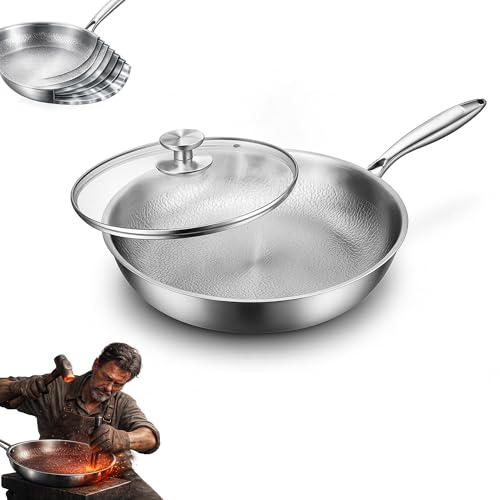
Titanium selections take a different route. AHRLEPIT lists 99.6% pure titanium and no chemical coating. LIBSTP describes a titanium surface with no traditional coating, and both products use hammered textures. XTBSE likewise describes a hammered titanium pattern and a coating-free food-release approach. These pans may appeal to shoppers who prefer to avoid synthetic nonstick coatings, but the evidence also shows that proper preheating and oiling can matter for release with this design type.
Match pan size to meal size
A 9.5-inch pan such as Zyliss is easier to dedicate to smaller portions, breakfast items, or sauces. The 10-inch All-Clad set piece, OXO, and Emura models are general-purpose middle sizes. The 11-inch THE ROCK SOHO provides more surface area without moving to the largest format. For family-size meals, the 12-inch PRICUSIS and XTBSE pans offer more room, while NutriChef provides several sizes from 8 to 12 inches plus a wok.
Size affects more than capacity. A larger skillet can be useful for one-pan meals and reducing batch cooking, but it may take more cabinet space and feel heavier when full. The supplied specifications identify XTBSE at the current price and NutriChef at about the current price for the complete set, so shoppers should consider storage and lifting as well as cooking area.
Check stovetop and oven compatibility
If you use induction, verify that the listing explicitly includes it. All-Clad, OXO, THE ROCK SOHO, Emura, NutriChef, XTBSE, AHRLEPIT, LIBSTP, PRICUSIS, and Zyliss all document broad stovetop compatibility in their supplied evidence, though the exact wording varies. This is more useful than assuming a material will work on every cooktop.
Oven limits differ. All-Clad, XTBSE, and LIBSTP list 500°F, while OXO lists 430°F and THE ROCK SOHO lists 320°F. PRICUSIS, AHRLEPIT, and Zyliss are identified as oven safe without a numerical limit in the supplied evidence. Always follow the product’s own instructions, including any restrictions for handles, lids, or removable parts.
Consider care and handling
Dishwasher safety can simplify cleanup, but it does not make every pan equally carefree. OXO, THE ROCK SOHO, NutriChef, XTBSE, AHRLEPIT, PRICUSIS, and Zyliss list dishwasher-safe construction. All-Clad also lists dishwasher safety but recommends soap, a sponge, and silicone, nylon, or wooden utensils to help preserve its nonstick surface. Those instructions are important trade-offs rather than contradictions.
Handle design matters when a pan is large or full. OXO and Zyliss use stainless-steel handles in the supplied descriptions. THE ROCK SOHO and XTBSE identify heat-resistant or stay-cool handle features, while NutriChef lists cool-touch ergonomic handles. A lid is included with PRICUSIS, LIBSTP, XTBSE, and AHRLEPIT, and NutriChef supplies lids for its stir-fry pans. Those accessories can expand cooking options but also add storage requirements.
How this comparison was scored
The editorial score uses five category-specific criteria: surface durability, heat and construction, cooktop and oven versatility, food-release design, and care and handling. The weights favor durability while still giving substantial credit to heat behavior, compatibility, release features, and practical maintenance. Scores are based only on supplied feature and specification fields. This is not a hands-on test, and no score uses customer opinions, review activity, popularity, or marketplace labels.
Final recommendation
All-Clad HA1 Expert Nonstick 2-Piece Set ranks first overall in this specification-based comparison under the published weighted criteria.
All-Clad HA1 Expert Nonstick 2-Piece Set is the first overall specification-based choice among these best scratch-resistant skillets. Its combination of two useful sizes, hard-anodized scratch-resistant construction, stainless-steel reinforcement, induction compatibility, and 500°F oven safety gives it the broadest documented everyday package.
Choose OXO Enhanced if a PFAS-free ceramic surface, dishwasher safety, and a stainless-steel handle matter most. THE ROCK SOHO is a strong alternative for a larger pan with explicit coating durability and warp-resistance claims, although its oven limit is lower. For shoppers seeking coating-free construction, AHRLEPIT and LIBSTP provide the clearest titanium-focused options; AHRLEPIT adds a glass lid, while LIBSTP emphasizes a forged body and high oven limit.
Among the top scratch-resistant skillets, NutriChef is the most expansive set, XTBSE is a practical large titanium pan, PRICUSIS is a large ceramic option with a lid, and Zyliss is a compact choice with a pour spout. Emura rounds out the group with detailed triple-layer coating and release claims. The right selection depends on whether your priority is coating-free construction, easy cleanup, high oven use, multiple sizes, or a manageable everyday format.
Frequently Asked Questions
Among the best scratch-resistant skillets, what should I look for in scratch-resistant cookware?
Look for a clearly described surface or construction feature, such as hard-anodized aluminum, reinforced ceramic, a textured hybrid surface, or hammered titanium. Also check heat distribution, cooktop compatibility, oven limits, care instructions, and handle design. Scratch-resistant wording is a listing claim in this comparison, not a substitute for independent testing.
Are uncoated titanium skillets easier to use than ceramic pans?
Not necessarily. AHRLEPIT and LIBSTP document uncoated or coating-free titanium designs, while OXO and PRICUSIS use ceramic surfaces. The titanium listings emphasize preheating, oiling, or a textured surface for food release. Ceramic pans generally present conventional nonstick-style release claims. Your preference for coating-free construction versus a release-focused coated surface should guide the choice.
Which selected skillet is best for induction cooking?
All-Clad HA1 is a strong specification-based choice because its listing explicitly names induction compatibility and includes a stainless-steel base. OXO, THE ROCK SOHO, Emura, NutriChef, XTBSE, AHRLEPIT, LIBSTP, PRICUSIS, and Zyliss also document broad stovetop compatibility that includes induction. Confirm the manufacturer’s current instructions before use.
Is a 12-inch skillet better for family meals?
A 12-inch pan gives more cooking area and can accommodate larger portions, but it also needs more storage and may be heavier when full. XTBSE and PRICUSIS are selected 12-inch options, while NutriChef includes a 12-inch pan along with smaller pieces. For one or two servings, a 9.5- or 10-inch pan may be easier to handle.
The supplied evidence specifically identifies PRICUSIS as metal-utensil safe and AHRLEPIT as designed to withstand metal utensils. All-Clad recommends silicone, nylon, or wooden utensils to preserve its nonstick surface. For the remaining products, the supplied data does not establish a universal utensil policy, so follow the individual care instructions rather than assuming metal use is appropriate.