Buying Guide
Choosing the best silicone cooking tongs starts with the food and cookware you use most. Silicone heads are generally selected here because the listings describe them as suitable for nonstick surfaces, but the designs differ substantially. Some have conventional scalloped tips for lifting and turning, while others use flat or tweezer-style heads for precision. The right choice depends less on a single headline feature and more on how heat, reach, grip, storage, and cleaning fit together.
Match the head shape to the food
Scalloped heads are the most common format in this comparison. They are documented for tasks such as turning meat, lifting vegetables, tossing salads, and serving pasta. The OXO Good Grips 9-Inch, KitchenAid, U-Taste, HOTEC, GORILLA GRIP, Walfos, and EEKEDO models all use listing language that supports broad cooking or serving work. Their shaped edges are intended to hold food rather than slide under it.
For delicate ingredients, the OXO Good Grips 14-Inch Flexible Tongs are different. Their flat head has thin, flexible edges that are described as suitable for fish, asparagus, and scallops. The perforations are also listed for draining grease and oil, and the straight front edge can scrape the bottom of a pan. This is a specialized design rather than a general replacement for every tong in a kitchen.
The Yamazaki Home model takes another approach with a tweezer-style format and knurled tip. Its listing specifically identifies small or slippery ingredients and plating. Joseph Joseph emphasizes lockable arms, non-slip feet, and an integrated tool-rest design instead of a specialized food head. Those features are useful when keeping the utensil off a countertop is a priority.
Check heat documentation carefully
A stated heat limit is useful, but it should not be treated as a promise that every part of the tong can remain in a hot pan. Several selected products document silicone-tip ratings at or near 600°F: OXO’s 9-inch model is listed to 600°F, as are U-Taste, HOTEC, and EEKEDO. Walfos lists 480°F, GORILLA GRIP lists 484°F, and Joseph Joseph lists 392°F. KitchenAid provides heat-resistant language but no numerical tip limit in the supplied listing.
Yamazaki documents separate figures for silicone and nylon, 428°F and 330°F respectively. That distinction matters because the materials may not share the same limit. The Joseph Joseph listing also cautions users not to leave the utensil in cookware while cooking. In practice, compare the documented rating with your intended use, and follow any product-specific cautions rather than assuming a high number applies to the entire utensil.
Consider length and reach
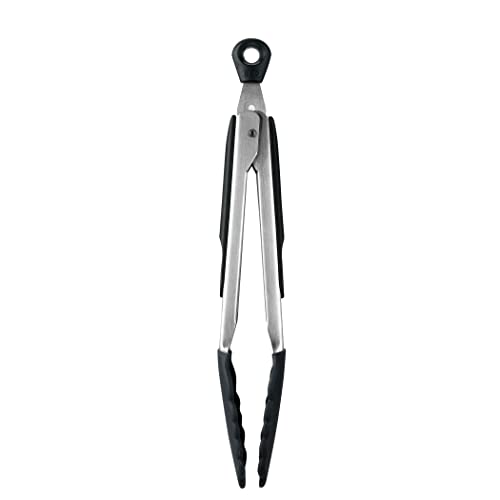
Nine-inch tongs are compact and usually easier to control close to a pan. The OXO Good Grips 9-Inch, KitchenAid, U-Taste, and the 9-inch pieces in several sets fit this role. They are convenient for stovetop work, serving, and smaller cookware, but they place your hand closer to heat than a longer model.
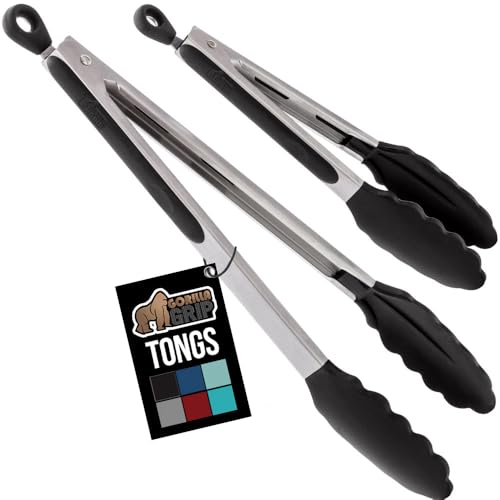
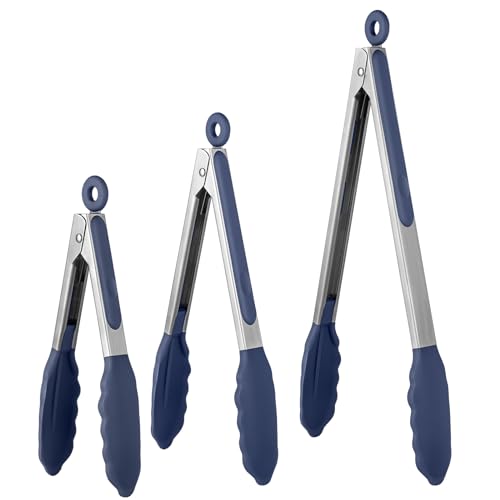
Two-size sets expand the range. HOTEC and EEKEDO include 9- and 12-inch options, while Walfos covers 7, 9, and 12 inches. GORILLA GRIP includes 7- and 9-inch pieces, making it more compact. For grilling or deeper cookware, the 12-inch option in a set can provide useful distance.
Look for control features
Handle construction affects how confidently you can lift or turn food. OXO’s 9-inch model documents a soft, nonslip handle and thumb rests. GORILLA GRIP, HOTEC, and EEKEDO also list grip-oriented handle features, including thumb rests or cushioning. U-Taste describes a smooth locking mechanism and a spring intended to balance opening and grasping force.
Not every claim should be generalized across models. A stainless steel handle does not by itself establish a particular comfort level, and a silicone tip does not prove that a tong can lift every food securely. Use the documented handle, edge, and spring details as indicators of intended control rather than as substitutes for hands-on testing.
Prioritize storage and cleaning
Pull-ring or locking systems let many tongs close for drawer storage. OXO’s 9-inch model, U-Taste, HOTEC, GORILLA GRIP, Walfos, and EEKEDO document locking features. Hanging hooks or rings appear on GORILLA GRIP and EEKEDO, while the Yamazaki model uses a built-in stand. Joseph Joseph adds non-slip feet and an integrated tool-rest design, making it especially distinct for countertop placement.
Dishwasher-safe care is documented for OXO’s 9-inch model, KitchenAid, Yamazaki, Joseph Joseph, Walfos, GORILLA GRIP, and HOTEC. It is not stated in every supplied listing, so do not assume that omission means either dishwasher compatibility or incompatibility. If easy cleanup is important, choose a product with explicit care information.
How this comparison was scored
The editorial criteria are specific to silicone cooking tongs: cookware protection received 25% of the score, documented heat resistance 20%, grip and handling control 20%, storage and cleanup 15%, and format and task fit 20%. Scores use only the supplied feature and specification fields. No hands-on testing, customer sentiment, review information, popularity signals, or marketplace labels were used in the published scores. The list contains one product per non-empty parent group, with products ranked by the resulting specification-based comparison.
Final Recommendation
OXO Good Grips 9-Inch Silicone-Head Tongs ranks first overall in this specification-based comparison under the published weighted criteria.
The final choice among the best silicone cooking tongs depends on the documented features that match your intended use.
OXO Good Grips 14-Inch Flexible Tongs are the first overall specification-based choice among these selections. Their flat flexible head, perforations, scraping edge, and long reach make them particularly well documented for delicate foods and pan work. For a more conventional everyday tool, the OXO Good Grips 9-Inch Silicone-Head Tongs add a 600°F rating, thumb rests, locking storage, and dishwasher-safe care. Shoppers seeking the top silicone cooking tongs in multiple lengths should compare HOTEC, EEKEDO, or Walfos, while Yamazaki and Joseph Joseph stand out for counter-conscious designs.
No selection should be treated as a hands-on performance winner. The rankings reflect the completeness and usefulness of the supplied specifications, so buyers should still confirm current care instructions and intended heat use before purchase.
Frequently Asked Questions
What should I look for in the best silicone cooking tongs?
Look for silicone heads identified as suitable for your cookware, a documented heat limit that fits your cooking tasks, a handle shape you can control, and a length appropriate to the pan or grill. A locking system and explicit dishwasher-safe care can also simplify storage and cleanup.
Are longer silicone tongs better for grilling?
Longer tongs can provide more distance from a grill or deep cookware, but they may be less compact. The selected range includes 12-inch options from HOTEC, EEKEDO, and Walfos, a 14-inch OXO flexible model, and shorter 7- or 9-inch options for closer control. Choose based on reach and handling rather than length alone.
Which selected tongs are designed for delicate foods?
OXO Good Grips 14-Inch Flexible Tongs are the clearest fit because the listing names fish, asparagus, and scallops and describes thin flexible edges. Their perforated head can also drain grease or oil. The Yamazaki Home tongs are better suited to small or slippery ingredients and plating because their listing documents a knurled tweezer-style tip.
Does a silicone heat rating apply to the whole tong?
Not necessarily. The supplied listings generally describe heat resistance for silicone tips or materials, and Yamazaki provides different figures for silicone and nylon. Follow the product’s specific instructions and cautions. Joseph Joseph, for example, lists a 392°F limit and warns against leaving the utensil in cookware while cooking.
Which models are easiest to store?
OXO’s 9-inch model, U-Taste, HOTEC, GORILLA GRIP, Walfos, and EEKEDO document locking mechanisms. GORILLA GRIP and EEKEDO also list hanging features. Yamazaki uses a built-in stand, while Joseph Joseph documents non-slip feet and an integrated tool-rest design for keeping the utensil positioned on a counter.