Buying Guide
Choosing among the best silicone potato mashers starts with the head design. Silicone can protect nonstick, ceramic, and enamel cookware from scratches, but the underlying structure still determines how the utensil presses through cooked potatoes. The products here fall into several useful formats: silicone-coated stainless-steel wire heads, silicone blades over reinforced cores, and mostly or fully silicone designs.
Match the head to your mashing style
A wire head is the most familiar format. KITCHENDAO, Zulay Kitchen, and Jell-Cell document stainless-steel wire construction with silicone protection. These designs may suit cooks who want a conventional pressing motion and a head with a defined framework. The stainless-steel core can also add rigidity, although the supplied listings do not provide hands-on evidence about the force required or the texture produced.
Blade-style mashers use fins or beveled edges rather than a wire loop. Badiano documents curved silicone-coated blades that can scrape the sides of bowls and pots. Farberware uses four beveled blades and is also intended for ground meat. GIR goes further with seven blades, including hard and semi-soft fins, for mixing, scraping, and chopping. These formats may be more useful when one utensil needs to cover several skillet or bowl tasks.
Seamless silicone models, including UPKOCH and SouxMux, emphasize a smooth surface without food-trapping crevices. That design can be appealing for soft foods and quick cleanup. However, the supplied evidence gives less detail about the internal reinforcement or exact head pattern on these models, so shoppers who prioritize a clearly documented rigid core may prefer a coated stainless-steel option.
Check cookware compatibility
For nonstick cookware, look for an explicit silicone or non-scratch claim. Tovolo states that its silicone head protects nonstick pans, while KITCHENDAO, Zulay Kitchen, Jell-Cell, and Better Houseware also describe cookware-safe use. Farberware specifically lists nonstick, ceramic, stainless steel, and cast iron surfaces. These claims come from public product listings; they are not independent abrasion tests.
A silicone-coated wire head can offer a middle ground between pan protection and a familiar mashing structure. A silicone blade or seamless head may have fewer exposed hard edges, but the best choice depends on whether you want a classic pressing action or a multi-purpose chopping tool.
Consider heat handling
If you mash directly in a hot pot, a stated heat limit is useful. UPKOCH, Farberware, and SouxMux list resistance to 450°F, while GIR lists resistance up to 425°F. Those figures are technical listing claims, not results from this editorial’s testing. Tovolo describes its silicone head as heat resistant but does not provide a numerical limit in the supplied evidence.
When no temperature is listed, follow the maker’s care instructions and avoid treating a general heat-resistant claim as permission for prolonged exposure to high heat. A long handle, such as the 12-inch Better Houseware or 13.2-inch Badiano, may also help keep hands farther from hot cookware, but handle length alone does not establish a safety rating.
Evaluate grip and reach
Mashing is a pressing task, so handle shape matters. UPKOCH and SouxMux document contoured handles with thumb rests. KITCHENDAO and Jell-Cell describe soft-touch or non-slip handle features, while Zulay Kitchen lists an ergonomic non-slip handle. GIR and Farberware use silicone handles for grip. These details are more relevant than color or styling when comparing tools for repeated preparation.
Length is another practical factor. Tovolo is listed at 10 inches, UPKOCH at about 10.4 inches, Farberware at 11.54 inches, Better Houseware at 12 inches, and Badiano at 13.2 inches. Longer tools may provide reach in deeper pots, but compact users or cooks working in shallow bowls may prefer a shorter profile. The listings do not establish a universal best length.
Plan for cleanup and storage
Dishwasher-safe care is documented for every selected product, although the appropriate rack and care instructions should still come from the manufacturer. Seamless silicone surfaces, such as those described for UPKOCH and SouxMux, are presented as resisting food buildup. KITCHENDAO also highlights a waterproof handle design. Tovolo and Zulay Kitchen add hanging features for storage, while Badiano lists hanging holes and a holder.
Versatility can also affect how often the tool earns space in a utensil drawer. Most selected models are listed for potatoes plus foods such as avocado, bananas, pumpkin, root vegetables, or other cooked vegetables. Farberware, GIR, and Badiano extend into ground-meat chopping or scraping tasks. Those added uses are documented capabilities, not independent performance findings.
Final recommendation
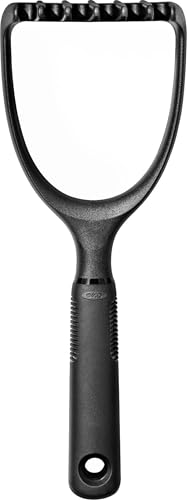
Farberware Silicone Meat Masher and Chopper ranks first overall in this specification-based comparison under the published weighted criteria.
Tovolo Silicone Potato Masher is the first overall specification-based choice among the best silicone potato mashers. Its listing provides the most balanced evidence across nonstick protection, heat-resistant silicone, stainless-steel handle construction, dishwasher cleaning, storage, and use with several soft foods. KITCHENDAO is a strong alternative for shoppers who prefer a silicone-coated 18/8 stainless-steel core, while UPKOCH and SouxMux are better aligned with buyers who prioritize a seamless silicone surface and a stated 450°F heat rating.
For multi-purpose skillet work, Farberware and GIR are the most distinctive top silicone potato mashers because their blade systems are explicitly designed for meat chopping as well as mashing. Choose Zulay Kitchen or Jell-Cell for a classic wire format, Badiano for curved scraping blades, and Better Houseware for a straightforward long-handle design. These rankings reflect the supplied specifications and documented features, not customer opinions or hands-on testing.
Frequently Asked Questions
Are silicone potato mashers safe for nonstick pans?
Many are listed as non-scratch or safe for nonstick cookware. Tovolo, KITCHENDAO, Zulay Kitchen, Jell-Cell, Farberware, Better Houseware, and SouxMux make such claims in the supplied evidence. Silicone protection helps address contact with coated cookware, but users should still follow the pan and utensil care instructions.
Which best silicone potato mashers have a stated temperature rating?
UPKOCH, Farberware, and SouxMux list heat resistance to 450°F. GIR lists resistance up to 425°F. Other selected products describe heat-resistant silicone without giving a numerical limit, so their listings do not support a direct temperature comparison.
Should I choose a wire head or silicone blade?
Choose a wire head if you want the familiar potato-mashing format; KITCHENDAO, Zulay Kitchen, and Jell-Cell document that construction. A blade design may be more useful for scraping, chopping, or mixing. Badiano, Farberware, and GIR document blade-based designs with additional food-preparation uses.
Are silicone mashers dishwasher safe?
All ten selected listings describe dishwasher-safe cleaning. Seamless designs such as UPKOCH and SouxMux are also described as reducing food buildup, while Tovolo and Zulay Kitchen document hanging features for storage. Always use the manufacturer’s care guidance for placement and temperature.
Yes. The selected listings commonly mention foods such as avocado, bananas, pumpkin, beans, root vegetables, or other cooked vegetables. Farberware and GIR also document ground-meat chopping, while Badiano describes pan- or bowl-side scraping. These are listing-based use claims rather than independent performance results.