Buying Guide
This guide compares the best spider fly swatters using documented reach & length, paddle surface area, head material & durability, handle ergonomics & grip, indoor/outdoor versatility, spider handling capability, and portability & storage.
Why the best spider fly swatters Are Worth Comparing
The best spider fly swatters share a few engineering priorities: enough reach to keep you away from biting or stinging insects, a paddle large enough to connect reliably, and a handle design that does not tire your wrist. Spiders and flies behave differently, so the right tool often comes down to whether you need a flat paddle for fast swats or a scooping mechanism to capture spiders without crushing them. Comparing specifications side by side helps you choose a swatter that matches your home without adding features you will not use.
Reach and Length
Reach is a useful specification for ceiling corners and wall seams where spiders tend to rest. Fixed-handle swatters in this roundup range from about 17.5 to 19.7 inches, while telescopic models extend further. The Grip Super Jumbo Telescopic Fly Swatter reaches up to 39 inches, the Foxany and Begonia telescopics reach roughly 25 inches, and the Coghlan’s camping model extends to 18 inches. For indoor rooms with standard 8-foot ceilings, an 18 to 25 inch swatter covers most wall and ceiling work, while vaulted rooms benefit from the longer telescopic options.
Paddle Surface Area
Paddle geometry matters more than most buyers expect. A larger swatting surface increases the chance of connecting with a fast-moving fly, but a smaller, lighter paddle can be faster to maneuver. The Grip Super Jumbo offers a 6.5 by 7.5 inch surface, the Enoz Sergeant Swat sits at the wide end with a 10-inch width, and most standard 17.5-inch swatters cluster around a 4 to 5 inch width. If you mainly target small gnats and fruit flies, a mid-size paddle often balances speed and contact area better than an oversized head.
Head Material and Durability
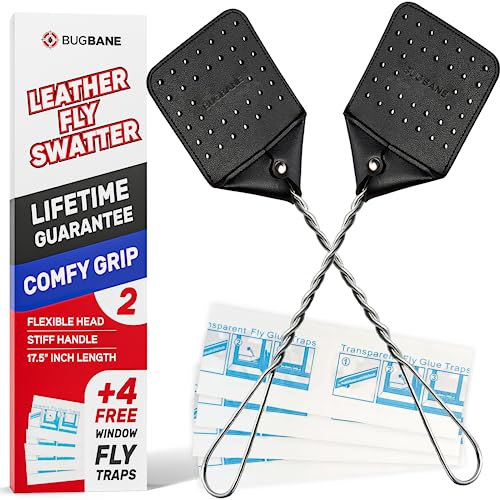
Three material families appear in this category. Plastic paddles are lightweight but may crack on hard impacts. Leather heads, such as those on the BugBane and DEBETOOL swatters, flex on contact and resist cracking, though they may need occasional wiping. Metal-handle models with reinforced heads, like the Enoz Sergeant Swat, are heavier but handle repeated swings against wasps and hornets without bending. For indoor spider duty, a leather or reinforced head tends to outlast basic plastic.
Handle Ergonomics and Grip
A cushioned or shaped grip keeps control during repeated swings. The Grip Super Jumbo uses a double-dipped rubber grip for secure handling at full extension, the DEBETOOL swatter uses a solid wooden round handle for a classic feel, and the Coghlan’s outdoor model relies on a sturdy wooden handle suited to campsite conditions. For users with smaller hands or arthritis, lighter plastic handles may be more comfortable than heavier metal or wood designs.
Spider Handling Capability
Most flat swatters kill spiders on contact, which works but can leave residue on walls and ceilings. The SWAT-N-SCOOP Heavy Duty Fly Swatter and Spider Catcher uses a built-in beveled scoop to lift spiders off walls and ceilings, which is a different mechanical approach from a flat paddle. Scoop-style designs may be useful for households that prefer catch-and-release spider control, or for reaching ceiling corners where crushed remains are hard to clean.
Indoor and Outdoor Versatility
Materials and construction determine whether a swatter belongs indoors, outdoors, or both. Plastic and leather swatters suit indoor walls and furniture, while metal-handle and wooden-handle models handle patios, garages, and campsites. If you need one tool for a back porch and a kitchen, choose a model with a sealed handle and a paddle that will not scuff furniture.
Portability and Storage
Storage footprint matters in apartments and small homes. Flat plastic swatters such as the LifHap five-pack and the PAL&SAM three-pack slip into drawers or hang from wall hooks. Telescopic models collapse to roughly 11 to 12 inches, which fits glove boxes and backpacks. Multi-pack sets naturally require more space but reduce the chance of being without a swatter when you need one.
Electric Versus Manual
Electric fly swatter rackets add a powered option for users who prefer not to swing. Electric rackets are heavier and require charging or batteries, so they may suit stationary or outdoor use more than quick indoor grabs.
Final Recommendation
Grip Super Jumbo Telescopic Fly Swatter ranks first overall in this specification-based comparison under the published weighted criteria.
The SWAT-N-SCOOP Heavy Duty Fly Swatter and Spider Catcher earns a leading specification slot among the best spider fly swatters thanks to its 18-inch reach and built-in scoop that lets you catch and release spiders without contact, an unusual combination in this category. For users who prioritize maximum reach over spider handling, the Grip Super Jumbo Telescopic Fly Swatter extends to 39 inches with a 6.5 by 7.5 inch paddle, making it a specification-aligned reach-and-area option in the roundup. Across the top spider fly swatters, the right pick depends on whether you need reach, paddle size, spider-safe capture, or pack quantity.
Frequently Asked Questions
What is the best spider fly swatter for high ceilings?
The Grip Super Jumbo Telescopic Fly Swatter extends to 39 inches, making it a specification-aligned reach option for vaulted rooms and tall ceilings. The SWAT-N-SCOOP is a strong alternative at 18 inches for standard 8-foot ceilings.
Are leather fly swatters better than plastic ones?
Leather heads like those on the BugBane and DEBETOOL swatters resist cracking and flex on impact, while plastic paddles are lighter. Leather may last longer with regular use but may need occasional wiping to remove residue.
Can the best spider fly swatters also catch live spiders?
Flat paddle swatters are better suited to quick kills than catch-and-release use. The SWAT-N-SCOOP uses a built-in scoop for a different mechanical approach, which may suit users who want a hands-free disposal option.
How many swatters should a household keep on hand?
Most multi-packs in this category include three to six swatters, which is enough to place one in the kitchen, one in the living area, and one in a garage or patio. A single telescopic model can cover multiple rooms if you store it centrally.
Are electric fly swatters worth considering?
They are heavier and need charging or batteries, so they work as a complement to a manual swatter rather than a replacement.