Buying Guide
The best decorative stone trays are easiest to compare by the details that affect placement and daily use: the documented stone, the footprint, the underside, the finish, and the shape. Public listings frequently use marble and travertine somewhat interchangeably, so read the material wording and color description together rather than relying on the title alone. The products selected here are all presented as complete decorative trays or vanity organizers, not inserts or replacement parts.
Start with the surface you need to organize
Measure the usable width and depth of the destination before choosing a style. A tray that is attractive but too deep can crowd a bathroom counter, while a very narrow piece may not hold the bottles or accessories you want to group. The VEROBELL is listed at approximately 9.8 by 4.7 inches, and the Koville 10-by-5-inch model offers a similar slim rectangular approach. These are logical formats for a narrow vanity, shelf, nightstand, or desk.
Longer rectangles give you more room to line up perfume bottles, candles, or skincare items. The 12-by-6-inch Koville tray and the 12-by-8-inch Homaura tray are better suited to a broader countertop or dresser. The Homaura’s larger footprint can accommodate a more substantial arrangement, while its gray-black color creates contrast against light surfaces. The 11.8-by-7.8-inch MULWR tray also gives you generous room, with a cyan-green color that functions as a stronger accent.
For a centered display, round and shaped trays may work better than rectangles. The WORHE is listed at about 9.4 inches in diameter, while the STRONA is an 8-inch round tray. The smaller STRONA is more appropriate for a compact arrangement of jewelry, keys, or a candle. A cloud-shaped tray such as the Koville C1032-CA or LWALMS model can look decorative even when it is not holding anything, but curved edges may reduce the amount of efficiently usable straight-line space.
Compare marble and travertine evidence
Natural stone is the defining feature across this selection, but the visual effect varies. Travertine listings commonly mention pores, holes, warm beige tones, and irregular veining. The two Koville options, VEROBELL, and Denique all document travertine characteristics. Those pores and variations are part of the stated appearance, so buyers seeking a uniform finish should account for the fact that each piece may differ.
The marble options offer a broader color range. WORHE and Homaura describe natural marble with individual veins, while MULWR lists a cyan-green color. STRONA presents a beige scalloped marble design, and LWALMS combines a natural marble description with a cloud form.
A listing’s material claim does not by itself establish sealing, stain resistance, or resistance to every household substance. Some products specifically mention a smooth or polished surface, while others emphasize a raw, porous, or matte appearance. Treat those descriptions as finish information, not as proof that a tray is suitable for prolonged exposure to water, oils, or acidic liquids.
Look at stability and furniture protection
Stone is generally presented in these listings as substantial, but weight alone does not tell you how the underside will interact with furniture. The WORHE lists four non-slip pads, Homaura lists four non-slip feet, STRONA lists felt feet, and Denique lists non-slip pads. Those details are useful when the tray will sit on a finished dresser, vanity, or countertop.
Other listings describe stability through the weight of the stone or a textured base. The cloud-shaped Koville tray is described as having a heavy, tip-resistant base, and the 10-by-5-inch Koville tray is presented as naturally resistant to sliding or tipping because of its weight. VEROBELL describes a textured stone base. These claims support comparison, but they are not substitutes for checking whether the tray sits level on your particular surface.
If furniture protection is important, prioritize a product whose listing explicitly identifies pads or feet. Also consider the tray’s height. The compact VEROBELL is listed at 0.6 inches high, while the Denique and STRONA listings contain different height presentations. Confirm the final dimensions and underside details on the product page before purchase, especially when clearance is limited.
Match the shape to the décor job
Rectangular trays are the most straightforward choice for arranging several items in rows. They suit perfumes, cosmetics, soaps, candles, and other small containers. Round trays create a more concentrated centerpiece and are useful for jewelry or a single decorative grouping. Scalloped designs, represented here by STRONA and Denique, add edge detail without requiring a separate decorative object.
Cloud shapes make the tray itself part of the room’s styling. The Koville cloud tray has an organically curved silhouette, while the LWALMS version adds grooves intended to help keep small objects from rolling. A grooved or shaped tray can be practical for rings and keys, but it may be less efficient when you want to maximize every inch of a rectangular surface.
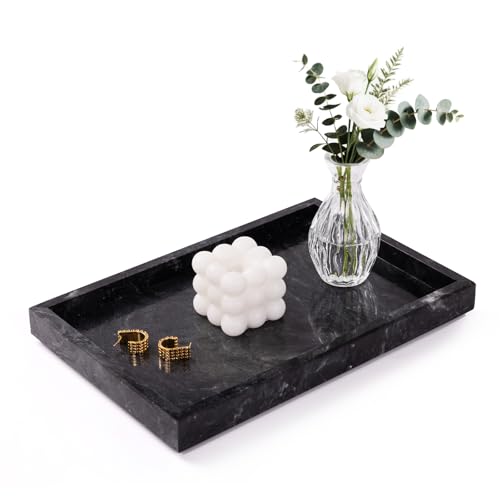
Color is another design decision. Beige travertine and marble blend with warm, neutral interiors, while gray-black marble gives the Homaura a stronger contrast. The MULWR’s cyan-green color is the most distinctive option in this group. Natural veining and pores also mean that the displayed image may not match every individual piece exactly.
Check the care instructions carefully
Several listings describe wiping the tray with a damp cloth, including Homaura, VEROBELL, and LWALMS. The safe comparison point is that a damp-cloth instruction appears for some products, not all.
Do not assume that a natural stone tray is sealed merely because it is polished or described as stain-resistant. Travertine pores and unsealed marble can affect how spills are handled, and the supplied listings do not provide a single care rule covering every product. Use the manufacturer’s instructions for the exact tray, keep standing moisture controlled, and avoid treating broad durability language as a guarantee against damage.
Confirm dimensions and intended load
These are decorative organizers, not universally specified serving or load-rated platforms. Some listings mention coffee, tea, fruit, cutlery, or serving uses, but the evidence does not establish a maximum load or certify food-service suitability. For vanity use, compare the tray’s footprint with the number and size of bottles you plan to place on it. For a coffee table, check whether the selected shape leaves enough room around the grouping.
Natural stone can also be heavy. The WORHE, Homaura, and other listings provide weights that indicate a substantial product, while some do not. A heavier tray may feel stable but can be inconvenient to relocate. Check both dimensions and weight when the tray will be moved often or placed on a delicate surface.
Final Recommendation
Homaura 12-by-8-Inch Gray Black Marble Tray ranks first overall in this specification-based comparison under the published weighted criteria.
Homaura 12-by-8-Inch Gray Black Marble Tray is the first overall specification-based choice in this comparison.
The Homaura is a strong pick among these best decorative stone trays because it combines a documented natural marble build, broad 12-by-8-inch footprint, four non-slip feet, and a smooth surface described as easy to wipe. Its gray-black color also gives shoppers an alternative to the many beige travertine options.
The top decorative stone trays for specific needs differ from that all-purpose pick. Choose the Koville Cloud-Shape Travertine Vanity Tray for an organic silhouette, the 12-by-6-inch Koville Italian travertine model for a long, narrow arrangement, STRONA for a compact scalloped centerpiece, or LWALMS when grooves and anti-slip mats matter. For larger surfaces, MULWR and Denique provide broad rectangular options. VEROBELL and the 10-by-5-inch Koville model are more space-conscious choices.
Before ordering, measure the destination, confirm the listed dimensions, and decide whether you prefer visible travertine pores, marble veining, a polished finish, or a more matte appearance. Also verify the underside protection and care directions for the exact listing. These checks matter more than choosing solely by shape or color, particularly because natural stone varies from piece to piece.
Frequently Asked Questions
What should I measure before buying the best decorative stone trays?
Measure the clear width and depth of the surface, then leave room to access the items around or inside the tray. Compare those measurements with the listed footprint, not just the product title. Slim models such as VEROBELL and the 10-by-5-inch Koville tray are better suited to narrow areas, while Homaura and MULWR require more counter or dresser space.
Are marble and travertine trays the same?
No. The listings identify both as natural stone, but they describe different visual characteristics. Travertine commonly appears with pores, holes, and warm irregular texture, while marble listings emphasize polished surfaces and veining. Individual color and pattern variation is documented for multiple products, so the exact appearance may differ from the listing image.
Which selected tray is best for jewelry and keys?
The LWALMS cloud tray is a strong option because its listing describes sculpted grooves intended to help prevent items from rolling off, along with anti-slip mats. The smaller STRONA round tray is also shaped for compact items such as jewelry, keys, watches, or candles, but its surface holds less than the larger rectangular designs.
Do stone trays need special care?
Care depends on the material and finish. Some selected listings recommend wiping with a damp cloth, but the supplied evidence does not establish one universal routine or confirm that every tray is sealed. Follow the product-specific instructions, control standing moisture, and confirm how the manufacturer wants spills handled before placing cosmetics, oils, or liquids on the tray.
Which tray is best for a large countertop display?
The Homaura 12-by-8-inch tray offers one of the broadest documented rectangular surfaces in this selection, while the MULWR is listed at approximately 11.8 by 7.8 inches. Denique also provides a relatively broad scalloped format. Compare the available counter depth and the size of your bottles before choosing, because larger trays may not suit compact vanities.