Buying Guide
Choosing the best hair clips for straight hair starts with identifying how much hair the clip must gather and whether you need a low-profile shape. Straight strands often move smoothly under pressure, so a clip’s spring, teeth, interior texture, and surface finish are more useful specifications than appearance alone. The products above document several approaches: French flat claw clips, larger banana profiles, medium claws, mixed-size sets, and sectioning clips.
Match the clip profile to your routine
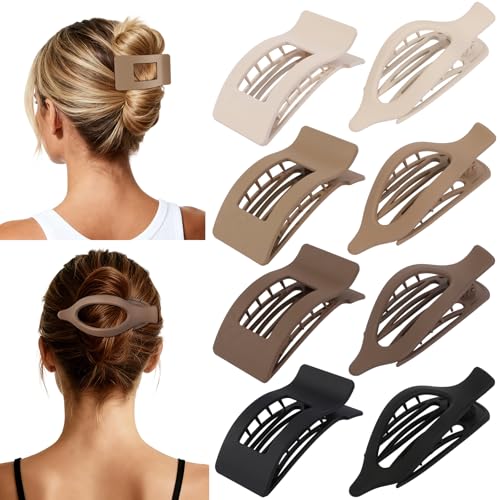
Flat designs are the most distinctive category in this comparison. AWAYTR, Amlaidu, CENTSTAR, Drealoe, and Artchita all describe flat or lay-flat construction. These profiles are intended to sit closer to the head than a conventional raised claw clip. The listings specifically connect that shape with driving, resting, desk work, or lying down. If you want a clip that is less likely to press against the back of your head, start with AWAYTR or Amlaidu, then compare the stated size and pack format.
Drealoe uses a rectangular profile, while Artchita supplies both oval and square versions. That makes those two sets useful when shape affects how you gather a twist, low bun, or half-up section. CENTSTAR combines square clips, flat clips, and flower pins, so it provides more design variety but is not a single-shape set. Read the assortment carefully if you already know which silhouette you prefer.
Look for grip features for smooth strands
A straight-hair clip should have a documented mechanism for resisting movement. Close-set or long teeth, a multi-tooth interior, a double-row design, a textured surface, and a firm spring are all relevant evidence. AWAYTR lists a multi-tooth interior and matte coating. Amlaidu names a multi-tooth structure and metal spring. CENTSTAR and Drealoe specify long teeth and reinforced springs. These details do not prove a particular result in every head of hair, but they explain why each design is included.
LuSeren is particularly explicit about smooth straight hair, pairing a matte coating with inner teeth and a strong spring. Its banana profile measures 4.33 inches, so it is aimed at a larger section than the small clips in this list. DEPOKA takes a different approach: its small clip has double-layer teeth, while the medium rectangle clip is intended for broader styling. For fine straight hair, the smaller DEPOKA piece or a medium clip may be easier to size than a jumbo jaw.
Choose size by hair volume and section
Size affects both coverage and control. LuSeren and CENTSTAR are large formats for fuller sections. AWAYTR is also a substantial 4.7-inch clip, while Artchita’s oval version is listed at 4.9 inches. These designs are relevant for long hair, large twists, or full updos, but a large clip may be unnecessary for bangs or a narrow half-up section.
Kitsch is explicitly medium, and Amlaidu is described as medium. Those options are more targeted to moderate sections and partial updos. DEPOKA offers the broadest size flexibility among the claw-style selections because it includes 2-inch and 1.6-inch clips. The smaller size can address short sections or compact updos, while the rectangle is positioned for half-up styling and gathering more hair.
Consider comfort and construction
A low-profile design is only one part of comfort. The listing evidence also identifies materials and finish. AWAYTR uses polycarbonate and a matte coating; Amlaidu is also described as polycarbonate and lightweight. CENTSTAR and Drealoe use plastic with matte finishes, while Camila Paris identifies cellulose acetate. Kitsch lists recycled materials and professional-strength springs. These specifications help distinguish construction approaches without implying hands-on durability or comfort results.
If you wear a clip while reclining, prioritize products whose listings specifically document a flat or contour-focused profile. If your main concern is a secure working section during styling, AIMIKE’s silicone-band design is more relevant than a decorative claw clip. AIMIKE is described for wet or dry hair, large or small sections, and non-trace sectioning. It is a functional styling tool rather than the right format for a finished bun or half-up look.
Decide between a set and a single clip
Multi-piece sets provide different colors, replacements, or multiple styling stations. CENTSTAR, Drealoe, Artchita, and AWAYTR each offer several pieces, while DEPOKA adds two sizes in one set. This format can be useful when your straight-hair routine changes from a small section to a full updo. However, a mixed set may contain styles you use less often.
A single Camila Paris CP2371 is more focused: it is a 4-inch narrow French clip in tortoise shell with a solid spring and interior teeth. Choose that format when you want one defined accessory for buns, partial updos, or full updos. Kitsch sits between the two approaches with two medium clips in black and tortoise.
Final recommendation
AWAYTR French Flat Hair Clips ranks first overall in this specification-based comparison under the published weighted criteria.
AWAYTR French Flat Hair Clips are the highest-scoring first overall specification-based choice for the best hair clips for straight hair because the listing combines a concave flat profile, multi-tooth grip, matte coating, polycarbonate construction, and a substantial size. Amlaidu is a close alternative for a lighter medium flat format, while CENTSTAR and Drealoe make sense when you want larger multi-piece sets.
Among the top hair clips for straight hair, choose LuSeren when large coverage and direct smooth-hair grip language matter most. Choose DEPOKA for two sizes, AIMIKE for sectioning, Kitsch for medium everyday claws, Artchita for two flat shapes, or Camila Paris CP2371 for one cellulose-acetate French clip. The most appropriate selection depends on your section size, preferred profile, and whether you need a finished hairstyle or a styling aid.
Frequently Asked Questions
Are flat clips useful for straight hair?
Flat clips can be useful when you want a profile designed to sit close to the head. AWAYTR, Amlaidu, CENTSTAR, Drealoe, and Artchita all document flat or lay-flat construction. Their listings connect that design with activities such as driving, desk work, resting, or lying down. A flat profile does not by itself establish a hold for every person, so also compare the teeth, spring, size, and interior finish.
What features help a clip grip smooth straight strands?
Look for evidence of close-set or long teeth, a multi-tooth structure, a textured interior, a matte coating, or a firm spring. LuSeren directly discusses smooth straight hair and combines matte coating with inner teeth. AWAYTR and Amlaidu specify multi-tooth structures, while DEPOKA adds double-layer teeth to its small clip. These are design indicators, not guarantees of performance.
Which best hair clips for straight hair are suitable for small sections?
DEPOKA is the clearest choice among the selected products because its set includes a 1.6-inch clip alongside a 2-inch rectangle clip. AIMIKE also supports small sections, but it is described as a sectioning accessory rather than a finished-style claw clip. Kitsch’s medium clips may suit partial styling, while the large LuSeren, AWAYTR, CENTSTAR, and Artchita formats are aimed at broader coverage.
Are sectioning clips different from claw clips?
Yes. AIMIKE uses a silicone-band design for holding hair sections during styling, including wet or dry hair, and its listing describes a non-trace format. Claw clips such as Drealoe, Amlaidu, and Kitsch are designed more for gathering hair into partial or full styles. Select the format based on whether you are preparing hair or wearing the clip as part of the finished look.
Should straight hair users choose one large clip or several smaller clips?
Choose by the size of the section and the hairstyle. Large clips such as LuSeren and AWAYTR are documented for broader sections, while DEPOKA offers both a medium rectangle and a smaller double-row clip. Several clips can provide flexibility across hairstyles, but a single larger clip may be simpler for a full twist or updo. The supplied dimensions and stated use cases are the best starting points.