Buying Guide
Choosing among the best tempered glass diving masks starts with separating documented construction from broad marketing language. Tempered glass is the defining lens material here, but it does not make every mask interchangeable. A low-volume freediving mask, a three-window panoramic model, and a mask bundled with a dry-top snorkel each solve a different equipment problem.
Start with the activity
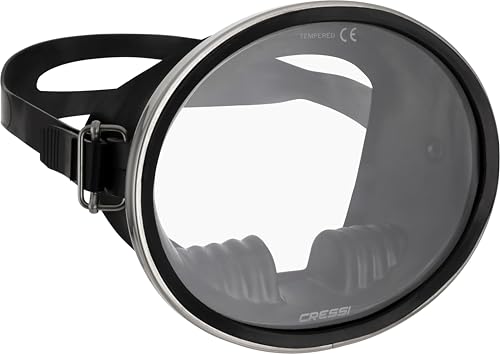
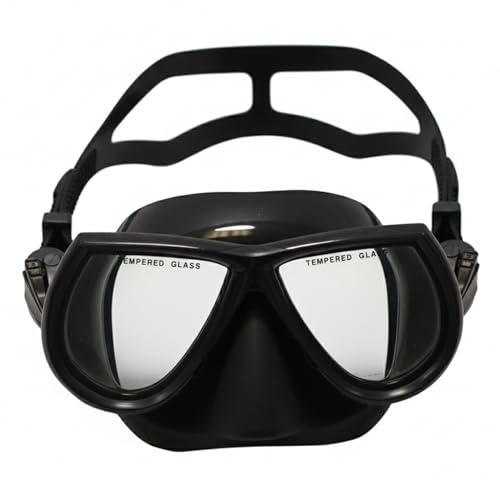
For freediving or spearfishing, consider whether a close-fitting low-volume layout matters more than maximum peripheral coverage. The Scuba Choice low-volume model is explicitly aimed at freediving and spearfishing and is described as suitable for narrow faces. The Cressi Pacifico and Jwintee masks take a more traditional oval approach, with both listings connecting their formats to freediving and underwater photography. These designs may appeal to users who want a conventional mask profile, but the supplied descriptions do not establish that every face will fit equally well.
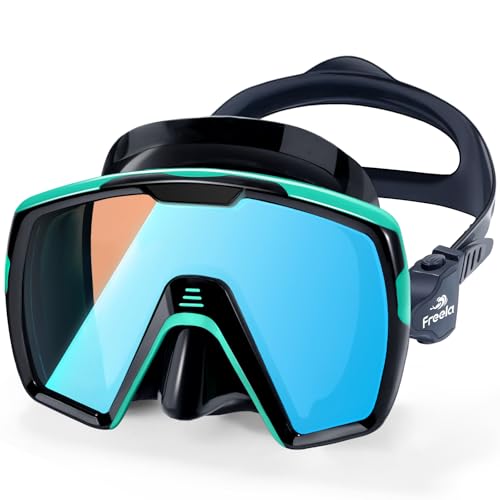
For recreational snorkeling, broad viewing can be more important than compactness. Scuba Prime Pano 3 and EXP VISION Adult Pano 3 both document three-lens panoramic designs and a 180-degree field of view. Mikinya and Freela use single-lens or oval panoramic approaches while also stating 180-degree coverage. A wide-view claim is useful for comparison, but it is not a substitute for checking skirt contact around the nose, cheeks, and forehead.
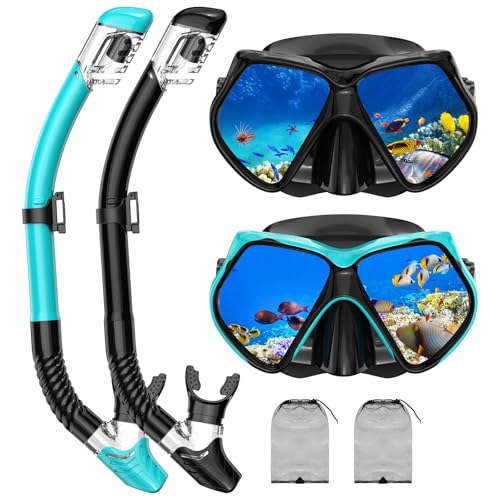
If the goal is a complete snorkeling setup, ForShine is the only selected package that specifically documents a dry-top snorkel, float valve, lower purge valve, and mesh bag. That can simplify packing, but a set is not automatically preferable for scuba divers who already own a snorkel or need only a mask.
Compare lens construction and treatments
Every selected product documents tempered glass, but the additional lens features differ. Cressi describes scratch-resistant glass, while Kraken emphasizes tempered glass and prescription compatibility. Mikinya, EXP VISION, and ForShine specify anti-fog treatment or anti-fog lenses.
Anti-fog treatment may reduce preparation work, but the supplied evidence does not establish how long any treatment lasts or how it performs in every water temperature. Follow the manufacturer’s care directions and avoid assuming that a treatment eliminates all fogging. Tempered glass also needs careful handling. One selected EXP VISION listing specifically warns against dropping the mask and against diving or jumping into water while wearing it. That warning is a practical reminder that impact resistance does not mean the lens is indestructible.
Evaluate the skirt and seal
The skirt is the part that contacts the face, so material and shape deserve close attention. Most selected models document silicone skirts, including Kraken’s soft hypoallergenic silicone, Scuba Prime’s soft silicone, Mikinya’s oval silicone, and Freela’s widened food-grade silicone. Cressi uses natural rubber, while the Scuba Choice low-volume model specifies a silicone skirt intended for narrow faces.
A soft material can support comfort, but a seal is highly dependent on face shape, hair placement, strap tension, and correct positioning. Product listings frequently use terms such as leak-proof or watertight; these are manufacturer claims, not independent test results. Use them as evidence of intended design rather than a guarantee. A mask that is too wide may press unevenly, while one that is too narrow may leave gaps. Check the seller’s sizing guidance and return policy when available.
Look at adjustment hardware
Quick-adjust buckles are common across this category. Kraken, Mikinya, Scuba Prime, and Jwintee all document adjustable or quick-adjust strap systems. Freela specifies multi-direction adjustment, and Aegend describes one-hand micro-adjustable buckles. These details matter when the mask needs to be fitted over bare skin or a hood.
Adjustment convenience should not be confused with universal fit. A strap can change tension, but it cannot change the underlying frame width or skirt contour. If you have a narrow face, the Scuba Choice model has the clearest narrow-face positioning among the selected products. If you need a household solution, Aegend’s two-mask format may be practical, although its listing does not provide detailed measurements for each mask.
Consider viewing layout and size
Single-lens masks can offer an unobstructed central view, while three-window designs divide the lens into separate sections. The Kraken is a single-lens model with stated prescription compatibility. Cressi and Jwintee use oval single-lens formats. Scuba Prime and EXP VISION Adult Pano 3 document three-window layouts. Neither design is universally better: choose based on preferred coverage, frame profile, and fit around the bridge of the nose.
Also check listed dimensions when available. Scuba Choice gives a compact set of product dimensions, Scuba Prime lists its frame dimensions, and Mikinya provides dimensions in its specifications. Measurements in a listing may describe the packaged or overall product rather than the face-contact area, so treat them as a screening tool rather than a complete fitting specification.
Final recommendation
Freela Mirror Anti-Fog Diving Mask ranks first overall in this specification-based comparison under the published weighted criteria.
Cressi Pacifico is the first overall specification-based choice among the best tempered glass diving masks because it combines a clearly documented tempered-glass lens, traditional oval viewing, natural rubber sealing, adjustable buckles, broad activity suitability, and a two-year limited warranty. Kraken Aquatics is a strong alternative when prescription compatibility and a soft silicone skirt matter. For panoramic viewing, Scuba Prime Pano 3 and EXP VISION Adult Pano 3 are the clearest documented choices, while Scuba Choice is the more targeted option for narrow-face, low-volume freediving. Among the top tempered glass diving masks, the best match depends on whether your priority is compact freediving fit, wide recreational viewing, or a complete snorkeling package.
Frequently Asked Questions
Are the best tempered glass diving masks suitable for snorkeling and scuba diving?
Many selected models are documented for both activities. Kraken, Cressi, Mikinya, Scuba Prime, and EXP VISION Adult Pano 3 list combinations of snorkeling, scuba diving, freediving, or spearfishing. Always check the specific product instructions and intended-use limitations before diving.
Is a low-volume mask better for freediving?
A low-volume design reduces the amount of air space inside the mask and is commonly associated with freediving. The Scuba Choice model is explicitly described as low volume and intended for freediving and spearfishing. However, the evidence supplied here does not establish that low volume is best for every diver or face shape.
Does anti-fog tempered glass stay clear without preparation?
Not necessarily. Several listings document anti-fog coatings or anti-fog lenses, but the evidence does not provide independent durability testing or a guarantee of fog-free use. Follow the manufacturer’s cleaning and preparation directions, and avoid abrasive products that could damage lens treatments.
Should I choose a single-lens or three-window mask?
A single-lens design may provide a continuous central view, while a three-window design can support a panoramic layout and may have a different frame profile. Kraken, Cressi, Jwintee, and Freela document single-lens or oval formats; Scuba Prime and EXP VISION Adult Pano 3 document three-window designs. Fit and personal viewing preference should guide the decision.
What should I check before ordering?
Confirm adult or youth sizing, frame and face dimensions, skirt material, strap adjustment, lens treatment, included accessories, warranty terms, and the seller’s return policy. A two-pack such as Aegend may suit two users, while ForShine’s dry-top package may be more equipment than needed if you already own a snorkel.