Buying Guide
Universal intake filters are not universal in the sense of fitting every intake tube. They are designed to work across multiple applications when the inlet diameter, flange length, filter height, and available space match the installation. The most important first step is measuring the outside diameter of the intake tube where the filter will clamp. A filter with the wrong inlet size may not seal correctly, regardless of its advertised application range.
This guide compares the best universal air intake filters using the specifications supplied in the public listings. The ranking emphasizes fitment clarity, filtration design, cleaning and reuse information, construction, and installation readiness. It does not represent a hands-on test.
Match the inlet diameter
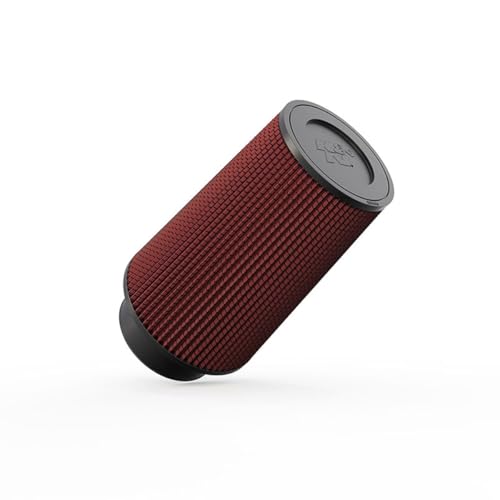
Start with the tube measurement. The selected products cover several common sizes, including 2.5-inch, 3-inch, 4-inch, and 6-inch inlets. The K&N RU-4950 is the clear small-flange choice because its listing specifies a 2.5-inch flange. For a 3-inch tube, the K&N RU-3580, K&N RU-5111, and KYOSTAR KD2046GN all document a 3-inch connection. The RU-3580 is 5 inches high, while the RU-5111 is 5.75 inches high, so the shorter RU-3580 may be easier to place where vertical clearance is restricted.
A fixed flange is straightforward when the tube size is known, but it offers less flexibility if the intake system changes. The Spectre SPE-9736 documents 3-, 3.5-, and 4-inch flange IDs, and the FALVFUN kit supplies 76mm, 89mm, and 102mm adapter rings. Those designs can simplify matching different tube sizes, but the adapter or flange still needs to create a secure seal.
For a larger custom intake, the Spectre SPE-HPR9886 lists a 6-inch flange. Its larger inlet and body demand more room, so it should be considered only after checking the engine bay and surrounding components.
Check filter height and engine-bay clearance
Inlet diameter is only half of the fitment decision. Cone filters extend beyond the tube, and their height, base, and top dimensions determine whether they can be installed without contacting nearby parts. The K&N RG-1001RD lists a 5.5-inch filter height, making it one of the more compact choices among the selected tapered filters. The Spectre SPE-9736 reaches 8.75 inches, and the K&N RE-0870 and K&N RU-3112HBK are listed at 9 inches.
A taller filter may provide a larger element, but the supplied evidence does not establish that a particular height will produce better results in a specific vehicle. Treat height as a physical fitment requirement rather than a performance guarantee. Measure from the end of the intake tube to the nearest obstruction, then compare that space with the listed filter height and base dimensions.
The Spectre SPE-HPR9886 lists a 6.219-inch height, 7.719-inch base, and 5.219-inch top. These details are more useful than a generic small, medium, or large label because they help establish the shape of the installed filter. If the listing does not provide complete dimensions, use the available flange and product measurements cautiously and confirm the actual application before installation.
The selected products document more than one filter-media approach. The K&N models use four layers of premium cotton gauze and are described as pre-oiled. The K&N RU-3112HBK uses two layers of dry synthetic media and is specifically described as oil-free. The Spectre models use non-woven synthetic media, while the KYOSTAR KD2046GN describes a three-layer combination of oiled synthetic material, cotton gauze, and polyurethane.
A dry, oil-free design may be preferable for someone who wants to avoid oiling the element after cleaning. The K&N Dryflow listing also provides a 50,000-mile cleaning interval under normal highway conditions. Oiled cotton-gauze designs have more detailed media-layer information in these listings and are supplied ready for installation, but maintenance should follow the manufacturer’s stated process.
Do not treat the phrase high-flow as a measured result for every vehicle. The listings make performance and airflow claims, but this comparison scores the documented design rather than presenting those claims as independently verified outcomes.
Reusable construction is a central reason to choose a universal intake filter. The K&N models list cleaning intervals of 75,000 miles under normal highway driving conditions, with the Dryflow RU-3112HBK listing 50,000 miles. Spectre lists 50,000 miles before the first cleaning under normal highway conditions. These are manufacturer-provided conditions, not a recommendation for every environment.
Dusty roads, off-road use, unusual weather, or visible contamination can change how often inspection is appropriate. The important comparison point is whether the listing identifies the media as washable and reusable and whether it gives useful maintenance guidance. The KYOSTAR, FALVFUN, and other selected designs document reusable or washable construction, but they provide less specific interval information. That makes the maintenance instructions supplied with the individual product especially important.
Inspect construction and installation details
A filter should remain securely attached to the intake tube. Clamp-on installation is documented across the selected group, but included hardware varies. The FALVFUN listing includes three adapter rings. The KYOSTAR listing describes a universal clamp design. The K&N products are described as pre-oiled and ready to install, while the Spectre products emphasize clamp-on installation. These details help explain installation readiness, but they do not confirm that every vehicle needs no additional couplers, brackets, or tubing.
Construction details also differ. Spectre documents reinforced steel mesh and a urethane frame. K&N describes rugged construction and premium materials. The KYOSTAR listing identifies polyurethane as one part of its layered design. These features support a durable design assessment, but actual service life depends on installation, cleaning, exposure, and application.
Use the included dimensions as a checklist
Before selecting from the top universal air intake filters, write down four measurements: tube outside diameter, available filter height, available base width, and the required flange length. Then check whether the product uses a fixed inlet or adapter rings. Confirm whether the filter is dry or pre-oiled, and note the cleaning instructions. Finally, verify that the clamp or other needed hardware is included. The listings do not establish vehicle-specific fitment for every model, so a universal label should not replace measurement.
Final recommendation
Among the top universal air intake filters, the ranked products differ under documented fitment range and sizing clarity, filtration media and protection design, washability and maintenance details, construction and durability evidence, and installation readiness.
K&N RU-3580 3-Inch Tapered Filter ranks first overall in this specification-based comparison under the published weighted criteria.
The Spectre SPE-9736 is the first overall specification-based choice among these best universal air intake filters because it documents three flange sizes, reusable synthetic media, a steel-reinforced urethane frame, and clamp-on installation. Its 8.75-inch height makes clearance checking essential.
The K&N RG-1001RD is the more compact premium cotton-gauze option for a 4-inch tube, while the K&N RU-3112HBK is the most clearly differentiated oil-free choice. For smaller tubes, the K&N RU-3580 suits a 3-inch connection and the K&N RU-4950 covers 2.5 inches. The FALVFUN kit is useful when adapter rings are more important than a fixed flange. In every case, the correct tube diameter and available space should decide the final selection.
Frequently Asked Questions
Among the best universal air intake filters, are universal air intake filters vehicle-specific?
Usually, no. Universal products are intended for multiple applications, but they still require a compatible intake-tube diameter and enough clearance. The supplied listings describe universal fitment for several selected products, yet they do not guarantee fitment for every vehicle. Measure the tube and compare the filter’s dimensions before installation.
What is the difference between dry and oiled intake filters?
The K&N RU-3112HBK is listed as using dry synthetic, oil-free media. Several other K&N models are described as pre-oiled cotton-gauze filters, and the KYOSTAR design includes oiled synthetic media with cotton gauze and polyurethane. Dry and oiled designs have different maintenance procedures, so follow the instructions for the specific filter rather than applying one process to all media types.
How do I choose between a fixed flange and adapter rings?
Choose a fixed flange when your intake tube has a known diameter and you want a direct match. The FALVFUN kit is more flexible because it includes 76mm, 89mm, and 102mm adapter rings. The Spectre SPE-9736 also documents three flange sizes. An adapter still needs to fit securely and seal properly, so verify the assembled diameter and available space.
How often should a reusable filter be cleaned?
The supplied listings provide manufacturer-stated intervals rather than one universal schedule. Several K&N models list 75,000 miles under normal highway conditions, while the K&N RU-3112HBK and Spectre products list 50,000 miles in stated conditions. Inspect the filter according to the product instructions and account for dust or other demanding environments.
Do these filters include a complete cold-air intake system?
No. The selected products are filters, and some include a clamp or adapter rings. The listings do not establish that every item includes intake tubing, brackets, heat shielding, or a complete cold-air system. Confirm the package contents and the components already present in your intake before ordering.