Buying Guide
Choosing the best vegan packaged miso soups is mainly a matter of matching the product format and documented ingredients to the way you plan to eat it. The products in this comparison range from dry packets and freeze-dried cubes to noodle cups and ready-to-use broth. Because this is a specification-based guide, the discussion below uses supplied listing claims rather than hands-on testing or customer commentary.
Single-serve packets are useful when you want a measured portion that can be stored at work or packed for travel. Edward & Sons Traditional Tofu Miso-Cup lists individual packets, while Tsubi Soup uses individually wrapped cubes. Tsubi gives the clearest preparation instruction: one cube goes into a cup with 6 ounces of hot water and is stirred for five seconds. That makes it the most specifically documented option for a very fast cup.
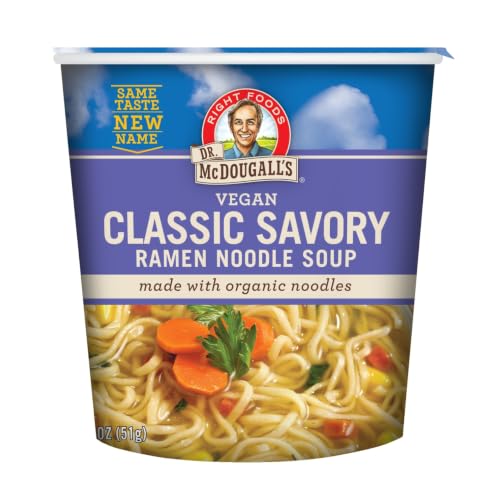
Cup formats can provide a more complete bowl when noodles or vegetables are already included. Dr. McDougall’s Organic Miso Big Soup Cup lists organic noodles, shiitake mushrooms, wakame, ginger, and tofu. Lotus Foods Red Miso Rice Ramen Soup Cup provides a rice-ramen alternative with red miso. Koyo also includes organic noodles, but its directions indicate preparation in less than six minutes, so it fits a short cooking routine rather than a simple pour-and-stir approach.
Larger formats serve a different purpose. Ocean’s Halo is a 32-fluid-ounce liquid broth, and Marukome offers a 13.2-ounce package that is prepared by adding water and heating. These options can work better when you are making multiple portions or using miso broth as part of another dish. The trade-off is less portability than a packet, cube, or cup.
Check what is actually included
A plain miso base and a soup containing solid ingredients are not interchangeable. Hikari Miso lists tofu and wakame, while the Edward & Sons tofu version specifically identifies tofu. The Dr. McDougall’s cup has the broadest named ingredient mix among the selected cup products, including noodles, mushrooms, seaweed, ginger, and tofu.
The 7.05-ounce Wakame and Tofu Miso Soup Mix also names two substantial inclusions, but it should be understood as a customizable dry mix. Its listing says to add a spoonful of miso paste to create instant miso soup. That means it gives you control over the amount of base and can also be used in ramen, rice bowls, salads, and stews, but the mix itself is not presented as a complete seasoned broth in the same way as a finished packet.
Ocean’s Halo takes the opposite approach: it is a liquid miso broth with sustainably farmed kelp, but the supplied evidence does not list tofu, noodles, or other solid additions. Choose it when broth is the priority, and plan to add your own ingredients if you want a more filling bowl.
Compare vegan and dietary documentation
For the best vegan packaged miso soups, explicit wording matters. Tsubi, Ocean’s Halo, Lotus Foods, Hikari Miso, and the selected Edward & Sons products provide direct vegan or plant-based descriptions in the supplied evidence. Koyo and Dr. McDougall’s also identify their products as vegan. Marukome’s selected product is titled vegan and gluten free.
Gluten-free documentation varies across the group. Hikari, Tsubi, Edward & Sons, Marukome, Ocean’s Halo, and Lotus Foods provide gluten-free claims or certifications in their listings. Koyo documents organic noodles and vegan positioning but does not supply a gluten-free claim in the evidence used here. If gluten avoidance is important, rely on the product’s stated certification or claim rather than assuming that miso soup is automatically gluten free.
Ingredient exclusions also differ. Tsubi states that its cubes contain no MSG, artificial colors, flavors, preservatives, or seed oils. Koyo lists no MSG, no artificial colors, flavors, or preservatives. Edward & Sons describes its products as free from fish stock and provides additional special-diet positioning. These statements are product-specific and should not be generalized across the entire category.
Decide whether you need a meal or a base
Noodle cups from Koyo, Dr. McDougall’s, and Lotus Foods are the most meal-oriented selections because they include a noodle component. Tofu-and-seaweed products such as Hikari and Edward & Sons Traditional Tofu Miso-Cup provide texture without making noodles the centerpiece. Tsubi adds eggplant, ginger, and carrot to its yellow miso cube, giving it a more varied ingredient list than a plain broth.
A broth or plain miso format can be more useful for cooking. Ocean’s Halo can serve as a base for vegetables, noodles, or tofu, while Marukome’s larger package is positioned for heated preparation. The 7.05-ounce mix is especially adaptable because its listing names several uses beyond soup. Consider how much customization you want before choosing a single-serve product.
Consider storage and portion control
Dry formats generally offer simpler pantry storage than liquid broth, but the evidence does not establish identical storage requirements for every product. Tsubi specifically states that its cubes are shelf-stable for 12 months without refrigeration. The 7.05-ounce mix comes in a resealable jar, which supports repeated scooping. Packets and cups are naturally portioned, while a larger pouch or carton is more suitable when you expect to prepare several servings.
Portability is most specification-aligned among the individually wrapped products. Tsubi explicitly describes desk, travel, and camping use, and the Edward & Sons tofu packets are also individually portioned. Cups can travel but take more space, while Ocean’s Halo is a liquid carton rather than a compact dry serving.
Match the pick to your routine
For the quickest documented preparation, choose Tsubi Soup. For noodles, compare Koyo, Dr. McDougall’s, and Lotus Foods according to whether you prefer wheat-style organic noodles, a broad vegetable-and-tofu ingredient list, or rice ramen. For a liquid cooking base, Ocean’s Halo is the clearest fit. For a resealable ingredient mix, choose the 7.05-ounce Wakame and Tofu Miso Soup Mix. These distinctions make the top vegan packaged miso soups easier to narrow down without relying on unsupported taste assumptions.
Final Recommendation
Tsubi Soup Yellow Miso Eggplant & Ginger ranks first overall in this specification-based comparison under the published weighted criteria.
Tsubi Soup Yellow Miso Eggplant & Ginger is the highest-scoring returned product and the first overall specification-based choice. Its individually wrapped cube format, five-second hot-water preparation, detailed vegan and dietary claims, and documented eggplant, ginger, and carrot inclusions give it the most complete convenience profile in this comparison.
Choose Hikari Miso Organic Tofu & Wakame Soup if organic tofu-and-wakame packets are more important than the fastest stated preparation. Dr. McDougall’s Organic Miso Big Soup Cup is the better fit for a noodle cup with mushrooms, seaweed, ginger, and tofu. Lotus Foods is a strong alternative for rice ramen and broad dietary documentation, while Ocean’s Halo is the most suitable selected product for a larger liquid broth format.
The best vegan packaged miso soups are not all designed for the same job. Tsubi and Edward & Sons fit portioned servings, Koyo and the noodle cups lean toward fuller bowls, and the Marukome, Ocean’s Halo, and resealable-mix formats provide more room for batch preparation or customization. The top vegan packaged miso soups therefore depend on whether your priority is speed, texture, noodles, portability, or cooking flexibility.
Frequently Asked Questions
Among the best vegan packaged miso soups, what makes a packaged miso soup vegan?
A product should provide an explicit vegan or plant-based claim, or clearly document a formulation without animal-derived soup components. In this selection, Tsubi, Hikari, Koyo, Dr. McDougall’s, Lotus Foods, Ocean’s Halo, Marukome, and Edward & Sons provide relevant vegan wording in their supplied listings. Edward & Sons specifically says its selected products are made without fish stock.
Which selected product has the fastest stated preparation?
Tsubi Soup Yellow Miso Eggplant & Ginger has the fastest documented method. The listing says to drop one cube into a cup, add 6 ounces of hot water, and stir for five seconds. Other products provide general instant or hot-water directions without giving the same specific time.
Which options include tofu?
Hikari Miso lists tofu and wakame. Edward & Sons Traditional Tofu Miso-Cup includes tofu, and Dr. McDougall’s Organic Miso Big Soup Cup lists tofu along with noodles, shiitake mushrooms, wakame, and ginger. The 7.05-ounce Wakame and Tofu Miso Soup Mix also includes freeze-dried tofu and wakame.
Are all of these products gluten free?
No. Gluten-free claims are documented for several selections, including Tsubi, Hikari, Edward & Sons, Marukome, Ocean’s Halo, and Lotus Foods. The supplied evidence for Koyo does not include a gluten-free claim. Check the specific product information when gluten avoidance is required.
Which product is best for adding to other meals?
The 7.05-ounce Wakame and Tofu Miso Soup Mix has the broadest stated uses. Its listing names ramen, udon, rice bowls, salads, and stews in addition to instant miso soup. Koyo also presents its soup as a base for noodle bowls or salads, while Ocean’s Halo is a ready-to-use broth suitable for larger cooking applications.