Buying Guide
The best velvet jewelry boxes differ mainly in how they divide space. A large collection may need layers, drawers, hooks, and adjustable sections, while a travel case should stay compact and easy to open. The products in this comparison cover those documented design types without treating one layout as suitable for every jewelry collection.
A layered organizer is useful when several jewelry categories need separate homes. The Dajasan 3-Layer Velvet Jewelry Organizer has three layers, one drawer, five ring slots, nine ring boxes, 10 necklace hooks, and 26 earring holes. QBestry also uses three layers and a drawer, but its listing emphasizes removable partitions, 16 ring rolls, eight necklace hooks, and 56 earring holes. These formats are the most structured choices for a dresser or vanity.
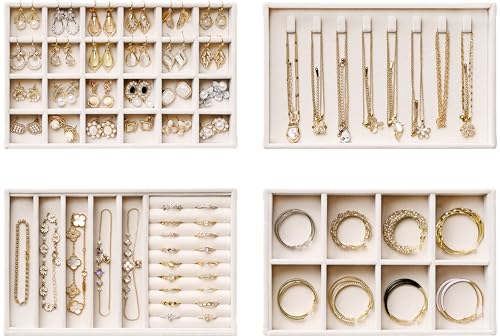
Flat trays work differently. The ProCase Double-Layer Velvet Jewelry Box provides 27 compartments, eight hooks, an elastic pouch, and removable slots. The pickpiff 4-Layer Velvet Jewelry Tray Set separates storage into several tray types, including an earring tray, necklace tray, and ring-and-bracelet tray. Choose this style when you prefer to sort jewelry by category or place trays inside a drawer.
Match compartments to your collection
Count the types of jewelry you actually store. Rings and stud earrings benefit from rolls, grooves, or small individual sections. Long necklaces need hooks or separated channels. Bracelets and watches generally need wider open sections. Josmimic’s 48-grid tray is centered on small, separated compartments and uses removable dividers, so it can be reconfigured for different pieces. Frebeauty takes the opposite approach with 15 dedicated necklace hooks and raised dividers.
A blank or open tray can be more adaptable than a highly segmented case, but it may require more careful arrangement. Coward documents a broad blank interior behind a clear glass lid, making it a display-oriented option rather than a fixed-compartment organizer. Check the interior dimensions and layout against your largest pieces before choosing a tray.
Consider protection and materials
Every selected product documents velvet or plush velvet on the exterior, lining, or both. Velvet lining is presented in the listings as a soft surface for jewelry storage, while several designs add structural materials. Dajasan specifies an FSC-certified wood frame, Coward lists a solid wood density-board interior, and CASEGRACE documents a bead-fleece interior lining.
Closures also affect handling. Cases use zippers, clasps, or snap-style closures, while QBestry documents a lock and key and Frebeauty documents two lockable clasps. A closure can help keep contents contained during movement, but the supplied listings do not establish that any design is theft-proof or fully travel-proof. Treat closure type as a practical specification rather than a guarantee.
Decide whether portability matters
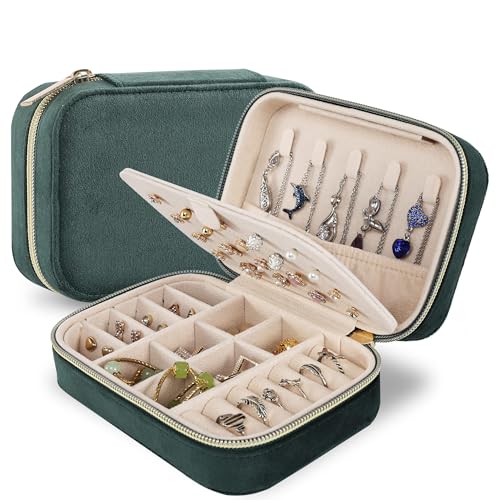
For luggage or a handbag, compare external dimensions and listed weight with the number of pieces you need to carry. CASEGRACE measures 6.7 by 4.72 by 2.16 inches and documents a double-layer layout, removable partition, necklace hooks, and elastic pouch. Benevolence LA adds a built-in mirror, while the Dajasan Mini Travel Jewelry Box weighs 0.42 pounds and includes a dedicated earring tray.
The trade-off is capacity. Portable cases generally provide less room than layered dresser organizers or wide display trays. A compact case is more appropriate for a small rotating selection, weekend travel, or separating jewelry from the rest of a larger home collection.
Use glass lids for display
A transparent lid makes contents easier to identify without opening the box. Josmimic uses a clear glass top that the listing also describes as a dust cover. Coward and Frebeauty likewise document glass tops, with Frebeauty adding two lockable clasps. These designs suit a vanity, shelf, jewelry presentation area, or any setting where visual access matters.
Glass adds a display benefit but may make a box less convenient to carry. The supplied information does not provide impact testing, so handle glass-lid designs as stationary organizers unless the manufacturer specifically indicates otherwise.
Compare access features
Drawers, removable dividers, hooks, mirrors, and layered interiors change how quickly you can reach individual pieces. Dajasan and QBestry provide drawers, while pickpiff uses separate trays. Removable dividers in QBestry, Josmimic, CASEGRACE, and pickpiff allow some customization. Benevolence LA’s mirror is useful when the case is used away from a dressing table.
For a collection that changes often, adjustable sections may be more practical than fixed slots. For a stable collection of mostly necklaces or earrings, dedicated hooks and grids can reduce the need to rearrange the interior.
Final Recommendation
Dajasan 3-Layer Velvet Jewelry Organizer ranks first overall in this specification-based comparison under the published weighted criteria.
Dajasan 3-Layer Velvet Jewelry Organizer is the highest-scoring returned product and the first overall specification-based choice. Its three layers, drawer, varied ring storage, 10 necklace hooks, 26 earring holes, velvet lining, metal clasp, and wood frame create the most complete documented home-storage layout in this comparison.
The top velvet jewelry boxes are not interchangeable: QBestry is the better fit for adjustable sections and a lock-and-key closure; ProCase suits a broad flat arrangement; and Josmimic is the clearest choice for a glass-top 48-grid layout. For drawers, pickpiff offers multiple specialized trays. For travel, CASEGRACE, Benevolence LA, and the Dajasan Mini Travel Jewelry Box prioritize smaller formats. Coward and Frebeauty are display-focused alternatives for glass-lid storage, with Frebeauty concentrating on necklaces.
Before selecting, measure the intended drawer, shelf, or luggage compartment. Then compare your jewelry mix with the documented hooks, rolls, grids, drawers, dividers, and open sections. This approach will help you choose among the best velvet jewelry boxes based on fit and organization rather than appearance alone.
Frequently Asked Questions
What should I look for in the best velvet jewelry boxes?
Start with the jewelry types you need to store. Look for ring rolls or grooves for rings, small compartments for earrings, hooks for necklaces, and wider sections for bracelets or watches. Also check external dimensions, closure type, lining, and whether dividers can be removed. A three-layer case can suit a large collection, while a compact double-layer case may be easier to carry.
Are velvet jewelry boxes suitable for travel?
Some are specifically documented for travel. CASEGRACE has a compact double-layer design with a zipper, hooks, ring grooves, and a removable partition. Benevolence LA includes a mirror and several dedicated sections, while Dajasan’s mini case measures 5.9 by 4.13 by 1.97 inches and weighs 0.42 pounds. Larger organizers and glass-top trays are generally more appropriate for stationary storage because of their dimensions and construction.
Which selected box is best for necklaces?
Frebeauty is the most specialized option because it documents 15 necklace hooks and raised dividers in a 13.8-by-9.5-by-2-inch tray. Dajasan and QBestry also include necklace hooks within broader mixed-jewelry layouts. If you want to display chains behind a visible cover, Frebeauty, Coward, and Josmimic document glass-top designs.
Do removable dividers matter?
They matter when jewelry sizes vary or your collection changes. QBestry, Josmimic, CASEGRACE, and pickpiff document removable or adjustable sections. Fixed grids can provide more predictable organization, while removable dividers let you create wider spaces for larger pieces. Compare the divider system with your largest items before choosing.
How should I choose between a box and a tray?
Choose a box when you want enclosed, layered, or portable storage. Choose a tray when visibility, drawer placement, or broad display space is more important. Coward and Frebeauty document glass-lid trays, while Dajasan and QBestry provide layered boxes with drawers. The right format depends on whether you prioritize compact transport, category separation, or at-a-glance access.