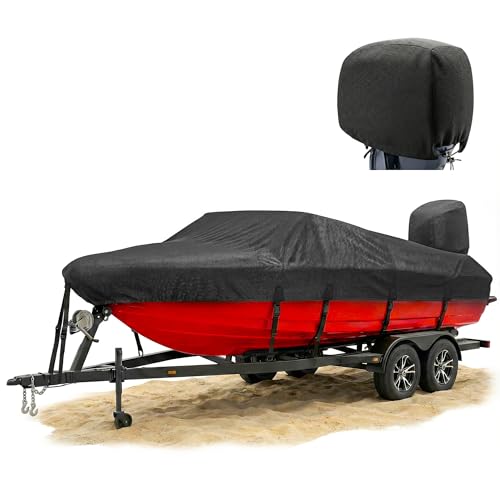
Buying Guide
Choosing among the best waterproof boat covers starts with fit, not fabric weight alone. A cover that is too short, too narrow, or shaped for the wrong hull can leave exposed areas and create tension at the seams. Use the boat’s actual length and beam, including relevant external accessories, and compare those measurements with the manufacturer’s stated range. The selected products cover several common sizes, from compact Jon boats to 20-22-foot V-hull-style boats.
Match the cover to boat length and beam
The size labels in this category are ranges rather than universal standards. UIRWAY, RVMasking, Cerumute, and HAHASOLE are intended for boats around 20-22 feet, but their beam limits differ: UIRWAY and HAHASOLE list up to 100 inches, while RVMasking and Cerumute list up to 100 and 102 inches respectively. That difference can determine whether the cover sits correctly along the sides.
For mid-size boats, Kipiea and YimSting cover approximately 16-18.5 feet, while FOCEAN and Comnova offer similar ranges. iCOVER is listed for 17-19-foot boats with a beam up to 96 inches. Do not assume two covers with similar length labels have the same shape or side coverage. Confirm the beam limit and hull style before choosing.
Choose the right hull design
Several selected covers are described for V-hull, bass, fishing, tri-hull, runabout, or fish-and-ski boats. FOCEAN and Comnova have especially broad documented compatibility within the 16-18-foot class. HAHASOLE also lists Jon boats among its compatible styles, but a dedicated Jon boat cover can be a better match when the hull is narrow and relatively straight-sided.
Nukugula’s 12-14-foot and 14-16-foot options are specifically aimed at Jon boats, with beam limits of 70 and 75 inches. Their narrower application is a benefit when it matches the boat, not a weakness. Conversely, using a cover designed around a different hull profile may leave excess material or place stress in unexpected locations.
UIRWAY includes an important restriction: it is not suitable for T-Top boats. This is a reminder to check console, windshield, bow, and motor clearances rather than relying on boat length alone.
Evaluate waterproofing construction
A waterproof label is useful, but construction details make comparisons more meaningful. Look for coated fabric, PU backing, taped or sealed seams, and protection around strap attachment points. UIRWAY lists four-layer 1200D fabric, dual PU coatings, and fully sealed seams. RVMasking lists dual-layer coating and taped seams, while Cerumute specifies three-layer PU coating and waterproof strips over strap seams.
FOCEAN documents fully sealed seams and multi-layer PU-coated backing. HAHASOLE lists four-layer fabric, PU coating, and waterproof strips over webbing seams. The two Nukugula covers describe five-layer 1200D material, dual PU backing, and sealed seams. These descriptions do not replace real-world testing, but they provide useful evidence about how each listing addresses potential water-entry points.
Some listings state water-pressure figures, including UIRWAY, RVMasking, Cerumute, FOCEAN, Kipiea, and the Nukugula models. Treat those numbers as listing specifications rather than independent test results. A cover still needs a suitable fit and support underneath to avoid pooling.
Consider fabric and reinforcement details
Fabric denier is only one part of durability. UIRWAY, HAHASOLE, YimSting, FOCEAN, Cerumute, and the Nukugula covers identify reinforced bow, stern, corner, or other high-stress areas. RVMasking uses 1400D material in the center and 900D fabric at the ends, a targeted approach for a stress-prone panel. FOCEAN similarly describes 1200D reinforcement at selected high-wear areas rather than claiming the entire cover uses the same fabric.
Seam construction also matters. YimSting lists triple-folded, double-stitched seams, while HAHASOLE lists double stitching and bound seams. The Nukugula options describe double stitching, reinforced corners, and reinforced tie-down areas. iCOVER uses a heavy-duty elastic cord around the hem and lists a water-resistant PVC coating with an anti-UV finish, but its supplied evidence is less detailed about denier and seam sealing than the heavier-specification choices.
Check wind security and trailering features
A trailerable design should have more than an elastic edge. Look for adjustable straps, quick-release buckles, reinforced attachment points, and a hem that pulls the lower edge snugly around the hull. HAHASOLE lists 14 straps; Kipiea, Cerumute, and both Nukugula covers list 13; UIRWAY, RVMasking, and Comnova list 11 or adjustable tie-down systems. These counts describe the supplied product features, not a guarantee of performance at any particular speed or in every weather condition.
Metal buckles are a specific feature of Cerumute. YimSting highlights detachable straps, which may be useful if a strap is damaged. UIRWAY adds reflective strips for visibility during nighttime or low-light trailering. Always follow the cover’s installation instructions and use enough support to keep loose fabric from rubbing against the boat.
Plan for ventilation and water runoff
Water resistance does not mean moisture should be trapped beneath the cover. Ventilation can help air circulate, but the supplied evidence does not establish a specific drying time or guarantee against condensation.
A support system is also relevant. RVMasking advises using a support rod to help prevent water accumulation, and iCOVER recommends a support pole for the same general purpose. This is particularly important when the cover is used for extended storage. Follow the product’s guidance rather than allowing water to collect in a low spot.
Review included accessories and warranty terms
A storage bag is common, but some selected products add more utility. FOCEAN’s bag is described as an engine cover for motors up to 25 HP. Kipiea, YimSting, and both Nukugula models describe bags that can also serve as motor covers. HAHASOLE, UIRWAY, RVMasking, and iCOVER list storage bags, while Comnova’s supplied features focus more on the cover and tie-down system.
Warranty language varies from one product to another, and some listings provide only a brief or non-specific term. Treat warranty coverage as a documentation detail to verify before purchase, not as proof of expected lifespan.
Final Recommendation
Nukugula 1200D 12-14 FT Jon Boat Cover ranks first overall in this specification-based comparison under the published weighted criteria.
UIRWAY is the first overall specification-based choice among these best waterproof boat covers because it combines 1200D four-layer fabric, dual PU coatings, sealed seams, reinforced areas, ventilation, reflective strips, and a detailed trailer-oriented strap system. Its 20-22-foot, 100-inch-beam fit is not universal, and the T-Top exclusion must be taken seriously.
RVMasking is a strong alternative when center reinforcement and dual-layer waterproofing are priorities. Kipiea is particularly practical for 16-18.5-foot boats when the dual-use motor-cover bag and replacement warranty are useful. Cerumute deserves attention for its metal buckles and 102-inch beam allowance, while YimSting offers a balanced combination of detachable straps, reinforced seams, and dual vents.
For a compact Jon boat, the 12-14-foot Nukugula model is the most directly matched choice in this group. The 14-16-foot Nukugula version serves the next size range. FOCEAN and Comnova are sensible options for broader 16-18-foot compatibility, and HAHASOLE is a well-specified large cover with 14 straps. Among these top waterproof boat covers, the final decision should follow the boat’s measured length, beam, hull shape, storage conditions, and whether trailering is part of the use case.
Frequently Asked Questions
How do I choose between the best waterproof boat covers for storage and trailering?
Start by confirming that the listing explicitly supports trailering if the boat will be transported. Then compare the strap count, buckle style, elastic hem, reinforced attachment points, and stated size range. UIRWAY, Cerumute, HAHASOLE, and the Nukugula covers provide especially detailed tie-down information. A storage-only cover may not have the same documented transport features.
Are 1200D or 1400D boat covers automatically better?
Not automatically. Denier describes a fabric specification, but waterproof coatings, seam treatment, reinforcement placement, fit, and ventilation also matter. RVMasking uses 1400D fabric in the center and 900D at the ends, while FOCEAN targets 1200D reinforcement at high-stress areas. Compare the complete construction rather than choosing from denier alone.
Do I need a support pole under a waterproof cover?
A support pole may help prevent water from collecting on the cover. The iCOVER and RVMasking listings specifically recommend a support pole or rod for this purpose. Whether one is needed depends on the boat’s shape, cover tension, and storage conditions. Use the manufacturer’s guidance and avoid leaving a low point where rain can pool.
Which cover is suitable for a Jon boat?
The two Nukugula models are the most directly specialized choices here: one fits 12-14-foot Jon boats up to 70 inches wide, and the other fits 14-16-foot Jon boats up to 75 inches wide. HAHASOLE also lists Jon boats among its compatible styles, but its 20-22-foot size is intended for much larger boats. Measure length and beam before selecting.
Why are vents useful on a waterproof cover?
Vents allow air circulation beneath the cover and may reduce trapped moisture and heat. UIRWAY, RVMasking, Cerumute, FOCEAN, YimSting, and both Nukugula covers document vents or breathable panels. Ventilation does not make a cover maintenance-free, so the boat and cover should still be kept clean and dry according to the product instructions.