Buying Guide
Choosing among the best waterproof table runners starts with deciding what kind of protection you actually need. Public listings use terms such as waterproof, water-resistant, stain-proof, and wipeable differently, so read the material and care details together. A runner with a sealed vinyl or faux-leather surface generally has a more direct spill barrier than a textile runner described as water-resistant. The latter can still be useful for occasional splashes, but it should not be treated as equivalent to a nonporous surface.
Match the runner to the table size
Measure the table length and width before ordering. A 72-inch runner is a common middle ground for dining tables seating roughly four to six people, as shown by the Smiry, Artoid Mode, and OYIMUA listings. A 48-inch design such as the Rinpon or Mebakuk is better suited to a smaller table, coffee table, dresser, or short accent surface. The Chitomars and Myir JUN runners measure 55 inches and are also positioned for smaller dining arrangements.
Long tables need a longer option. The DII runner measures 108 inches, while the Over&Back model measures 90 inches. Those dimensions can provide more balanced coverage on a large table, but they may look excessive on a compact one. Width matters too: the Over&Back runner is 18 inches wide, whereas several alternatives are about 12 to 14 inches wide. A wider runner creates more visual presence and tabletop coverage, but it also leaves less exposed table surface for place settings.
Compare waterproof materials
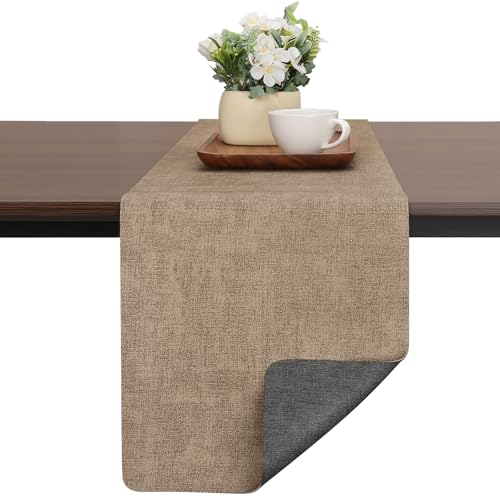
Vinyl and faux leather are the most prominent easy-care materials in this selection. Smiry uses thickened vinyl and documents waterproof, oil-proof, and stain-proof performance. Artoid Mode, Chitomars, and Myir JUN use faux-leather or vinyl constructions with waterproof or stain-resistant claims and wipeable care. These surfaces are a sensible starting point for households that expect food spills, drink condensation, or frequent cleanup.
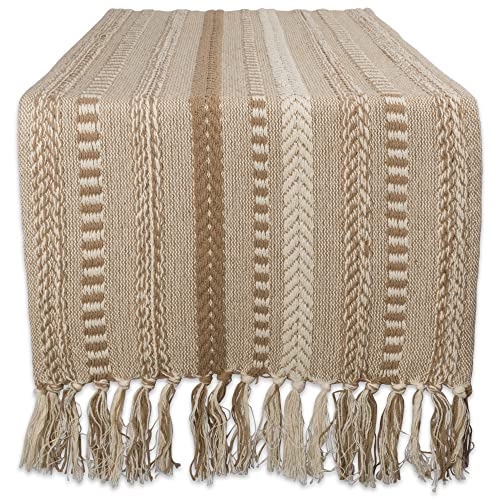
Fabric options offer a different balance. OYIMUA uses chenille polyester and describes the runner as waterproof and oil-proof, while DII uses polyester for an outdoor-oriented design. Mebakuk uses linen-style polyester and describes its fabric as water-resistant. Fabric can provide more texture and softness, but the evidence for liquid protection should be read carefully. If a listing says water-resistant rather than waterproof, treat it as protection against occasional moisture rather than a fully sealed barrier.
The Over&Back runner uses woven polypropylene fibers and is positioned for indoor and outdoor use. Its UVA/UVB-proof claim makes it notable for sunny locations. That outdoor-focused construction may be more relevant for a patio than a decorative indoor runner, especially when fading is a concern.
Consider cleaning and storage
Wipe-clean care is usually the most convenient approach after a spill. The Artoid Mode vinyl, Chitomars, Myir JUN, Jeloris, and Rinpon listings all describe wiping or rinsing as part of routine care. Faux-leather and vinyl runners can also be rolled for storage, which is useful when the table changes between meals and entertaining.
Washable designs may be preferable when the runner will be used often. Smiry lists cold machine washing and gentle drying, OYIMUA lists machine washing or towel cleaning, and DII lists wiping or gentle machine washing. Mebakuk also gives wipe and machine-wash guidance, but recommends low-temperature handling. Follow the individual listing instructions rather than assuming every waterproof runner can be washed the same way.
Look for tabletop protection features
Water protection is only one part of the decision. Several selected products also document protection from scratches, burns, or hot dishes. Smiry specifically mentions protection from scratches and burns, while the DII listing mentions scratches, stains, and burns.
Do not use a runner as a substitute for a trivet unless the product documentation supports the intended heat level. Even when a listing gives a heat-resistance figure, cookware can exceed that temperature, and the table surface underneath may still require additional protection. The most suitable interpretation is to use stated heat features as one part of a setup rather than as permission to place every hot pan directly on the runner.
Choose design and placement
A waterproof runner can be decorative as well as functional. Jeloris adds a lace border for formal events, OYIMUA uses a teal daisy pattern, and Smiry offers a rose floral print. For simpler rooms, the black Myir JUN, gray beige Chitomars, or camel brown Rinpon options offer more restrained color directions. Reversible designs from Artoid Mode, Chitomars, Myir JUN, and Over&Back allow two styling choices without buying another runner.
Think beyond the dining table, but check the dimensions first. The listings mention coffee tables, dressers, cabinets, desks, TV stands, and other surfaces for several products. A short runner may work well as a dresser accent, while an extra-long runner is more appropriate for a large dining or outdoor table. This is a practical way to narrow the field without relying on appearance alone.
Methodology
This is a specification-based comparison using public listing data. Products were selected from distinct parent groups and evaluated on documented water protection, cleaning guidance, tabletop protection, material and reuse features, and size or placement flexibility. No hands-on testing, customer sentiment, volatile marketplace labels, ratings, current listing information, or popularity activity was used in the published criteria. The ranking favors evidence that directly addresses spill control and practical ownership, while preserving room for different table sizes and design preferences.
Final Recommendation
Artoid Mode Blue Double-Sided Vinyl Runner ranks first overall in this specification-based comparison under the published weighted criteria.
The final choice among the best waterproof table runners depends on the documented features that match your intended use.
Smiry is the highest-scoring returned product and the first overall specification-based choice for shoppers who want a thick, reusable, waterproof runner with non-slip backing and flexible cleaning. Its 12 x 72-inch size suits many everyday dining tables, and the listing provides unusually broad protection details.
Among the top waterproof table runners, Artoid Mode’s blue double-sided vinyl model is the better fit for reversible styling and documented heat resistance. Choose Jeloris when a formal lace finish matters, Over&Back for a long outdoor table, or DII when 108 inches of length is useful. For smaller tables, Rinpon, Chitomars, Myir JUN, and Mebakuk provide shorter formats, while OYIMUA offers a softer patterned textile approach.
Before buying, confirm the runner’s actual dimensions, decide whether you need a sealed waterproof surface or only water resistance, and check the care instructions. Those three details will usually matter more than the pattern name when matching a runner to daily use.
Frequently Asked Questions
How should I choose among the best waterproof table runners for a small table?
Start with the table length and the intended overhang, if any. The Rinpon and Mebakuk runners are 48 inches long, while the Chitomars and Myir JUN models are 55 inches. These shorter formats are positioned for smaller tables or two-to-four-seat arrangements. A 72-inch runner can work if the table is longer or if you want more end coverage, but measure before ordering because width and placement also affect the finished look.
Are vinyl table runners easier to clean than fabric runners?
The supplied listings generally support that conclusion for these products. The vinyl and faux-leather options describe wiping, rinsing, or damp-cloth cleaning, while textile options more often add machine washing, low-temperature drying, or flat drying. That does not mean every vinyl runner is superior for every use. Fabric may provide a softer appearance, while a wipeable surface is more convenient for frequent liquid spills.
Can a waterproof table runner go outdoors?
Only choose outdoor placement when the listing documents it. Over&Back, OYIMUA, DII, Jeloris, Chitomars, and several other selected listings mention indoor and outdoor use. Over&Back is especially oriented toward outdoor tables because its polypropylene fibers are described as UVA/UVB-proof. Outdoor use still exposes a runner to sunlight, wind, dirt, and weather, so follow the stated cleaning and storage guidance.
What is the best length for a six-seat dining table?
The supplied product descriptions commonly associate 72-inch runners with tables seating about four to six people. The 13 x 72-inch OYIMUA, 12 x 72-inch Artoid Mode, and 14 x 108-inch DII examples show why measuring is important: six seats do not identify the table’s exact length. Use the table measurement, not seating capacity alone, and consider whether you want the runner centered with little overhang or extending closer to the ends.
Does waterproof mean I can place a hot pan directly on the runner?
No. Waterproofing addresses liquid protection, not necessarily heat. Some selected listings document heat resistance, including Artoid Mode, Chitomars, and DII, but those claims include specified conditions or temperatures. Use a suitable trivet for cookware unless the product documentation clearly supports the intended application. Also consider the tabletop underneath, since a runner’s heat feature may not protect every surface from high temperatures.