Buying Guide
The best 1-subject spiral notebooks are easiest to compare by the work they need to support. A notebook for long lectures has different priorities from one for diagrams, younger writers, or quick notes on the move. This guide uses the supplied listing specifications only. It does not report hands-on impressions, customer sentiment, or volatile marketplace information.
Start with the ruling
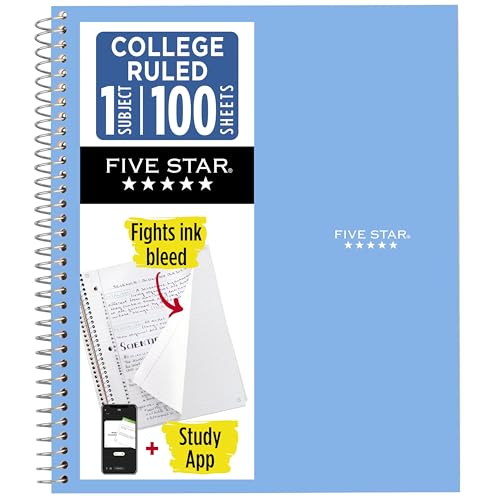
College ruling places more lines on a page and is a practical default for lecture notes, office notes, and detailed writing. The Five Star full-size college-ruled models, the Five Star compact model, Yeplan, and the Orange notebook listing all document college-ruled paper. Among the selected products, the Five Star 1-Subject College Ruled, 100 Sheets provides a broad combination of full-size writing space and organization features, while the Five Star Small 1-Subject College Ruled, 80 Sheets is more suitable when carrying size matters.
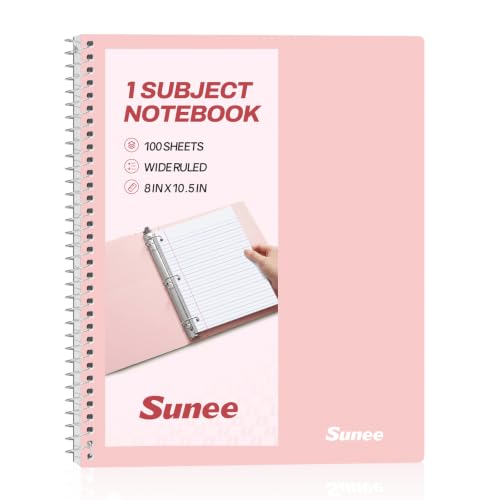
Wide ruling leaves more space between lines. That can be useful for larger handwriting, younger writers, or notes that need room for annotations. The SUNEE wide-ruled notebook, Five Star wide-ruled notebook, Oxford Wide Rule notebook, Mead notebook, and C-Line notebook all document wide-ruled formats. Mead specifically describes its wider ruling as suitable for younger students, while the SUNEE and Five Star options add storage or digital features.
Graph ruling serves a different purpose. The SUNEE graph notebook is the selected option that documents graph paper, red margin lines, three-hole punching, pockets, and a water-resistant cover. It is a suitable match for mathematics, charts, diagrams, and technical layouts. Graph paper can also help with structured tables, but it may be less natural for pages made up mostly of ordinary paragraphs.
Match sheet count to the assignment
Sheet count indicates how much paper is available before replacement, but it is not the only measure of usefulness. The selected notebooks range from 70 to 100 sheets, with some listings describing double-sided pages or the resulting page count. The Five Star 100-sheet models and SUNEE 100-sheet models are appropriate when one subject will generate substantial notes. Their full-size pages also provide more surface area for handouts, diagrams, or extended classwork.
A 70-sheet model can fit a shorter course, a project, or a subject with lighter note requirements. Mead, C-Line, Oxford Wide Rule, and Yeplan occupy that simpler capacity range. Yeplan supplies multiple notebooks, so its total pack format may help households or students separating several subjects, though each individual notebook still has its own stated sheet capacity.
Perforation changes how completed work can be handled. Five Star, SUNEE, Oxford, C-Line, Mead, and Yeplan listings document perforated or micro-perforated pages. That feature is useful when pages need to be removed for submission or transferred elsewhere. Check the stated tear-out dimensions when page size matters, because a detached sheet may be smaller than the notebook’s outside dimensions.
Consider binder compatibility
Three-hole punching is valuable if notes eventually move into a standard three-ring binder. SUNEE, Oxford Wide Rule, C-Line, Mead, and Yeplan explicitly document pre-punched or three-hole-punched pages. This design supports a workflow in which active notes stay in the spiral notebook and completed pages move into a larger archive.
Not every selected notebook documents this feature. The Five Star models emphasize pockets, perforation, and digital study tools instead. If binder filing is essential, choose a listing that explicitly states three-hole compatibility rather than assuming that every spiral notebook uses the same page layout.
Look at storage and cover protection
Loose papers are easier to manage when the notebook includes pockets. The Five Star full-size and compact models document tough pockets, and the SUNEE models document double-sided pockets. These compartments can hold handouts or loose sheets that belong with the subject, although the listings do not establish a specific maximum load.
Cover material also affects the type of handling a notebook is designed to accommodate. Five Star and SUNEE list water-resistant plastic covers. Mead lists a coated cover, while Oxford Wide Rule lists a chipboard backer for writing support. The Orange notebook listing describes heavyweight sheets, inside pockets, and a spiral-bound format, but it is not included in this top 10 because the selected group offers stronger documented category variety and comparable or broader feature evidence.
A water-resistant cover may help protect notes from ordinary surface moisture, but it should not be interpreted as waterproof protection for the entire notebook. Similarly, a snag-resistant or coil-lock spiral addresses handling convenience, but the supplied evidence does not establish a specific durability lifespan.
Choose size for the way you carry it
Full-size notebooks around 8 by 10.5 inches or 8.5 by 11 inches provide conventional writing space and are well suited to classes, meetings, and desk work. The Five Star 100-sheet college-ruled notebook, Five Star wide-ruled notebook, SUNEE notebooks, Oxford Wide Rule, Mead, C-Line, and Yeplan are full-size choices based on their listed dimensions or sheet dimensions.
The Five Star Small notebook is substantially more compact at 4-3/8 by 7 inches. It is a suitable choice for quick reference notes, small bags, or situations where a full-size notebook is inconvenient. The trade-off is less writing area per sheet. Portability should therefore be weighed against how much information must fit on each page.
Final recommendation
Five Star 1-Subject Wide Ruled, 100 Sheets ranks first overall in this specification-based comparison under the published weighted criteria.
The Five Star 1-Subject College Ruled, 100 Sheets is the first overall specification-based choice among these best 1-subject spiral notebooks. It documents a broad mix of page capacity, college ruling, pockets, perforation, water-resistant cover protection, Spiral Lock wire, and Study App support. Those features make it a strong default for full-size school or work notes.
Choose the SUNEE 1-Subject Graph Ruled, 100 Sheets when diagrams and grids matter more than conventional lined writing. Select the SUNEE 1-Subject Wide Ruled, 100 Sheets or Five Star 1-Subject Wide Ruled, 100 Sheets for larger handwriting. Oxford Wide Rule and Mead are simpler binder-ready choices, while the Five Star Small model is the better fit for portability. For several separate subjects, Yeplan’s assorted-color pack offers a practical color-coding approach. Together, these are the top 1-subject spiral notebooks for matching format and features to a specific workflow rather than choosing by appearance alone.
Frequently Asked Questions
What should I look for in the best 1-subject spiral notebooks?
Start with ruling and sheet count, then check whether you need perforation, three-hole punching, pockets, a protective cover, or a compact size. College ruling suits dense notes, wide ruling gives handwriting more room, and graph ruling supports diagrams and grids. Verify that the listing explicitly documents any feature that is essential to your filing system.
Which selected notebook is suitable for math or diagrams?
The SUNEE 1-Subject Graph Ruled, 100 Sheets is a clear match because its listing identifies graph paper and also documents red margin lines, binder compatibility, perforation, pockets, and a water-resistant cover. Those features support structured writing and page organization.
Are wide-ruled notebooks better for large handwriting?
Wide ruling is generally the more suitable documented format for larger handwriting because it provides more space between lines. The Mead listing specifically identifies wide ruling as suitable for younger students. SUNEE, Five Star, Oxford Wide Rule, and C-Line also provide wide-ruled options, with different storage and cover features.
Do all spiral notebooks in this comparison fit a three-ring binder?
No. Three-hole punching is explicitly documented for SUNEE, Oxford Wide Rule, C-Line, Mead, and Yeplan. The Five Star listings emphasize pockets, perforation, and Study App features instead. If binder storage is required, select a product whose listing clearly states three-hole compatibility.
Which option is easiest to carry?
The Five Star Small 1-Subject College Ruled, 80 Sheets has the smallest documented sheet dimensions in the selection, at 4-3/8 by 7 inches. Its compact size favors portability, but it also provides less writing area than the full-size notebooks. Choose it when carrying convenience is more important than maximum page surface.