Buying Guide
Picking the best primary composition notebooks for grades K-2 is easier when the evaluation stays grounded in the specifications that affect handwriting practice. The options in this guide cover single notebooks, small multi-packs, and bulk classroom sets, so the right choice depends on how many students will use them and whether the goal is handwriting drills, story writing, or both.
Understanding Primary Ruling
Primary ruling is the defining feature of the best primary composition notebooks. A standard layout includes a solid top line, a dotted midline, and a solid baseline, with a 1/2-inch writing height that gives early writers room to form tall, short, and descending letters. When the ruling is paired with clear color cues, such as a blue top line and red baseline, students can quickly see where each part of a letter should sit. Every notebook in this guide uses this primary ruling, which is why it carries the highest weight in the scoring criteria.
Page Layout and Drawing Area
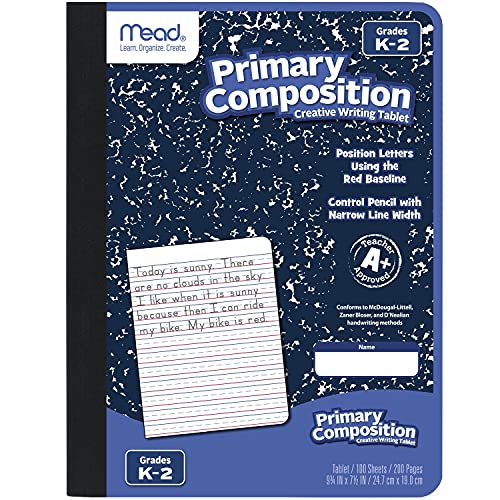
Many primary composition notebooks include a blank or unruled top section so children can illustrate a story before writing about it. This hybrid layout supports creative writing, vocabulary practice, and picture-supported sentence work. Models like the Mead Primary Journal, Oxford 4-Pack Animal Covers, ONAVIA 4-Pack, and Rosmonde 5-Pack include dedicated drawing space, while fully ruled formats such as the Mead Primary Composition Book focus purely on handwriting lines. Choosing between these layouts depends on whether the notebook will be used for journaling, story writing, or pure penmanship drills.
Binding and Durability
Sewn binding is the most common specification among the best primary composition notebooks because it keeps pages secure and allows the book to lay flat during writing. Several entries, including the Mead Primary Journal, Oxford 2-Pack, ONAVIA, and Taja 4-Pack, explicitly describe sewn or permanently bound construction. For classroom settings where notebooks travel between desks, backpacks, and home, a sewn binding reduces the risk of pages loosening over the school year.
Learning Reference Features
Reference aids such as alphabet charts, letter formation guides, and number references help students self-correct during independent writing time. Many products print these guides on the inside front or back cover so they remain visible without taking up page space. The Oxford 2-Pack and Oxford 4-Pack, Principal Lines 24-Pack, and Mead Blue Marble notebook all highlight reference content directly on the covers, which is helpful for both teacher-led instruction and at-home practice.
Page Count and Pack Options
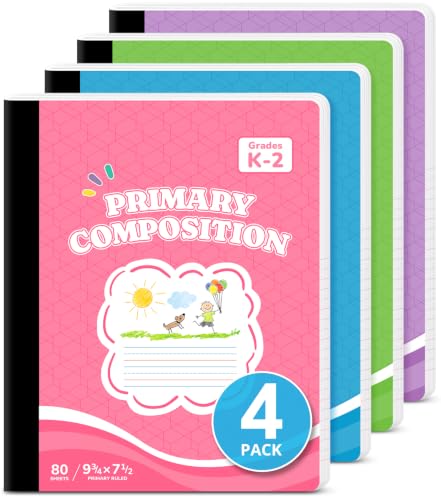
Most primary composition notebooks in this category contain 100 sheets, which is roughly 200 usable pages when both sides are written on. The Taja 4-Pack offers 80 sheets per notebook, which may suit shorter writing assignments but provides less capacity than the standard. Smaller packs work well for individual students, while larger packs are better suited for classroom supply lists.
Matching the Notebook to the Use Case
For story-based journaling, the Mead Primary Journal or ONAVIA 4-Pack combine drawing space with primary ruled lines. For classroom-wide adoption, the Amazon Basics 15-Pack or Principal Lines 24-Pack provide bulk quantities while still meeting the same primary ruling standards. Choosing by use case helps narrow the field quickly.
Final Recommendation
Oxford Primary Composition Notebooks, 4 Pack, Animal Covers ranks first overall in this specification-based comparison under the published weighted criteria.
The Mead Primary Journal Creative Story Tablet is the first overall specification-based choice among the best primary composition notebooks, because it combines a 100-sheet capacity, primary ruling, sewn binding, illustration space, and an alphabet reference in a single, well-documented design. For small classroom sets, the Oxford Primary Composition Notebooks 4-Pack and ONAVIA Primary Composition Notebook 4-Pack stand out as strong multi-pack options. For bulk school adoption, the Amazon Basics Primary Composition Notebook 15-Pack and Principal Lines 24-Pack deliver classroom-ready quantities while maintaining the same primary ruling standards. Together these selections represent the top primary composition notebooks available in 2026, balancing ruling layout, durability, reference features, and pack format across a range of classroom and home needs.
Frequently Asked Questions
Among the best primary composition notebooks, what makes a notebook a primary composition notebook instead of a standard composition book?
A primary composition notebook uses wide 1/2-inch ruling with a dotted midline, a solid top line, and a solid baseline, designed specifically for grades K-2 students learning letter formation. Standard composition books use narrower college or wide ruling aimed at older students.
Are primary composition notebooks good for handwriting practice?
Yes, primary composition notebooks are designed for handwriting practice. The wide ruling, dotted midline, and color-coded lines help young writers control letter height, spacing, and alignment during daily penmanship work.
Should I choose a notebook with or without picture space?
Choose a notebook with picture space if the notebook will be used for creative journaling, story writing, or vocabulary practice that pairs illustrations with sentences. Choose a notebook without picture space if the focus is purely handwriting drills, spelling lists, or handwriting worksheets.
How many sheets should a primary composition notebook have?
Most primary composition notebooks contain 100 sheets, which equals 200 usable pages when both sides are written on. Some options offer 80 sheets, which may suit shorter assignments but provides less capacity for full-year journaling.
What pack size works best for classroom use?
For individual classrooms, a 4-pack or 5-pack is typically sufficient. For school-wide adoption, a 15-pack or 24-pack is more practical. Bulk packs among the best primary composition notebooks still meet the same ruling and reference standards as single notebooks, so pack size mostly affects logistics rather than handwriting quality.