Buying Guide
Choosing the best 3-inch stem casters starts with the mounting interface, not the wheel diameter. A 3-inch wheel can suit furniture, carts, workbenches, cases, shelving, and equipment, but the stem must match the socket or threaded hole. The selected products use 3/8-inch-16 threaded stems, 1/2-inch-13 threaded stems, M12-1.75 metric stems, and 7/16-inch grip-ring stems. These systems are not interchangeable simply because the wheels share a diameter.
Measure the stem before comparing wheel features
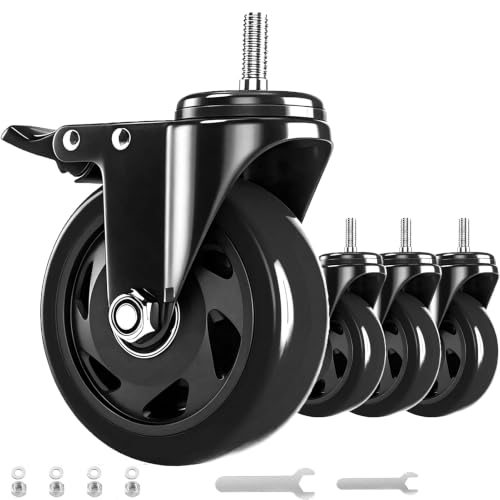
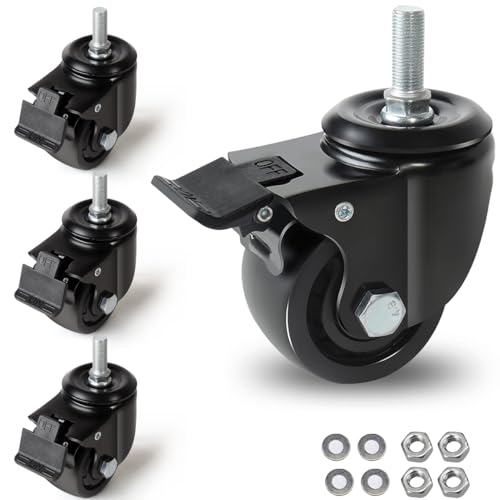
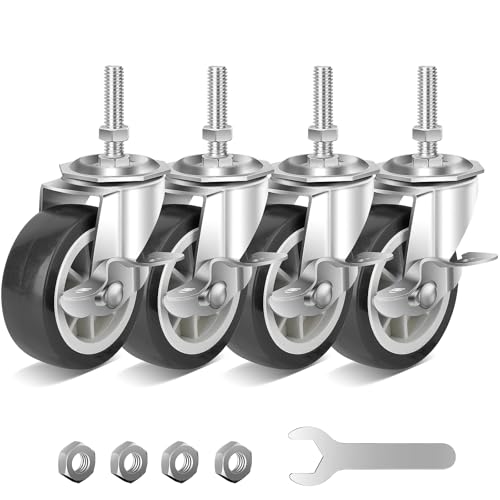
For a threaded caster, record the stem diameter, thread standard, and usable length. WOZESEIK, YUPEZOP, TAYLOON, NISUSK, HOLKIE, and Hirate document 3/8-inch-16 stems, but their lengths differ. WOZESEIK, YUPEZOP, and TAYLOON list 1-inch stems, while NISUSK and threaded HOLKIE list 1-1/2 inches. Hirate lists a shorter 0.79-inch stud. A length difference can affect thread engagement and clearance.
The 1/2-inch-13 products require a larger receiving thread. DICASAL uses an M12-1.75 metric stem. Metric threads and US threads are separate systems; verify the original caster or socket directly before ordering.
Grip-ring designs fit differently from threaded designs. HOLKIE uses a 7/16-inch by 1-3/8-inch grip-ring stem with plastic insert sleeves and recommends measuring the tube leg. This style is aimed at tubular-leg replacements such as carts, stools, mop buckets, and shop vacs. It should not be treated as a threaded substitute.
Match stated capacity to the complete assembly
A listing’s capacity helps screen products, but it is not a reason to ignore the frame, fasteners, socket, or load distribution. WOZESEIK and Finnhomy state the current price for a four-caster set. TAYLOON and YUPEZOP state 1,600-pound set capacities, while other products document more moderate capacities such as the current price for NISUSK and threaded HOLKIE.
Do not automatically divide a set rating by four and assume every caster will always carry an equal share. A movable object can shift its center of gravity, and uneven floors can reduce the practical contribution of one wheel. The mounting structure also needs to tolerate the load. For a heavy workbench or equipment cart, prioritize a documented capacity, steel housing, and a compatible stem.
Decide whether you need a brake
Locking and non-locking casters serve different purposes. The dual-locking products in this comparison secure both the wheel and the swivel. WOZESEIK, YUPEZOP, TAYLOON, DICASAL, and Hirate document locking features, though Hirate states that its brake locks caster rotation while the stem remains moveable for direction.
No-brake options can make sense for fixtures that need to roll freely. The no-brake HOLKIE model is a documented example. It is not the best match for a work surface that must remain fixed during use, but it avoids adding a locking mechanism where one is unnecessary.
The selected listings describe TPR, polyurethane, PE, PVC, and nylon wheel materials. TPR appears on the NISUSK and HOLKIE products and is described as quiet, non-marring, or floor-protective. Finnhomy and TAYLOON use polyurethane-related wheel descriptions, while DICASAL lists PVC wheels. Wheel material alone does not establish performance on every floor; surface condition, load, wheel width, and debris also matter.
If protecting hardwood, tile, laminate, or sealed flooring is important, favor a listing that specifically describes non-marring or floor-protective behavior and confirm the wheel is suitable for the environment. The supplied evidence does not establish a universal surface recommendation.
Check what comes in the package
Installation hardware can reduce a separate parts search, but it must match the application. WOZESEIK, YUPEZOP, and TAYLOON list nuts, washers, and tools. Finnhomy lists bolts, washers, and a spanner. Hirate includes threaded screw inserts, while the grip-ring HOLKIE set includes plastic insert sleeves.
Package contents do not correct a thread mismatch. Before choosing among the top 3-inch stem casters, confirm the stem standard, length, socket condition, wheel clearance, and whether the supplied hardware is appropriate for the equipment. Also check whether the listing describes a four-pack or a single caster.
Final recommendation
Among the top 3-inch stem casters, the ranked products differ under documented stem fit compatibility, stated load support, locking and swivel control, wheel and floor behavior, and installation and application range.
WOZESEIK 3-Inch 3/8-Inch Threaded Casters ranks first overall in this specification-based comparison under the published weighted criteria.
The final choice among the best 3-inch stem casters depends on the documented features that match your intended use.
WOZESEIK 3-Inch 3/8-Inch Threaded Casters is the highest-scoring returned product and the first overall specification-based choice. Its documented 3/8-inch-16 x 1-inch stem, dual locking, steel housing, ball-bearing swivel, included hardware, and stated 2,200-pound set capacity give it the broadest heavy-duty specification profile in this comparison.
YUPEZOP offers a similar US stem format with reinforced steel, double ball bearings, polyurethane rubber wheels, dual locking, and included hardware. Finnhomy is worth considering when polyurethane wheels and a 1/2-inch-13 stem are the better fit, but its supplied evidence does not identify a brake. TAYLOON offers a well-documented alternative with double ball bearings, PU rubber wheels, and double locking.
Choose the grip-ring HOLKIE when the equipment has tubular legs rather than threaded sockets. Choose the no-brake HOLKIE when free movement matters more than stationary control. NISUSK is a practical longer-stem option, DICASAL is the metric M12 choice, and Hirate is useful for cases and equipment where its shorter US-threaded stud and wheel-only brake match the application. Every selection should be verified against the existing mounting point before installation.
Frequently Asked Questions
How do I select the best 3-inch stem casters for a workbench?
Start by measuring the existing stem or socket. For a workbench that needs to stay still during use, look for a compatible threaded stem and a documented dual-locking brake. WOZESEIK, YUPEZOP, TAYLOON, and DICASAL describe locking features that can help provide stationary control. Then compare the stated load capacity with the complete bench, tools, frame, and mounting hardware rather than relying only on the wheel rating.
Are 3/8-inch-16 and 1/2-inch-13 caster stems interchangeable?
No. They have different diameters and thread specifications. The selected 3/8-inch products, such as WOZESEIK and NISUSK, require a matching 3/8-inch-16 receiving point. Measure the original stem and verify both diameter and thread pitch before ordering.
What is the difference between a threaded stem and a grip-ring stem?
A threaded stem screws into a compatible threaded socket or hole. A grip-ring stem, such as the one documented by HOLKIE, uses a ring and insert sleeve to secure the caster in a tube leg. The two systems require different mounting points, so a grip-ring caster is not a direct replacement for a threaded caster without a suitable compatible socket.
Are no-brake casters suitable for furniture?
They may be suitable when the furniture should roll freely and does not need to remain fixed. The no-brake HOLKIE model is listed for furniture, workbenches, and art tables, but the absence of a brake means it offers less stationary control than a dual-locking product. Consider the furniture’s use, floor slope, and stability before selecting this design.
Does a higher stated capacity always make a caster better?
No. Capacity is only one selection factor. The stem must fit, the frame must support the load, and the wheel material should suit the floor. A caster with a very high stated capacity is not useful if its thread is incompatible or the mounting point cannot safely carry the object. Treat published capacity as a comparison specification, not as a guarantee for every installation.