Buying Guide
Low-profile stem casters are selected less by appearance than by the relationship between thread fit, installation height, wheel diameter, and the load placed on the finished project. The best low-profile stem casters in this comparison range from small M6 furniture wheels to industrial leveling sets, so the right choice depends on the object being moved and the mounting hardware already available.
Start with the threaded stem
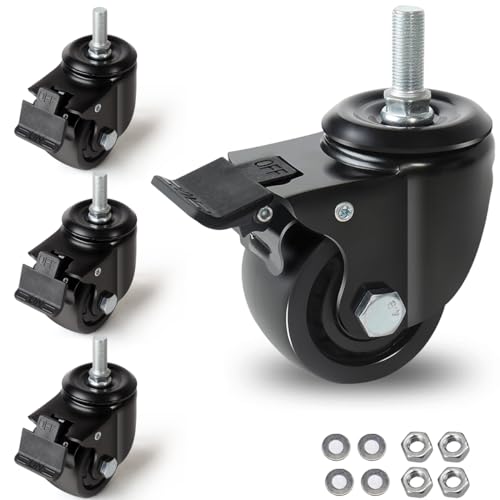
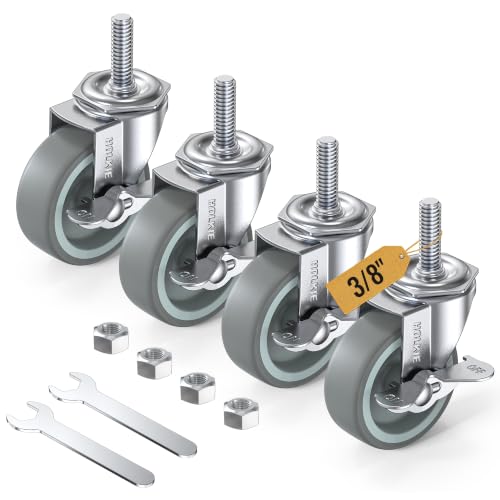
The stem is the compatibility point. A caster can have the right wheel diameter and still fail to install if its thread standard is wrong. The Service Caster and WIEYUNN options use 1/2-13 threads, while ANDUTEES and HOLKIE offer 3/8-16 versions. These are US-threaded specifications, but their lengths differ. A 1-inch stem is not automatically interchangeable with a 1-1/2-inch stem because the receiving hole, nut position, and available mounting depth may vary.
Metric choices need the same care. Luxinika documents an M6 x 15mm stem, YEEMIGO uses M8-1.25 x 25mm, and YAEMIKY specifies M8 x 15mm. Metric and UTS threads should not be treated as substitutes. Measure the existing stem or threaded insert, including diameter, pitch, and usable length. Luxinika is especially helpful for this step because its supplied information explicitly warns about metric and US-thread confusion.
HOLKIE’s retractable leveling set takes a different approach by supplying both M12-1.75 and 1/2-13 stems. That does not eliminate the need to measure, but it gives an equipment builder more installation flexibility than a single-standard set.
Match capacity to the whole load
Capacity figures are useful only when interpreted for the complete set and the actual distribution of weight. WIEYUNN lists the current price per caster and the current price for four. LSWhee lists the current price for its set, while HOLKIE’s retractable model lists the current price total. These are the most suitable selections for heavy workbenches, machinery stands, or equipment where the listing provides a substantial capacity margin.
For carts and furniture, the smaller options may be more appropriate. YEEMIGO lists the current price total, DICASAL lists the current price, YAEMIKY lists the current price, and Luxinika lists the current price. Do not select a small furniture caster solely because the wheel fits beneath the object. Include the object’s weight, contents, uneven loading, movement over thresholds, and the possibility that one caster may temporarily carry more than its proportional share.
The category includes both ordinary rolling sets and leveling designs. LSWhee and HOLKIE add adjustment or retractable functions that can help stabilize equipment after it is positioned. Those mechanisms are useful when a workbench or machine must be stationary during use, but they are more specialized than a basic swivel caster and may not be necessary for a lightweight table.
Decide how much locking control you need
A brake can mean different things. Some sets provide side brakes, while others describe dual locking that controls both the wheel and the swivel bearing. YEEMIGO explicitly documents a double-lock mechanism. WIEYUNN describes dual brakes, and YAEMIKY identifies side brakes. The distinction matters when you want to prevent both rolling and swiveling rather than merely stop the wheel from turning.
The Service Caster listing identifies its selected version as having no brakes. That can be a sensible choice for a cart that should reposition freely, but it is less suitable where the item must remain parked. DICASAL’s supplied information emphasizes swiveling and bearings but does not clearly establish a brake arrangement, so buyers who require positive locking should verify that point before ordering.
A four-brake arrangement gives every corner a locking point, while a mixed two-brake and two-free configuration can balance parking control with easier repositioning. Choose based on how often the object moves and whether it needs to stay fixed during use.
Check height, wheel size, and clearance
Low profile does not mean one universal height. Luxinika lists a 1.5-inch mounting height, LSWhee uses a 2-inch wheel with a compact design, and Service Caster lists a 2-3/4-inch overall height. Wheel diameter affects clearance over small obstacles, while mounting height affects the finished height of furniture or equipment. Measure from the mounting surface to the floor, not just the wheel diameter.
A small wheel may be better for a cabinet, shelf, desk, or under-bed project where every fraction of an inch matters. A larger wheel can be preferable for workbenches and carts, but its bracket and stem assembly may occupy more vertical space. The best low-profile stem casters should fit the available cavity without causing doors, drawers, shelves, or work surfaces to sit too high.
Consider wheel material and flooring
Wheel material influences the surfaces named in the listing. Luxinika and YEEMIGO use rubber-based designs, while DICASAL specifies polyurethane and Service Caster specifies polyolefin. YAEMIKY combines an acrylic center with polyurethane tread. Several listings describe non-marking, quiet, or hard-floor use, but these are product-description claims rather than independent test results.
For hardwood, laminate, tile, or other finished surfaces, look for the supplied non-marking or floor-protection language and inspect the tread design. For workshops and concrete floors, load rating and bearing construction may matter more than decorative appearance. WIEYUNN lists nylon wheels and double ball bearings, while the smaller furniture choices emphasize quiet or soft rubber-like materials.
Final recommendation
WIEYUNN 3-Inch Heavy-Duty Stem Casters ranks first overall in this specification-based comparison under the published weighted criteria.
The final choice among the best low-profile stem casters depends on the documented features that match your intended use.
WIEYUNN 3-Inch Heavy-Duty Stem Casters is the highest-scoring returned product and the first overall specification-based choice. Its 1/2-13 stem, 4400-pound total capacity, double ball bearings, and dual brakes make the documented feature set especially strong for heavy equipment and workbench applications. Among the top low-profile stem casters, LSWhee is the better fit when leveling and anti-vibration stability are central requirements, while HOLKIE’s retractable model is useful when dual stem standards and height adjustment matter.
For ordinary workbenches, ANDUTEES and Service Caster provide clearly documented US-threaded alternatives. HOLKIE’s 3/8-inch set is another practical choice when a 600-pound set capacity and floor-conscious TPR wheels fit the project. For furniture, YEEMIGO is a strong metric locking option, DICASAL offers polyurethane wheels with a 3/8-16 stem, and YAEMIKY adds clear styling with an M8 stem. Luxinika is the most compact selection for lighter M6 furniture applications.
Frequently Asked Questions
How do I choose the best low-profile stem casters for furniture?
Begin with the existing mounting thread and the height available beneath the furniture. For light furniture, Luxinika documents a 1-inch wheel, M6 x 15mm stem, 1.5-inch mounting height, and 90-pound total capacity. YEEMIGO and YAEMIKY are metric alternatives with M8 stems and higher listed capacities. Confirm the thread standard before considering color, brake layout, or wheel material.
Are metric and US-threaded stem casters interchangeable?
No. M6, M8, and M12 metric threads differ from US-threaded sizes such as 3/8-16 and 1/2-13. Luxinika specifically warns that metric and UTS standards are not interchangeable. Measure the diameter, pitch, and stem length, then compare those measurements with the caster listing. A similar-looking stem is not enough to establish a safe fit.
Do all selected casters lock both the wheel and the swivel?
No. Locking systems vary. YEEMIGO documents a double-lock mechanism, and WIEYUNN describes dual brakes. YAEMIKY lists side brakes, while Service Caster is identified as a no-brake version. If the object must resist both rolling and swiveling, select a listing that explicitly states both functions rather than assuming every brake provides the same control.
Are larger wheels always better for a low-profile project?
Not necessarily. Larger wheels may provide more clearance, but they can increase the finished height and require more room beneath the object. Small wheels such as the 1-inch Luxinika design can suit desks, cabinets, and shelves, while 2- or 3-inch designs may better match heavy carts and workbenches. Compare overall mounting height, wheel diameter, and available clearance together.
When should I consider leveling stem casters?
Choose a leveling design when the equipment must roll into position and then become stable for use. LSWhee documents a rotary leveling mechanism with an anti-vibration foot pad, while HOLKIE documents retractable casters with height adjustment. These features are more relevant to workbenches, machinery stands, and equipment than to a small coffee table that only needs occasional movement.