Buying Guide
The best adjustable clothes drawer organizers are not all the same type. Some are tension-mounted bars that divide an existing drawer, while others are fabric boxes with adjustable internal sections. Choosing between them starts with the drawer’s inside dimensions and the type of clothing you want to store.
Measure the drawer interior
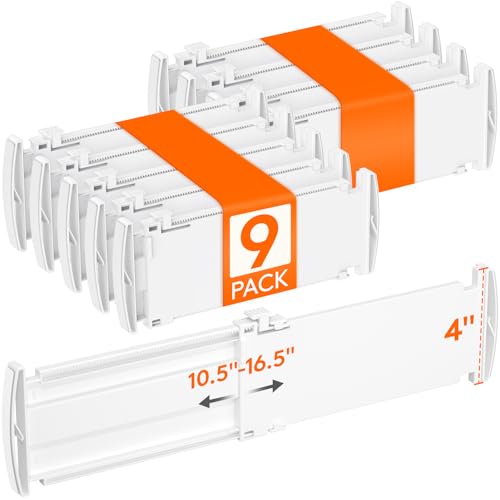
Measure the clear inside length or width where each divider will sit, rather than relying on the outside cabinet dimension. Also measure the usable height above the drawer bottom. The listed fit ranges vary substantially: the ROADNEX option begins at 10.2 inches, Lifewit’s 4-inch model covers 10.5 to 16.5 inches, and Vtopmart’s 6-inch model reaches 22.3 inches. A product that is too short will not hold tension, while one that is too long may not fit without forcing the drawer walls.
For box-style organizers, measure both length and width. Coorganisers lists approximate dimensions of 12.6 by 9.84 inches and a height of 3.94 inches for each unit. That is a different purchasing calculation from a single adjustable divider because the box occupies a defined footprint rather than expanding across the full drawer.
Choose height for the contents
A 2.5-inch divider, such as the mDesign design, creates a low visual boundary and may work well for smaller accessories or flatter folded items. Four-inch options from Vtopmart, Lifewit, and ROADNEX offer a typical dresser-divider profile for underwear, socks, and folded clothing. The 4.65-inch Fabsome design and 5-inch Lifewit model add more vertical separation.
Six-inch dividers are designed for deeper drawers or taller stacks. Lifewit and Vtopmart both document 6-inch products. These can help separate larger folded items, but they may be unnecessary in a shallow drawer. Vtopmart’s 4-inch set documents stacking for deeper drawers, which offers another way to build height when the drawer layout permits it.
Plastic and ABS dividers are the most common choices in this group. The listings describe shatter-resistant or durable plastic on several models, and silicone, rubber, or foam ends are intended to cushion contact with drawer walls. These pads are relevant for finished wood or painted drawer interiors.
Bamboo models from Fabsome and SpaceAid provide a natural material and spring-loaded adjustment. Their listings also describe foam or rubber contact surfaces. Bamboo may suit a visible open-drawer system, but the care instructions and material preferences in your home should guide the choice. The Coorganisers product uses non-woven fabric with PP boards and a solid bottom, making it more like a contained bin than a bare divider.
Decide how much customization you need
Simple tension dividers create broad lanes and are useful when you want to separate categories such as shirts, underwear, and socks. Sets with four, five, eight, or nine pieces can divide multiple drawers or create several parallel sections. Look for documented vertical and horizontal placement when you need to accommodate different drawer orientations.
The SpaceAid system adds inserts that make smaller sections, plus labels for identifying contents. Coorganisers allows each box to be divided into as many as seven compartments, while still allowing fewer sections or an open box. These designs offer more granular organization than a single spring-loaded bar, but they also use more interior space.
Review installation and repositioning
Most tension-mounted products in this selection are designed for tool-free setup. The general process is to adjust or extend the divider inside the drawer until the ends contact opposite walls. Several listings describe spring tension or silicone friction as part of the hold. Lifewit and Vtopmart document button-based retraction, while ROADNEX describes a central push button for unlocking and repositioning. mDesign uses a lever to adjust and lock its dividers.
Clean the drawer before installation when the listing recommends it, and avoid assuming that a divider will stay secure in every surface or load condition. The supplied evidence supports the adjustment mechanisms and protective pads, but it does not establish a universal holding capacity or performance result.
Match the set size to the project
A larger pack may be helpful when organizing several dresser drawers at once. Lifewit offers a nine-piece 4-inch set, while Vtopmart and ROADNEX offer eight-piece 4-inch sets. Smaller four-piece packs can be appropriate for one large drawer or a limited compartment plan. Box organizers work differently: Coorganisers supplies four units, each with its own adjustable internal grid.
Final Recommendation
Vtopmart 6-Inch Tall Drawer Dividers, 8 Pack ranks first overall in this specification-based comparison under the published weighted criteria.
The final choice among the best adjustable clothes drawer organizers depends on the documented features that match your intended use.
Lifewit 6-Inch Tall Drawer Dividers, 9 Pack is the highest-scoring returned product and the first overall specification-based choice. Its combination of 6-inch height, slim 0.4-inch construction, silicone protection, automatic locking, and an 11.5- to 18.5-inch fit range makes it a well-rounded option for deep clothing drawers.
The top adjustable clothes drawer organizers also include Vtopmart’s 6-inch set for a broader length range, Lifewit’s 5-inch set for long drawers, and Vtopmart’s 4-inch set for stackable flexibility. For a natural finish, Fabsome or SpaceAid offers bamboo construction; for contained folded-shirt compartments, Coorganisers is the distinct box-style choice. Measure first, then choose height and configuration based on the clothing categories you need to separate.
Frequently Asked Questions
Among the best adjustable clothes drawer organizers, are adjustable dividers or compartment boxes better for clothes?
Adjustable dividers preserve more of the drawer’s open area and let you position sections across the drawer. Compartment boxes such as Coorganisers create contained spaces for folded shirts, leggings, socks, or scarves. Choose dividers for flexible lanes and boxes when you prefer individual compartments.
How do I choose between 4-inch and 6-inch dividers?
Use the drawer’s usable interior height and the height of the folded items as the starting points. Four-inch models suit many standard dresser layouts, while 6-inch models are documented for taller or deeper drawer arrangements. A taller divider is not automatically better if it interferes with the drawer opening or closing.
The selected spring-tension dividers describe tool-free installation. mDesign uses a lever, while other models use a top or central button for adjustment or release. The listings do not support assuming that every drawer surface will provide identical grip, so measure and follow the product’s installation instructions.
Should I use bamboo or plastic?
Bamboo models provide a natural material and spring-loaded adjustment, while plastic and ABS models offer slim profiles and documented silicone or rubber contact pads on many products. The better choice depends on your preferred finish, drawer dimensions, and whether you want a low-maintenance wipeable material.
How much should the drawer be measured before ordering?
Measure the inside length or width where the divider will sit, the usable height, and, for box-style products, the full footprint. Compare those measurements with the listing’s stated range rather than using the dresser’s outside dimensions. This is particularly important because the selected models range from compact standard-drawer fits to products extending beyond 22 inches.