Buying Guide
Choosing among the best adjustable flatware organizers starts with the drawer, not the tray. Measure the interior width, front-to-back depth, and usable height, including any hinges, runners, or obstructions. Compare those measurements with both the organizer’s collapsed and expanded dimensions. A tray that fits only at its maximum setting may leave little room for adjustment, while one that is too tall can prevent the drawer from closing.
Match the organizer to drawer shape
Width-only organizers are often sufficient when the drawer has a familiar front-to-back dimension. The Lifewit Extra Large model, for example, expands from 13 to 22.4 inches wide and is 15 inches deep. The Oridom tray is a better compact option, with a 10.04-to-15.5-inch width range and a 13.98-inch length.
Two-way models are more adaptable when drawer proportions vary. Homecor adjusts from 13.2 to 22 inches wide and from 14.5 to 19 inches deep. The bidirectional Lifewit model expands from 12 to 20.5 inches wide and from 11.3 to 19.4 inches deep. Spaclear also changes depth as well as width, making it useful for drawers where a standard tray would leave an awkward gap.
Decide how many compartments you need
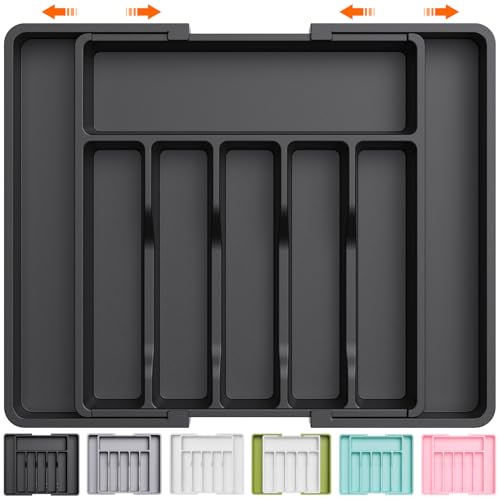
Count the categories you actually use. A basic flatware setup may need separate spaces for forks, spoons, knives, and teaspoons. Larger cooking tools such as spatulas, tongs, or whisks need wider or expandable sections. Homecor documents nine compartments plus two removable knife inserts, while Vtopmart expands from six to nine compartments and includes labels for common cutlery.
The best adjustable flatware organizers are not necessarily the ones with the highest compartment count. A compact five-to-seven-compartment tray can be easier to use in a small drawer, while a nine-compartment model may provide better separation in a wide drawer. Check whether the listed sections are all standard-width slots or whether some are intended for larger utensils.
Choose bamboo or plastic
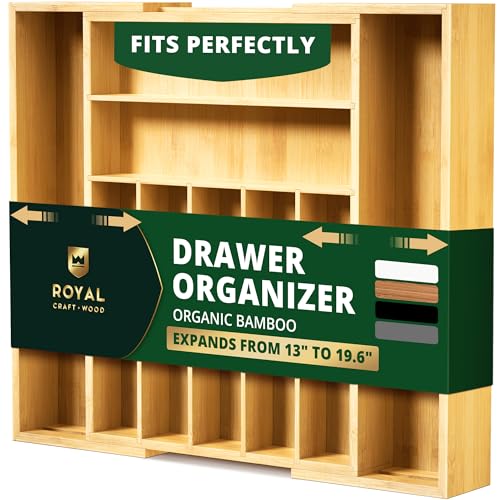
Bamboo trays bring a natural appearance and include several configuration options in this comparison. Umilife uses a 2.5-inch-high bamboo design with curved grooves, while Purawood specifies water-resistant moso bamboo. Oridom and Pipishell also document bamboo construction and damp-cloth or warm-water cleaning guidance.
Plastic organizers are generally easier to rinse and are often described as BPA-free. Spaclear specifies food-grade, BPA-free PP that resists moisture, and Ukeetap lists BPA-free waterproof plastic. Lifewit’s plastic models also specify BPA-free PP. However, several plastic listings advise hand washing or warn against dishwasher use, so do not assume that a rinse-clean surface is dishwasher safe.
Look for movement control
An organizer can be correctly sized and still shift when the drawer opens. Anti-slip feet or pads are therefore useful specification details. Homecor, Spaclear, Vtopmart, and Umilife document feet or pads intended to reduce movement. The bidirectional Lifewit organizer specifies non-slip bases on all bottom corners. Buckle structures and smooth sliding rails can also help keep adjustable sections aligned.
Products without documented anti-slip features may still fit securely in a full drawer, but the supplied evidence does not establish that. If movement is a priority, favor a model with named pads, feet, or a buckle system rather than relying on a general stability claim.
Check access and cleaning requirements
Grooved edges can make shallow compartments easier to reach. Spaclear, the bidirectional Lifewit model, Lifewit’s extra-large tray, Umilife, and Oridom all document groove or curved-edge details intended to improve access. These features are most relevant when the drawer is deep or the tray sits below the countertop.
Cleaning instructions vary. Many models recommend rinsing with water or wiping with a damp cloth, followed by air drying. Spaclear specifically says it is not dishwasher safe. Lifewit’s plastic models also advise against dishwasher cleaning. Bamboo models call for limited moisture and drying, so follow the listed care method rather than soaking them.
Consider special storage needs
If knives are part of the drawer layout, Homecor is the clearest documented choice because it includes two removable inserts for up to eight blades. If you need a tray for a very wide drawer, Ukeetap reaches 21 inches and Lifewit Extra Large reaches 22.4 inches. For a deep drawer, Umilife’s 19-inch version is a specialized alternative, although it is separate from the standard-width Umilife model and requires a large drawer.
Remember that these are specification-based comparisons, not hands-on tests. Dimensions, materials, compartment counts, and care instructions come from the supplied public listing data. Confirm the current product page details and measure your drawer before purchase.
Final recommendation
Homecor Large Expandable Silverware Organizer ranks first overall in this specification-based comparison under the published weighted criteria.
The final choice among the best adjustable flatware organizers depends on the documented features that match your intended use.
Homecor Large Expandable Silverware Organizer is the highest-scoring returned product and the first overall specification-based choice. Its two-way adjustment, nine compartments, removable knife inserts, and non-slip feet make it the most complete option for a large mixed cutlery drawer. Among the top adjustable flatware organizers, the bidirectional Lifewit model is the most specification-aligned alternative when depth adjustment is especially important. Choose Spaclear for a medium drawer with documented anti-slide features, Umilife for a higher bamboo tray, Vtopmart for labeled organization, or Oridom when compact dimensions are the priority.
Frequently Asked Questions
How should I measure for the best adjustable flatware organizers?
Measure the drawer’s usable interior width, depth, and height. Compare those figures with the organizer’s minimum and maximum width, depth, and listed height. Leave room for the drawer hardware and confirm that the tray does not obstruct closing. For example, Spaclear requires at least 9.5 inches of width and 12.6 inches of depth, while Vtopmart lists minimum interior dimensions of 11.4 by 14.4 inches.
Are bamboo or plastic flatware organizers easier to clean?
The answer depends on the care instructions for the specific model. Plastic trays such as Spaclear, Ukeetap, and Lifewit are described as rinse-clean, but their listings advise hand washing or avoiding the dishwasher. Bamboo trays such as Oridom, Pipishell, Umilife, and Purawood call for wiping or limited water exposure followed by drying.
Which selected organizer is best for knives?
Homecor is the clearest choice from the supplied evidence because it includes two removable knife inserts with protected slots for up to eight blades. Other selected trays may have compartments suitable for knives, but their listings do not document dedicated knife blocks or inserts.
Do adjustable trays stay in place?
Some selected products document anti-slip feet, pads, or bases. Homecor, Spaclear, Vtopmart, Umilife, and the bidirectional Lifewit organizer specifically list movement-control features. For other models, the supplied evidence does not confirm anti-slip hardware, so drawer fit and a full, balanced layout become more important.
Can these organizers hold items besides flatware?
Yes. The selected listings describe uses in bedrooms, offices, living rooms, bathrooms, or utility areas for items such as jewelry, stationery, cosmetics, tools, and small accessories. Check each organizer’s compartment sizes and material-care instructions before using it for a different category.