Buying Guide
Selecting the right air conditioning manifold starts with matching the tool to the refrigerants you handle most often. Manifolds are not universal by default, and using the wrong set can lead to cross-contamination, inaccurate readings, or damaged equipment. Before committing to a purchase, consider the refrigerant types, valve configuration, hose length, and long-term maintenance requirements that fit your workflow.
Sizing and Capacity
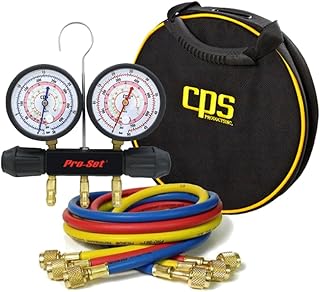
Air conditioning manifolds come in two primary valve configurations: two-valve and four-valve. A two-valve manifold is the traditional setup with a single high-side and low-side port, plus a vacuum or utility port. These sets are lighter, simpler to maintain, and ideal for standard residential HVAC or automotive AC service. A four-valve manifold adds extra ports that let you keep a vacuum gauge or additional service hose attached without disconnecting your primary lines. If you frequently alternate between charging, recovery, and deep vacuum work, a four-port design can speed up your workflow and reduce leak points from repeated threading.
Gauge size also matters for readability. Compact 2.5-inch dials are common on lightweight kits and work well in tight engine bays or attic installations. Larger 3-inch or 3-1/8-inch gauges are easier to read from a distance and often appear on professional-grade mechanical sets. Digital manifolds replace analog dials entirely, displaying exact pressures and sometimes superheat or subcooling calculations on a backlit screen. If you service systems with very narrow target pressures, a digital set or a large-face analog gauge reduces parallax error and improves repeatability.
Feature Tradeoffs
The main tradeoff in the best air conditioning manifolds is digital precision versus mechanical simplicity. Digital manifolds offer wireless connectivity, data logging, and automatic calculations that reduce manual math in the field. They typically current Amazon listing detail more and require battery management, but they save significant time on commissioning and troubleshooting. Mechanical manifolds, by contrast, have no batteries to fail, survive rough handling better, and are often preferred by technicians who work in extreme temperatures where electronics can lag or shut down.
Hose length is another practical consideration. Five-foot hoses are standard and manageable for most automotive and residential tasks. Sixty-inch hoses give you more reach across large rooftop units or cramped mechanical rooms, but they take longer to evacuate and can be cumbersome in small vehicles. Look for hoses with reinforced cores and ball-valve shutoffs at the coupler end; these let you isolate the manifold from the system without losing the charge in your hoses.
Refrigerant compatibility is critical. Many sets now cover R134a, R410A, R404A, and R22 in one box. However, newer automotive systems use R1234yf, and emerging residential equipment is moving toward A2L blends like R32 and R454B. If you want a single manifold to last through industry transitions, verify that the seals, hoses, and gauge scales are rated for the specific refrigerants you expect to encounter. Adapters can bridge some gaps, but dedicated A2L manifolds often include safety features and pressure scales tailored to mildly flammable refrigerants.
Installation and Setup Considerations
Before using any new manifold, purge the hoses with dry nitrogen or the target refrigerant to eliminate moisture and air. Moisture in a manifold set can freeze in expansion valves and corrupt system readings. When attaching couplers, thread them by hand first to avoid cross-threading Schrader valves, then tighten only until the seal seats. Over-tightening deforms gaskets and leads to slow leaks that are difficult to diagnose.
If your set includes a vacuum pump, confirm that the pump oil is clean and at the correct level before each evacuation. Contaminated oil reduces pull-down speed and can introduce moisture back into the system. For digital manifolds, calibrate pressure sensors according to the manufacturer schedule—usually once a year or after severe drops. Store analog sets in a case or bag that protects the gauge faces from impacts, because bent needle pointers are a common cause of inaccurate readings.
Maintenance and Reliability Signals
Reliable air conditioning manifolds share a few construction traits. Brass or aluminum valve bodies resist corrosion better than zinc alloys. Replaceable valve cores in the manifold body extend service life, because you can rebuild the valve instead of replacing the entire set. Hoses should have a burst pressure rating well above the maximum working pressure of the refrigerants you use, and couplers should include manual shutoffs to prevent accidental discharge.
When comparing reviews, look for patterns rather than isolated complaints. A few reports of leaking couplers may indicate user error, but repeated mentions of hose kinking, gauge fogging, or valve stiffness suggest a design or batch issue. Pay attention to reviews that mention longevity over six months or more; initial impressions are useful, but HVAC tools are judged by how well they hold calibration through seasonal temperature swings and repeated pressurization cycles.
How to Compare Reviews
Start by filtering for reviews that mention your specific use case—automotive, residential split systems, or commercial refrigeration. A manifold that excels on car AC may lack the hose length or refrigerant scale needed for a residential heat pump. Look for feedback on gauge accuracy verified against known reference pressures, and note whether reviewers mention ease of zeroing analog needles or recalibrating digital sensors.
Review volume matters for statistical confidence. A product with thousands of ratings and a 4.3 average is often more telling than a perfect 5.0 from a handful of early buyers. If a professional-grade set has fewer total reviews but comes from an established HVAC brand, weigh the brand’s trade reputation alongside the star count.
Final Recommendation
If you need an all-in-one solution for a home shop or light commercial use, the top-ranked pump-and-gauge combo delivers exceptional value and proven reliability without hunting for separate components. For technicians who want the most trusted mechanical platform, the premium two-valve set from the legacy brand offers decades of field-proven accuracy. The wireless digital manifold is the clear upgrade for advanced diagnostics, superheat calculations, and modern workflow efficiency.
DIYers and occasional users should look at the budget three-way sets that include adapters for the most common refrigerants; they provide everything needed for a single seasonal recharge without over-investing in trade-specific features. If your work is moving toward newer A2L or R1234yf systems, prioritize the modern refrigerant picks that ship with compatible scales and hoses. By aligning valve count, refrigerant range, and display type with your actual workload, you can choose a manifold that remains accurate and reliable across years of service calls.