Buying Guide
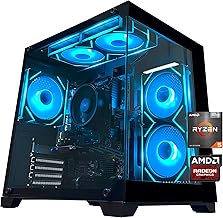
Choosing among the best AMD Ryzen 5 tower computers starts with understanding how you will use the machine. These systems range from productivity-focused desktops with integrated graphics to mid-range gaming towers with discrete video cards. Because the Ryzen 5 family spans several generations and core configurations, the right tower for your desk depends on matching the processor, memory, storage, and graphics to your actual workload.
Understanding Ryzen 5 Processor Tiers
AMD Ryzen 5 chips generally ship with six cores and twelve threads, though newer 8000-series models can offer eight cores. A Ryzen 5 5500 or 5600 provides excellent value for web browsing, office suites, and light content creation. If you need stronger built-in graphics without a separate GPU, the Ryzen 5 5600G or 8500G includes Radeon integrated graphics that can drive multiple monitors and handle casual gaming. For users who want to edit video or compile code, a 5600GT, 5600X, or newer 9000-series Ryzen 5 offers higher clock speeds and better single-threaded performance. Before you buy, check whether the tower uses a standard desktop processor or a tuned variant, because that determines your upgrade path later.
Memory and Storage Tradeoffs
Memory capacity and speed directly affect how responsive an AMD Ryzen 5 tower feels. Sixteen gigabytes of RAM is the practical minimum for modern multitasking, and DDR5 models offer a modest future-proofing advantage over DDR4. If you frequently keep dozens of browser tabs open alongside spreadsheets or creative tools, prioritize configurations with 16GB or more.
Storage type matters just as much. A 512GB NVMe SSD is acceptable for a basic setup, but a 1TB NVMe drive gives you room for larger game libraries, video projects, and local file archives without immediate upgrades. Some towers pair a smaller internal SSD with external storage, which works for backups but is not as fast as a single large internal drive. If you plan to store media or games locally, lean toward 1TB options.
Graphics: Integrated vs. Discrete
Not every AMD Ryzen 5 tower computer needs a dedicated graphics card. Systems with Ryzen 5 5600G or 8500G APUs run quietly and work well for office tasks, streaming video, and light photo editing. However, if you intend to play modern titles at 1080p or edit high-resolution video, a discrete GPU such as the Radeon RX 6500XT, RX 6600, or GeForce RTX 3050 provides significantly better frame rates and rendering performance. Keep in mind that discrete cards add heat and power draw, so verify that the included power supply has enough wattage and the case has adequate airflow.
Case Size and Expansion
Tower dimensions vary even within the mid-tower category. A compact case saves desk space but may limit future GPU upgrades or additional hard drives. Larger towers typically offer better cable management, more fan mounts, and easier access for maintenance. If you plan to add components later, look for standard ATX or micro-ATX layouts with spare drive bays and PCIe slots. Also consider front-panel connectivity: USB-C, multiple USB-A ports, and audio jacks improve daily usability.
Setup and Installation Considerations
Most prebuilt AMD Ryzen 5 towers arrive with Windows 11 installed, but you should still plan for initial setup. Connect your display to the correct video output—use the motherboard ports for integrated graphics and the graphics card ports for discrete GPUs. Update the chipset drivers and BIOS soon after unboxing to ensure stability and compatibility with the latest Ryzen features. If your system includes WiFi 6 or Bluetooth 5.2, attach the included antennas for the strongest wireless signal. Finally, remove any temporary packing foam inside the case that protects components during shipping.
Maintenance and Reliability Signals
Keeping a tower reliable over time requires simple maintenance. Dust filters should be cleaned every few months to prevent thermal throttling, especially in gaming builds with dedicated graphics. Check that case fans spin properly and that the system does not run unusually loud under load. From a buying perspective, review volume and average rating are useful reliability signals. A product with hundreds of reviews and a consistent four-star or higher average usually indicates fewer defects and better seller support than a listing with only a handful of ratings. Read recent reviews specifically for notes on packaging quality, dead-on-arrival rates, and how the seller handled returns.
How to Compare Reviews Effectively
When reading customer feedback on AMD Ryzen 5 desktop towers, focus on verified purchase reviews that mention long-term use. Look for patterns rather than isolated complaints: if multiple buyers mention loose cables or noisy fans, those are likely manufacturing trends. Pay attention to whether reviewers used the stock configuration or upgraded parts, because upgrades can change thermal and power behavior. Also note the context of each review—a budget gaming tower should be judged on value and 1080p performance, not compared against high-end workstations.
Final Recommendation
If you want the most balanced AMD Ryzen 5 tower for mixed gaming and productivity, the models with a Ryzen 5 5600GT, 16GB of memory, and a 1TB NVMe SSD offer the best combination of speed and storage headroom. For users who need a straightforward office or family computer, a Ryzen 5 5600G or 8500G system with integrated graphics keeps current Amazon listing detail reasonable while still driving multiple monitors. Budget-focused gamers should look for towers pairing a Ryzen 5 5500 with an RX 6500XT or RX 6600, which deliver solid 1080p gameplay without requiring aftermarket upgrades. If you prefer a recognizable brand with proven support channels, the HP Pavilion options provide reliable daily performance and generous USB connectivity. Match your pick to the heaviest task you plan to run, and choose a case size that leaves room for the upgrades you might want two or three years from now.