Buying Guide
Choosing the right arc welding nozzle is not simply about threading on the first replacement that looks close. The nozzle dictates gas coverage, affects bead appearance, and determines how much spatter you will fight during a session. Below is a practical guide to sizing, features, setup, and maintenance so you can match a ranked product to your actual workflow.
Sizing and Capacity
Nozzle sizing breaks down into two measurements: the bore diameter and the thread or mounting style that mates to the torch neck. For MIG welding, common bore sizes range from 1/2 inch to 5/8 inch, with larger bores offering better gas coverage on thick material and smaller bores improving visibility on tight joints. Wire diameter also matters. A .030-inch contact tip and nozzle pairing is standard for light automotive or sheet-metal work, while .035-inch setups handle thicker steel and higher deposition rates. If you run .023-inch wire for thin-gauge tasks, confirm the nozzle throat clears the smaller tip without restricting gas flow.
TIG welding uses a different vocabulary. Alumina nozzles, often called cups, are sized by the bore in sixteenths of an inch or by standard numbers such as #5 through #12. Larger cups provide broader shielding gas coverage for titanium or stainless steel, while smaller cups improve electrode visibility on intricate joints. The ranked TIG consumable kit covers WP-17, WP-18, and WP-26 torches, so verify your torch series before ordering.
Feature Tradeoffs
Anti-spatter coatings, brass versus copper construction, and one-piece versus two-piece designs each carry tradeoffs. Coated nozzles, like the ceramic-coated set in the rankings, resist spatter buildup and can extend cleaning intervals. However, once the coating eventually wears, the nozzle must still be replaced. Plain copper nozzles transfer heat efficiently and are often cheaper per piece, but they require more frequent scraping or dipping in nozzle gel.
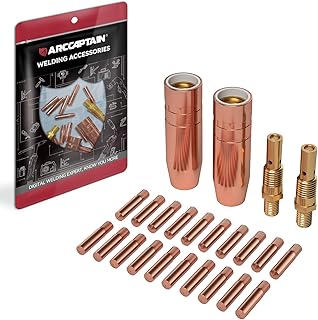
Kits that bundle the nozzle, diffuser, and contact tips simplify inventory. If you run a single shop with uniform torches, a bundled kit reduces the risk of mismatched parts. On the other hand, buying standalone nozzles makes sense if you already stock diffusers and prefer to swap only the wear item.
Installation and Setup Considerations
Installing a MIG nozzle should take seconds, yet small errors cause big problems. Always thread the nozzle hand-tight; over-torquing can distort the bore or damage the diffuser threads underneath. Before welding, trigger the gun briefly without wire feed to verify consistent shielding gas flow. Turbulent or lopsided flow usually means the diffuser O-ring is misaligned or the nozzle seat is dirty.
When switching between flux-core and solid wire, remember that flux-core nozzles are typically narrower or have a different internal taper because they do not need to direct shielding gas. Using a gasless nozzle with solid wire and shielding gas will produce porous welds, while using a standard gas nozzle for flux-core creates unnecessary bulk and poor access.
Maintenance and Reliability Signals
Nozzle life depends on amperage, wire condition, and how aggressively you clean spatter. A disciplined maintenance routine includes clipping the wire cleanly, keeping the contact tip tight, and dipping or wiping the nozzle before spatter layers fuse solid. Nozzle gel, such as the highly rated maintenance essential in the rankings, creates a thin barrier that makes spatter easier to wipe away. Do not rely on gel alone; periodic reaming with a tip cleaner keeps the bore round and the gas stream laminar.
Reliability signals in user reviews often mention thread quality and bore consistency. Look for feedback that says the nozzle seats squarely and does not wobble under vibration. Reviews complaining of early burn-through or cracking often point to thin-wall construction or poor copper alloy quality. A nozzle that arrives with dings from shipping is a red flag for weak packaging and possibly inconsistent manufacturing.
How to Compare Reviews
When reading reviews for arc welding nozzles, prioritize comments that name the torch model and wire size. Generic five-star ratings help, but detailed fitment notes confirm real-world compatibility. Pay attention to complaints about gas leaks at the diffuser joint; this usually indicates poor machining tolerances. Also watch for mentions of bore enlargement after a few hours of use, which suggests soft material or thin walls.
Review count matters differently across categories. A standalone nozzle with seventy ratings can be more telling than a kit with thousands of ratings if those seventy reviews specifically discuss nozzle longevity. Cross-reference the negative reviews to see whether issues stem from user error, such as forcing the wrong thread pitch, or from genuine defects.
Final Recommendation
If you need a direct replacement for a Lincoln Magnum 100L or Tweco Mini gun, the top-ranked .035-inch kit offers the best balance of fit accuracy, rating strength, and complete consumable coverage. For MB15 15AK torches, the best value kit in .030-inch delivers a proven bundle with enough reviews to confirm consistent quality. TIG welders should look at the comprehensive 71-piece set, which covers multiple torch series and includes both standard alumina nozzles and gas-lens hardware.
Those who fight heavy spatter should consider the anti-spatter coated nozzle set or pair a standard copper nozzle with a quality nozzle gel to extend service intervals. If you run flux-core wire exclusively, choose a gasless-specific nozzle rather than adapting a standard gas nozzle. Finally, high-volume shops will get the most economy from the bulk 14-pack replacement kits, while occasional hobbyists may prefer smaller sets to avoid shelf corrosion on unused spares.