Buying Guide
Artist trading cards are miniature works of art measuring 2.5 by 3.5 inches, created to be swapped and collected rather than sold. Because the format is so small, every surface choice matters. The right paper or card stock can elevate a simple sketch into a keepsake, while the wrong weight or texture can cause buckling, bleeding, or cracking during transit. This guide walks through the practical considerations that separate a satisfying purchase from a frustrating one.
Sizing and Capacity
The ATC standard is strict: each card must be 2.5 inches wide by 3.5 inches tall. Any product that arrives pre-cut to these dimensions saves you trimming time and guarantees your work will fit into standard trading-card sleeves, pocket pages, and storage boxes. If you choose a larger sheet and cut it down yourself, expect slight variations that may complicate swapping. When evaluating pack size, think in terms of projects rather than individual cards. A 10- or 20-sheet pack is perfect for a themed series or a small local swap, while a 100- to 120-sheet bulk pack is more economical for classrooms, workshops, or prolific traders. Remember that mixed-media and watercolor experiments often consume extra stock because of practice attempts, so buying a slightly larger count than you think you need is usually wise.
Surface Texture and Media Compatibility
Surface texture is the single biggest feature tradeoff when selecting artist trading cards. Smooth or vellum Bristol surfaces are ideal for pen and ink, marker, colored pencil, and graphite because they allow fine lines and minimize fiber drag. If you work primarily with dry media, look for a smooth or vellum finish rated around 250 to 300 GSM. Cold-press watercolor paper, on the other hand, has a pronounced tooth that holds pigment and water. It is essential if you plan to use wet media such as watercolor, gouache, or acrylic washes. A weight of 300 GSM or higher is preferable for wet techniques; lighter weights around 230 GSM can work for controlled washes but may warp without taping or stretching. Some artists prefer a middle-ground texture—slightly toothy but not heavily dimpled—for collage and stamping because adhesives and ink settle evenly without disappearing into deep valleys.
Paper Weight and Rigidity
Paper weight directly affects durability and mailability. Standard copy paper is far too thin for ATCs; cards need enough body to survive handling, sleeve insertion, and postal transit. In the metric system, 300 GSM is the threshold most experienced traders prefer. It resists bending, supports layered embellishments, and feels substantial in the hand. Heavier stocks such as 350 GSM are excellent for collages loaded with paper, fabric, or light dimensional objects, but they can add bulk if you are mailing dozens at once. If your style is minimalist or relies on delicate ink work, a 250 to 300 GSM sheet will keep the card lightweight while still feeling professional.
Color and Finish Options
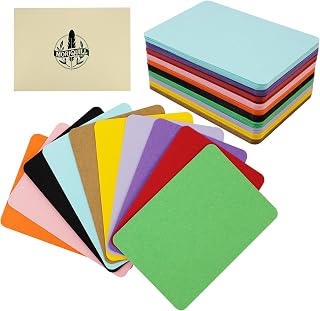
White or off-white remains the most versatile starting point because it does not shift the hue of your media. However, colored card stock can be a creative shortcut. Black or kraft bases make metallic pens and gel markers pop, while pastel backgrounds can unify a series thematically. Some packs offer ten or more colors in one bundle, which is useful for educators who want to assign color-coded groups or for artists who enjoy high-contrast swaps. Be aware that intensely dyed papers are sometimes less absorbent; test a small corner with your preferred medium before committing a full design.
Edge Treatments and Presentation
Pre-rounded corners give artist trading cards a finished, store-bought appearance and prevent the dog-earing that can occur during swaps. If you prefer a more organic look, deckled or hand-torn edges add a fine-art quality, though they can catch on card sleeves if the fibers are loose. Straight-cut corners are the most common and sleeve-friendly option, but they benefit from a quick pass with a corner rounder if you plan to store the cards in tight-fitting pockets.
Setup and Workflow Considerations
Before you begin a session, decide whether you will work on loose cards or tape them to a board. Watercolor and mixed-media artists often tape the edges of pre-cut cards to a flat surface to prevent curling as paint dries. If you use stamps, stencils, or die-cutting machines, confirm that your tools accommodate the 2.5 x 3.5-inch format. Some standard card-making dies are scaled for greeting cards and will not fit ATCs without adjustment. For postal swaps, prepare rigid mailers or card sleeves inside folded cardstock to prevent bending. Even the sturdiest paper will crease if mailed in a standard envelope without reinforcement.
Maintenance and Storage
Finished artist trading cards should be stored in acid-free sleeves or albums to prevent yellowing and surface abrasion. If your cards include wet media, allow at least 24 hours of drying time before sealing them in plastic; trapped moisture can lead to mold or ink transfer. Keep completed swaps away from direct sunlight and extreme humidity, especially if you used dye-based inks or organic embellishments such as pressed flowers. For your blank inventory, store unused sheets in a dry, flat drawer or portfolio. Humidity can cause pre-cut card stock to bow, which makes stamping and layering more difficult.
Reliability Signals and How to Compare Reviews
When shopping online, prioritize listings with several hundred reviews and an average rating above 4.5 stars. A high review count usually indicates that the manufacturer has maintained consistent sizing and paper quality across multiple production runs. Read recent critical feedback carefully; recurring complaints about miscut dimensions, warped packs, or inconsistent texture are red flags. Positive reviews that mention specific media—watercolor, Copic markers, embossing powder—are more useful than generic praise because they confirm the surface performs under real-world conditions. If a product has fewer than fifty reviews, treat its rating as preliminary and consider buying a small test pack before committing to a bulk order.
Final Recommendation
Choosing among the ranked artist trading cards comes down to your medium and output volume. If you draw or illustrate with fine-line pens and markers, the smooth Bristol surfaces at the top of the list offer the cleanest experience and easiest erasability. Watercolorists should gravitate toward the cold-press options rated at 300 GSM or higher; the added weight prevents the buckling that ruins small-format washes. For classrooms, clubs, or high-volume traders, the bulk packs of heavy card stock provide the lowest current Amazon listing detail per card and reduce the frequency of reorders. If you want your trades to stand out at an exhibition or dedicated swap event, consider the cotton deckled-edge option for its tactile elegance, or the multi-color assortment for instant visual variety. Match the paper to your technique, buy enough to avoid mid-project shortages, and always store your finished cards in archival conditions so they remain swap-worthy for years to come.