Buying Guide
Choosing the best bathroom door levers starts with the door preparation rather than the finish. Bathroom hardware in this comparison is generally a privacy lockset: it is intended to prevent casual entry, usually locks from the inside, and provides an emergency release from the outside. That is different from keyed entry hardware and should be treated as an interior privacy solution.
Confirm the privacy function
Most selected products use a button, thumb-turn, or turn piece on the inside. Schlage Latitude and Schlage Accent document push-button operation, while Kwikset Tustin and Kwikset Balboa use an interior turn-button arrangement. Copper Creek Avery and Amazon Basics Manchester also provide keyless privacy with an emergency release method. These systems are suitable when the goal is temporary privacy rather than keyed security.
The outside release is an important distinction. Some models include a pin-style tool, while others can be opened with a coin or flat screwdriver. Copper Creek Avery documents coin or screwdriver access, and the Kwikset models listed here include an emergency unlock tool. Before installation, identify where the release point is located and keep the appropriate tool accessible. A bathroom privacy lever should not be selected on the assumption that it functions like a keyed lock.
For a shared or commercial restroom, the MrArm Privacy Indicator Lever addresses a different need. Its red-and-green VACANT/IN USE display is intended to communicate occupancy visibly, and its larger commercial design is documented for public restrooms. That feature is unnecessary for most homes but useful where people need to know whether a room is occupied before trying the handle.
Measure door thickness and backset
The most common residential fit shown in this group is a door thickness of 1-3/8 inches to 1-3/4 inches. Schlage Latitude, Kwikset Tustin, Kwikset Balboa, Design House Springdale, Amazon Basics Manchester, and Probrico’s brushed-nickel lever all document that range. MrArm covers a wider 1-3/8-inch to 2-inch range, which supports some commercial applications.
Backset is the distance from the door edge to the center of the bore hole. Many selected levers support both 2-3/8-inch and 2-3/4-inch backsets. Measure the existing installation before ordering, especially if the door is older or has a less typical preparation. An adjustable latch can make replacement easier, but it does not eliminate the need to verify the door thickness and latch face.
Latch-face compatibility also matters. Copper Creek Avery is specifically described with a round-corner latch and is not intended for drive-in latch applications. Schlage Latitude includes both radius and drive-in faceplates, while Kwikset Halifax lists round, square, and drive-in options. These details can determine whether a replacement fits the existing edge preparation cleanly or requires additional work.
Check handing and installation details
A reversible lever can be installed on either a left- or right-handed door. This is documented for Schlage Latitude, Kwikset Tustin, Kwikset Balboa, Copper Creek Avery, Amazon Basics Manchester, and the other residential models selected here. Reversibility is especially useful when replacing one lever without changing the door or frame.
Installation claims should still be read carefully. Several products state that a screwdriver is sufficient, but the existing bore, latch opening, and strike alignment must be compatible. Schlage Latitude lists self-aligning screw holes, and its universal latch requires no manual adjustment according to the supplied evidence. Kwikset Halifax includes multiple latch-front options, while Probrico’s brushed-nickel model provides a printed step-by-step guide.
Do not assume that every standard-looking lever uses the same edge hardware. The Copper Creek Avery limitation against drive-in applications is a useful reminder to inspect the latch before buying. The goal is not merely to mount the rosette; the latch, strike, and privacy mechanism must work together.
Compare certification and construction evidence
ANSI and BHMA references can help separate documented hardware specifications from appearance alone. Schlage Latitude and Schlage Accent list Grade 2/AAA BHMA certification. Kwikset Tustin and Kwikset Balboa list BHMA grades, while Amazon Basics Manchester and Copper Creek Avery document Grade 3 certification or standards. MrArm is identified as a Grade 2 commercial product.
These grades should be interpreted in context. A commercial Grade 2 lever is not automatically the best choice for a home bathroom, and a residential Grade 3 lever may be more appropriate for a typical interior door. Certification is one input alongside fit, privacy operation, and the environment where the hardware will be used.
Construction details also vary. Schlage describes premium metal construction, Kwikset Halifax lists a dual-compression-spring chassis, and Probrico describes a heavy-duty design. Probrico also documents a 72-hour salt-spray finish test. These are supplied specifications, not independent test results from this comparison, so they should be used as documented differentiators rather than promises about service life.
Match the finish to the room
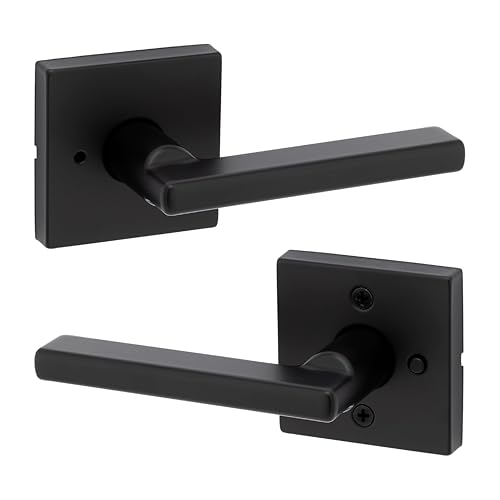
Finish is primarily a coordination decision. Satin nickel and brushed nickel work with many stainless, chrome, and light neutral fixtures. Matte black suits contemporary rooms and is available on Schlage Latitude, Kwikset Halifax, and Amazon Basics Manchester. Oil-rubbed bronze fits the more traditional or rustic direction represented by Design House Springdale. Satin chrome on MrArm is appropriate for its commercial setting, while polished brass on other available candidates would suit a classic interior but was not needed in this selected group.
Lever shape affects the visual result as well. Halifax uses a square-rose design, Springdale has a rustic profile, and the Schlage models offer distinct contemporary or curved styling. Select a shape that works with the existing hinges, faucets, towel hardware, and cabinet pulls. A technically compatible lever can still look out of place if its geometry and finish conflict with the rest of the room.
Final recommendation
Schlage Latitude Privacy Lever ranks first overall in this specification-based comparison under the published weighted criteria.
Schlage Latitude Privacy Lever is the first overall specification-based choice among these best bathroom door levers because it combines documented standard-door fit, reversible installation, flexible latch options, emergency release, and Grade 2/AAA BHMA certification. For commercial restrooms, the MrArm Privacy Indicator Lever is the more appropriate specialist option because its occupancy indicator and commercial specifications address a different use case.
Kwikset Tustin and Kwikset Balboa are strong residential choices when satin nickel and established transitional or traditional styling are preferred. Kwikset Halifax is the better fit for a square, matte-black appearance. Design House Springdale and Copper Creek Avery serve more specific finish or latch-preparation needs, while Amazon Basics Manchester and Probrico offer straightforward standard-door alternatives. These are the top bathroom door levers in this comparison based on supplied specifications, not customer sentiment or hands-on testing.
Before purchasing, compare the door thickness, backset, latch face, handing, and finish. If the door is in a public facility, confirm that the commercial indicator and larger hardware dimensions suit the installation. For a home bathroom, prioritize a clear emergency release and a privacy function that matches how the room will be used.
Frequently Asked Questions
What should I measure before buying the best bathroom door levers?
Measure the door thickness, backset, bore-hole preparation, and latch-face shape. Many residential products in this comparison fit doors from 1-3/8 inches to 1-3/4 inches and accept 2-3/8-inch or 2-3/4-inch backsets, but that should be confirmed against the specific listing. Also check whether the existing latch uses a round-corner, square-corner, or drive-in face. Copper Creek Avery, for example, is documented as unsuitable for drive-in latch applications, while Schlage Latitude lists radius and drive-in faceplate options.
Are bathroom privacy levers keyed?
The selected residential privacy levers are keyless on the inside and use a turn button or push button. Exterior emergency access is provided with a pin-style tool, coin, or screwdriver depending on the model. They are designed for interior privacy rather than keyed entry security. The MrArm product also uses a privacy indicator for commercial restroom applications, but the supplied evidence does not describe it as a keyed entry lock.
Which finish works best in a humid bathroom?
The evidence supports comparing documented finish information rather than assuming that one finish is universally best. Probrico’s brushed-nickel lever lists a 72-hour salt-spray finish test, while Kwikset products document Microban treatment. These details may help with selection, but they do not replace normal cleaning and installation practices. Choose a finish that coordinates with the room’s other hardware and verify the manufacturer’s care guidance where available.
Do reversible levers fit left- and right-handed doors?
Yes, a reversible lever is designed to support either door handing. This feature is documented on Schlage Latitude, Kwikset Tustin, Kwikset Balboa, Copper Creek Avery, Amazon Basics Manchester, and several other selected products. Reversibility does not guarantee compatibility with every door preparation, so the backset, thickness, latch, and strike should still be checked.
Is a commercial bathroom lever necessary at home?
Usually not. The MrArm Privacy Indicator Lever is designed around public restroom use, with a visible VACANT/IN USE display, a larger rosette, and commercial Grade 2 documentation. A residential privacy lever is generally more proportionate for a home bathroom. Choose the commercial model when occupancy indication and its broader door-thickness specification solve a real facility need rather than simply because the grade sounds higher.