Buying Guide
The best bi-directional rca cables are defined by more than a title that includes the word “bi-directional.” The useful question is whether the listing documents a connection that can carry audio from either end, and whether the plugs match the equipment on both sides. This comparison uses public listing descriptions and specification fields. It is not a hands-on test, and it does not assess customer opinions.
Start with the connector layout
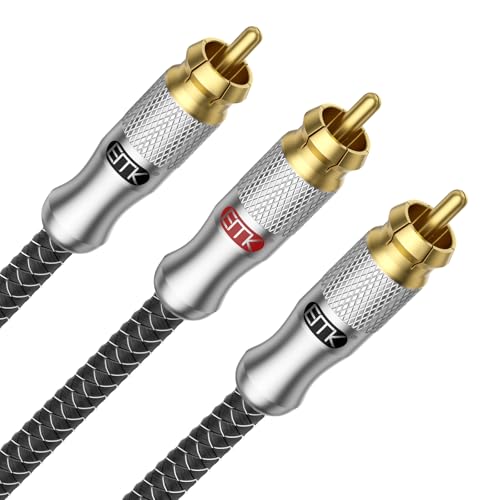
First identify every port in the signal path. A conventional stereo RCA cable normally has red and white plugs for the right and left channels at each end. The selected J&D 2 RCA model uses that 2-to-2 arrangement, while the EMK, SOUNDFAM, and Kxable products use a 1-male-to-2-male Y layout. A Y cable is a different design: it can combine or split a single RCA path and two RCA paths, so it should be chosen for a documented splitter or subwoofer application rather than assumed to be a regular stereo lead.
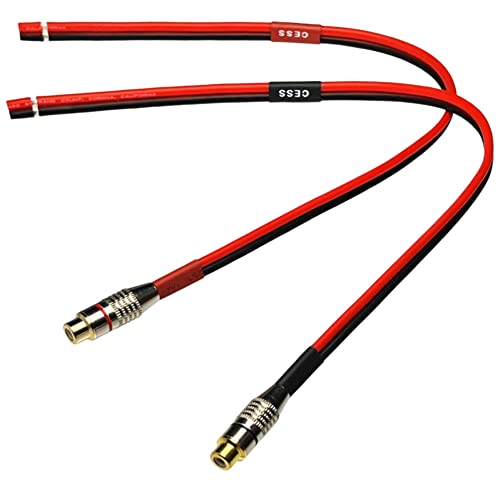
A 3.5mm-to-RCA cable is intended for a different port combination. JSAUX, HiFind, and J&D’s 6-foot model pair one 3.5mm male plug with two RCA male plugs. These can connect portable equipment, computers, or other 3.5mm sources with a receiver, amplifier, speaker, television, or other RCA-equipped device when the port genders match. Froggen and the shorter J&D model instead document a 3.5mm female end. That format is useful when an existing male 3.5mm plug needs a female socket, but it is not interchangeable with a cable that requires a male plug at both ends.
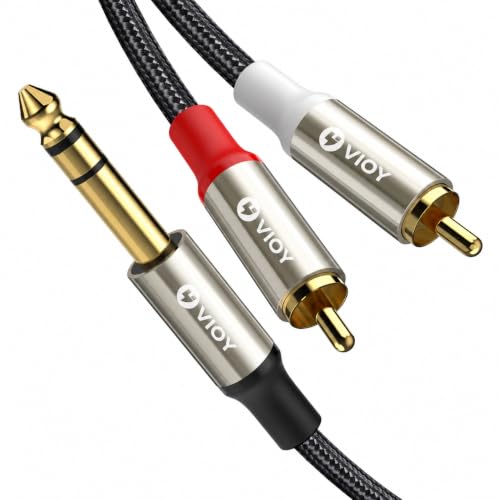
VIOY covers 6.35mm TRS equipment, while Cyberguys! covers RCA-to-XLR connections. These are specialist formats. Check the equipment manual and physical port labels before selecting either one. A cable can be bidirectional in signal flow while still being mechanically incompatible with the intended device.
Confirm two-way support
A true two-way claim should be tied to the connector arrangement. JSAUX, HiFind, both selected J&D 3.5mm models, VIOY, and Cyberguys! explicitly describe operation in both directions. SOUNDFAM and Kxable also document reverse use for their Y configurations. EMK identifies its RCA Y splitter as bi-directional, and Froggen describes its connectors as line-in and line-out.
For standard RCA-to-RCA connections, do not confuse “input” and “output” labels on a component with a directional cable. The cable itself generally has no active electronics in the selected models, but the equipment ports still determine whether a signal can enter or leave. The source and receiving device must support the intended path.
Shielding is relevant when cables run near power supplies, displays, computers, or other sources of electromagnetic or radio-frequency interference. Kxable lists multilayer and aluminum-foil shielding, while Cyberguys! lists braided shielding. These statements support a construction comparison, but they do not establish a measured noise floor or guarantee a particular audible result.
Conductor details also vary. EMK lists oxygen-free copper, Kxable lists 22AWG pure copper, HiFind lists silver-plated copper, and Cyberguys! lists OFC conductors. Other selected models provide shielding and connector information without a conductor gauge. Treat a larger gauge or plating description as a specification difference, not proof of superior performance in every setup.
Match the length to the route
Measure the actual path, including bends around furniture or equipment. Short cables such as the 3-foot J&D model suit nearby components and leave less slack. The 3.3-foot Froggen cable is similarly aimed at compact arrangements. The 6-foot to 6.6-foot options from J&D, HiFind, JSAUX, and Cyberguys! provide more routing room for common equipment layouts. VIOY and EMK extend to 10 feet, and Kxable lists a 100-foot version.
Longer is not automatically better. Extra cable can create loops and make cable management harder, especially with a Y adapter. Conversely, a cable that is too short can pull on a connector or force a sharp bend. Select the shortest documented length that reaches comfortably without tension.
Inspect the physical construction
Jacket material and connector housing affect how a cable can be routed. Nylon-braided jackets appear on EMK, SOUNDFAM, Kxable, VIOY, HiFind, and JSAUX. Froggen also lists a soft nylon braid. The selected J&D models describe shielding and gold-plated connectors, while Cyberguys! adds a rugged PVC cover and strain relief. HiFind lists a spring strain-relief design and double-braided jacket.
Color coding is useful for stereo hookups. EMK, JSAUX, and Froggen identify red and white connectors or channel markings. A bonded 2-to-2 RCA design can keep left and right conductors together; however, the evidence supplied here for that feature belongs to a non-selected J&D 2-to-2 variant, so it is not used as a buying recommendation in this article. For the selected products, rely on the documented layouts and channel labels above.
Use the application description as a final check
The listed applications help narrow the field. EMK and SOUNDFAM are oriented toward home theater, receivers, amplifiers, and subwoofer connections. Cyberguys! is aimed at studio, stage, mixer, and amplifier links. VIOY is the fit for 1/4-inch audio hardware. HiFind and JSAUX focus on portable 3.5mm equipment paired with RCA systems. Kxable is the long-run option, while the shorter J&D and Froggen designs suit compact adaptations.
These application statements describe intended compatibility, not independent performance testing. Before connecting, verify whether the equipment expects analog stereo, a subwoofer path, or another RCA signal type. The cable’s two-way design does not convert an incompatible signal or replace an active converter.
Final Recommendation
JSAUX RCA to 3.5mm Cable 6.6ft ranks first overall in this specification-based comparison under the published weighted criteria.
EMK RCA Y Splitter 10ft/3m is the highest-scoring returned product and the first overall specification-based choice. Its documented two-way operation, 1-to-2 RCA layout, double shielding, oxygen-free copper, gold-plated connectors, and 10-foot length give it the most complete specification profile for the intended Y-splitter category. For a conventional 3.5mm setup, HiFind and JSAUX are more appropriate because their plug layouts directly address that port combination. Choose Cyberguys! when XLR is required, VIOY for 6.35mm equipment, and Kxable when a very long Y-adapter run is central to the installation. These are the top bi-directional rca cables here because each one is matched to a documented connector and use case rather than treated as interchangeable.
The best bi-directional rca cables still require a final port check. Confirm plug gender, channel count, signal type, and route length before selecting a model. A carefully matched 3-foot adapter can be more suitable than a 100-foot cable if the equipment is close together, while a specialist RCA-to-XLR or 1/4-inch-to-RCA cable can avoid an otherwise incompatible connection.
Frequently Asked Questions
Among the best bi-directional rca cables, what does bi-directional mean for an RCA cable?
It means the listing documents signal transmission in either direction between the stated connector formats. It does not mean that every RCA device will accept every signal. The connected equipment must still provide compatible input and output ports.
Are RCA Y-splitter cables the same as 2-to-2 stereo cables?
No. A Y-splitter has one RCA branch and two RCA branches, as shown by EMK, SOUNDFAM, and Kxable. A 2-to-2 stereo cable has two RCA plugs at each end. Select the Y format when the system needs a split or combine path, and select 2-to-2 when the equipment uses separate left and right RCA connections at both ends.
Which cable works with a phone or tablet?
A phone or tablet with a 3.5mm audio port can pair with a 3.5mm-to-dual-RCA model such as HiFind, JSAUX, or the selected male-to-male J&D cable. Check whether the device needs a male plug. Froggen and the shorter J&D option have a 3.5mm female connector, so they serve a different connection arrangement.
When is an RCA-to-XLR cable appropriate?
Cyberguys! is the selected RCA-to-XLR option and is described for mixers, amplifiers, instruments, and other professional audio applications. It is appropriate only when the equipment has the required RCA and XLR ports. It does not function as a universal replacement for a standard RCA-to-RCA lead.
How much cable length should I choose?
Choose enough length to route between the devices without tension, but avoid unnecessary slack. The selected options range from 3 feet to 100 feet. Short models suit close equipment, 6-foot models cover many ordinary layouts, and the longer EMK or Kxable options are intended for more extended routes or specialized Y-adapter placement.