Buying Guide
The best bi-metal reciprocating saw blades are easier to choose when the material, tooth count, length, and pack format are considered together. Bi-metal construction generally describes a blade that combines a flexible body with a hardened cutting edge, and every selected product identifies itself as bi-metal or supplies more specific bi-metal material information. That makes the category suitable for users who want a balance between flexibility and edge durability, but the individual designs still serve different jobs.
Match the blade to the material
Start with the material you expect to cut most often. Mixed-material sets such as the Diablo DS0014SPC2 and Milwaukee SAWZALL Ultimate Demolition Set document coverage for wood and metal, with the Milwaukee set also naming plastic. The Diablo DS0914BGP5 likewise lists wood, metal, and plastic, so it is a useful single-format choice when you do not need several lengths.
For metal-focused work, the EZARC Cryo Tech, EZARC 6-Inch 14 TPI, DEWALT DW4813, Milwaukee 48-00-5788, and HORUSDY 9-Inch 14 TPI products provide more targeted options. Their listings identify applications such as sheet metal, pipes, profiles, steel, rebar, tubing, or nail-embedded wood. The exact material ranges differ, so use the stated guidance rather than assuming that every blade is interchangeable for every thickness.
Use TPI as a practical guide
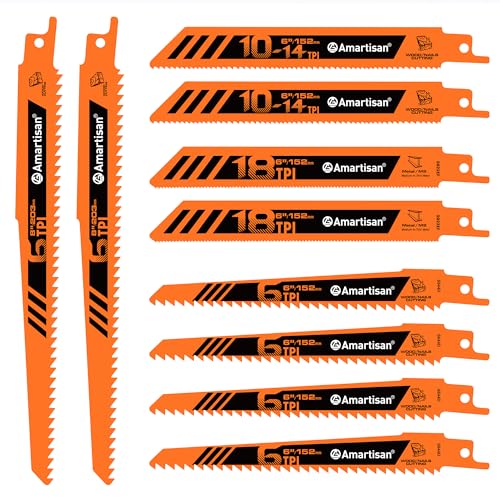
Teeth per inch, or TPI, helps indicate the intended cutting style. Coarser options in the 5–8 TPI range appear in the Milwaukee multi-material set, Diablo assortment, and AMARTISAN combination set. Those products connect lower tooth counts with wood or demolition work. Higher counts such as 14, 18, and 24 TPI appear in the metal-oriented products and are positioned for sheet metal, pipes, profiles, or finer cutting.
A variable or dual-tooth format can broaden the range. The Diablo DS0914BGP5 uses 8/14 TPI, while the Diablo 25-pack and several metal packs use 14/18 TPI. These formats may be useful when a job includes more than one metal condition, but a dedicated 24 TPI blade such as the DEWALT DW4813 is more narrowly oriented. Do not select only by the largest TPI number; match the tooth pattern to the material and the desired cutting style.
Choose a useful blade length
Six-inch blades are compact and appear in both EZARC packs, the DEWALT DW4813, and several combination sets. They can be convenient when the cut does not require extra reach. Nine-inch blades appear in the Diablo general-purpose pack, Milwaukee 48-00-5788, HORUSDY pack, and the larger combination sets. Longer blades can provide more reach, but the listing evidence does not establish that length alone guarantees better results.
Combination sets are useful when your work changes from task to task. The DEWALT DW4892, Milwaukee Ultimate Demolition Set, and AMARTISAN set offer multiple sizes or tooth configurations. A single-format pack may be preferable when you repeatedly cut one material and want a consistent replacement supply.
Check the shank and storage details
Several selected listings specify a universal 1/2-inch shank or universal tang, including both EZARC products, Milwaukee 48-00-5788, HORUSDY, and the Diablo 25-pack. This supports broad compatibility with mainstream reciprocating saw systems, but you should still confirm the saw manufacturer’s requirements before ordering.
Storage also varies. The Diablo DS0014SPC2 is a set, the DEWALT products include cases, the Milwaukee multi-material set has an adjustable job-site case, and HORUSDY supplies a storage case. The AMARTISAN listing mentions sturdy packaging, while the focused five-packs provide fewer storage details. If blades travel between work areas, a documented case can be more useful than an otherwise similar loose pack.
Consider pack size and replacement needs
A five-pack can suit occasional work or a user who wants one defined blade type. Larger formats such as the 12-piece, 14-piece, and 25-pack products make more sense when cutting frequency is higher or when several workers share supplies. Pack size should not be treated as a performance guarantee. It is mainly a logistical choice based on how often you replace blades and whether you need multiple tooth patterns.
The listings use phrases such as longer life, reduced vibration, faster cuts, heat resistance, or improved wear resistance. Those are supplied product claims, not results from this article’s testing. The most specification-aligned comparisons therefore rely on concrete specifications: bi-metal material, cobalt content where stated, Cryo Tech treatment, tooth count, length, named applications, universal shank details, and storage provisions. This guide does not add customer sentiment, hands-on results, or unsupported durability rankings.
Final Recommendation
Diablo DS0014SPC2 14-Piece Bi-Metal Set ranks first overall in this specification-based comparison under the published weighted criteria.
The final choice among the best bi-metal reciprocating saw blades depends on the documented features that match your intended use.
The Diablo DS0014SPC2 is the highest-scoring returned product and the first overall specification-based choice. Its 14-piece format, 6- and 9-inch lengths, variable tooth technology, and documented wood-and-metal demolition coverage make it the most adaptable selection for varied projects.
Among the top bi-metal reciprocating saw blades, the Milwaukee SAWZALL Ultimate Demolition Set is a close alternative for users who value thicker stock, multiple demolition tooth counts, and a job-site case. DEWALT DW4892 is better suited to buyers prioritizing a tall, thick profile and heavy-metal applications. For focused metal cutting, EZARC Cryo Tech offers the clearest treatment and material specifications, while the DEWALT DW4813 provides the most fine-tooth-oriented format.
Choose the Diablo DS0914BGP5 when a five-pack of 9-inch general-purpose blades is enough. Choose Milwaukee 48-00-5788 for a documented 9-inch, 18 TPI option with broad named metal applications. The AMARTISAN set offers a smaller mixed-material assortment, and HORUSDY provides a simple 9-inch, 14 TPI metal pack with a case. In every case, verify the material, tooth count, blade length, and shank before purchase.
Frequently Asked Questions
The Diablo DS0014SPC2, Milwaukee SAWZALL Ultimate Demolition Set, Diablo DS0914BGP5, and AMARTISAN set are the most broadly documented mixed-material choices in this comparison. Their listings mention combinations of wood, metal, plastic, drywall, or composites and provide multiple tooth counts or blade types. A mixed set is useful when the work changes between demolition and material-specific cutting, but it may contain blades you will not use for a single focused task.
No. The selected listings show different metal-oriented formats, including 14, 18, 14/18, and 24 TPI. Higher tooth counts can be appropriate for finer metal applications, while lower counts may be used for more aggressive or thicker-material work. The DEWALT DW4813 is the clearest fine-tooth example at 24 TPI, whereas the HORUSDY and EZARC 14 TPI products target stated pipe, sheet, profile, or plate applications. Follow the blade’s supplied application guidance.
Do these blades fit every reciprocating saw?
Several products specify a universal 1/2-inch shank or universal tang, including the EZARC, Milwaukee, and HORUSDY selections. That indicates broad compatibility with many mainstream systems, but it is not a substitute for checking your saw. Confirm the shank requirement and the manufacturer’s compatibility information before installing a blade.
Buy a set when you cut different materials or need several lengths and TPI options. The Diablo DS0014SPC2 and Milwaukee Ultimate Demolition Set provide especially broad assortments. A single-format pack such as the DEWALT DW4813, EZARC Cryo Tech, or Milwaukee 48-00-5788 is more focused and may be easier to match to recurring metal work. Pack size is a supply decision, not independent proof of cutting performance.
How should I interpret claims about blade life?
Treat claims about longer life, wear resistance, or reduced heat as listing-provided product information rather than independently verified test results. This comparison uses those statements only alongside concrete specifications such as material, tooth count, treatment, application range, length, and storage. Actual service life can depend on the saw, material, technique, and cutting conditions.