Buying Guide
The best stainless steel band saw blades are not selected by tooth count alone. A blade can be well suited to stainless steel yet unusable if its loop length, width, or thickness does not match the saw. Start with the machine manual or the dimensions printed on the existing blade. Then compare the material statement, tooth pattern, construction, and any operating guidance in the listing.
Confirm the blade length and width
Blade length is the first compatibility check. The products here range from the 32-7/8-inch Makita B-40559 to 93-1/2 inches for the Imachinist S93121214SS. Other formats include 59-1/2, 62, 72, 80, and 93 inches. These are not interchangeable simply because they share the same tooth count.
Width matters too. Several selected blades are 1/2 inch wide, including the Imachinist S801214SS, S59121224SS, S621224SS, S721224SS, and S93121214SS. The Imachinist S933414SS, S93341014SS, S933458SS, and HUGEARM 2-pack are 3/4 inch wide. The Makita blade has a shorter portable-saw format. Match both measurements rather than relying on brand or appearance.
Thickness can help confirm fit. The 1/2-inch Imachinist blades commonly list 0.025-inch thickness, while the 3/4-inch Imachinist and HUGEARM options list 0.035 inch. The Makita listing provides length and tooth count but does not provide a blade-thickness figure in the supplied specifications.
Choose fixed or variable teeth
A fixed tooth pattern keeps spacing consistent. The Imachinist 14TPI and 24TPI models use constant or fixed patterns. This makes the specification easy to match when the workpiece profile suits the listed application. The 14TPI blades are described for thin pipe or tube profiles, while the 24TPI models are also identified for thin profiles.
Variable teeth change spacing across the pattern. The Imachinist S93341014SS uses 10/14TPI, the S933458SS uses 5/8TPI, and the HUGEARM option uses 5/8TPI. The Makita B-40559 uses a wavy tooth set. These patterns give shoppers alternatives to constant-tooth blades, but the supplied listings do not provide hands-on comparisons of cut speed, finish, or service life. Treat tooth configuration as a matching specification rather than a performance guarantee.
Match tooth count to the workpiece
The listings provide useful but limited guidance. The 14TPI products are described for thin pipe and tube profiles. The 24TPI blades are also associated with thin profiles, while the 5/8TPI options are listed for stainless steel and other ferrous materials. A lower tooth count is not automatically better for every thick section, and a higher count is not automatically better for every thin section. Consider the workpiece profile and follow the blade maker’s guidance.
The Makita B-40559 is described for sheets, tubes, and pipes and has an 18TPI wavy tooth set. Its intended portable band saw format differentiates it from the longer stationary-saw options. The Imachinist S933458SS is specifically listed for stainless steel under 30 HRC, so that hardness limitation should remain part of the selection decision.
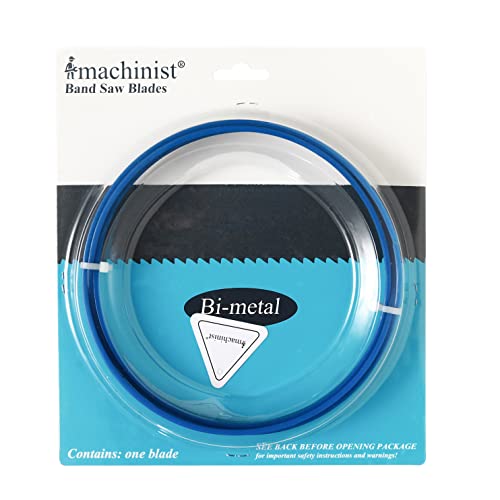
Every selected product identifies bi-metal construction, although the listings vary in detail. Several Imachinist products specify M42 grade. The S59121224SS and S933458SS listings describe 8% cobalt and 2% tungsten content; the S933458SS additionally lists a spring-steel backer and an almost invisible welded joint. The S621224SS and S721224SS list spring-steel backers.
These details distinguish products on paper, but they do not establish a measured service-life result. Use them as construction information alongside size and tooth pattern. The Makita listing adds an improved welding process and durable bi-metal construction, while the HUGEARM listing identifies M42 material and teeth guards for storage.
Check restrictions and speed notes
Stainless steel is the central application, but several listings also mention other ferrous metals and exclude non-ferrous metals for particular tooth patterns. The Imachinist 14TPI and 24TPI stainless listings caution against non-ferrous metals. The 3/4-inch Imachinist S933414SS and S93341014SS listings also warn against aluminum and other non-ferrous metals. Do not assume that a stainless-oriented blade is suitable for aluminum.
Some products provide operating guidance. The Imachinist S93121214SS, S59121224SS, S621224SS, and S721224SS list 100–300 SFPM for ferrous metals and 300–800 SFPM for non-ferrous metals, while warning against cutting metal on wood-cutting saws operating above 1,000 SFPM. The S933458SS gives a stainless hardness limit. These notes are useful because they define conditions a buyer can verify.
How this comparison was scored
This is a specification-based comparison using public listing data, not a hands-on test and not a summary of customer opinions. Editorial scores consider stainless-steel application fit, saw dimensions, tooth configuration, documented construction, and application guidance. Marketplace signals were not used in the published criteria or product descriptions. Products were grouped by parent product where a parent identifier was supplied, and the selected list contains one ASIN per distinct parent grouping.
Final Recommendation
Imachinist S933458SS 93-inch 5/8TPI ranks first overall in this specification-based comparison under the published weighted criteria.
Imachinist S933458SS is the first overall specification-based choice. Among the best stainless steel band saw blades reviewed here, it offers a strong combination of explicit stainless-steel application guidance, a 93-inch by 3/4-inch format, variable 5/8TPI teeth, and documented construction details. It is suited on paper to a saw that accepts those dimensions and to stainless steel under 30 HRC as stated in the listing.
The Imachinist S93341014SS is an alternative when a variable 10/14TPI pattern and the documented stainless-grade compatibility fit the job. Choose the Makita B-40559 when a compact portable-saw blade and five-pack are more relevant. For thin profiles, compare the 14TPI and 24TPI options by saw length first, then by tooth pattern. The top stainless steel band saw blades in this list are not universal; the appropriate choice is the one whose complete specification matches the machine and material.
Frequently Asked Questions
What should I verify before buying the best stainless steel band saw blades?
Verify the saw’s required loop length, blade width, and acceptable thickness. Then check whether the listing explicitly names stainless steel, whether the tooth pattern matches the workpiece profile, and whether any hardness, speed, or non-ferrous-metal restriction applies. A correct dimensional fit is an important selection requirement even when the material description is suitable.
Is a 14TPI or 24TPI blade better for stainless steel?
Neither is universally better from the supplied evidence. The selected Imachinist 14TPI listings describe thin pipe and tube profiles, while the 24TPI listings also identify thin profiles and use a finer constant tooth pattern. Select based on the workpiece profile and the blade maker’s guidance, not tooth count alone.
When should I consider a variable-tooth blade?
Consider a variable pattern when the documented 10/14TPI or 5/8TPI format matches your saw and application. The Imachinist S93341014SS, S933458SS, and HUGEARM 2-pack provide examples in this comparison. The listings establish the tooth configurations, but they do not provide hands-on proof that one pattern cuts faster or lasts longer.
Are all of these blades suitable for aluminum?
No. Several Imachinist stainless listings specifically advise against cutting aluminum or other non-ferrous metals with their listed tooth patterns. The HUGEARM listing names aluminum and other materials, but its broad guidance should still be checked against the saw and operating instructions. Confirm the exact product’s material restrictions before using it outside stainless or ferrous work.
No guarantee can be made from these listings. Bi-metal construction is documented for every selected product, and some listings add M42, cobalt, tungsten, spring-steel backing, or welding details. Those are useful specifications, but they are not test results or a promise of service life.