Buying Guide
When shopping for the best artificial boxwood trees, the most useful decisions happen before you click order. Defining your space, identifying the silhouette you want, and understanding how materials hold up to your climate will narrow the field quickly. The picks below cover spiral, single ball, and triple ball designs at heights suited to porches, patios, and indoor entryways.
Match the silhouette to the spot
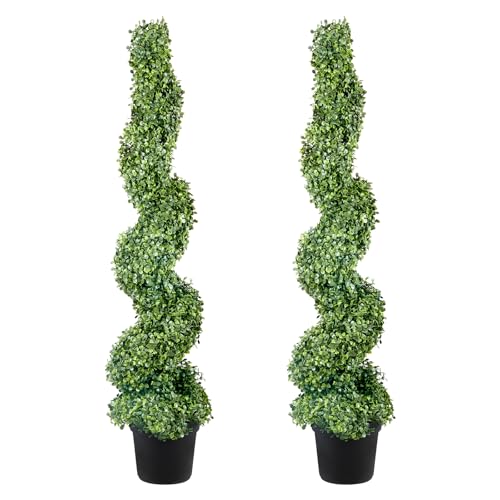
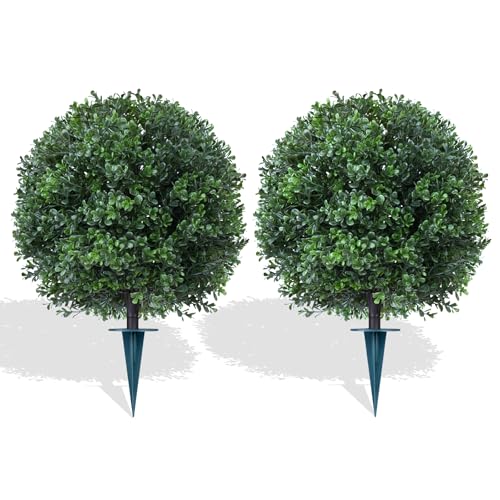
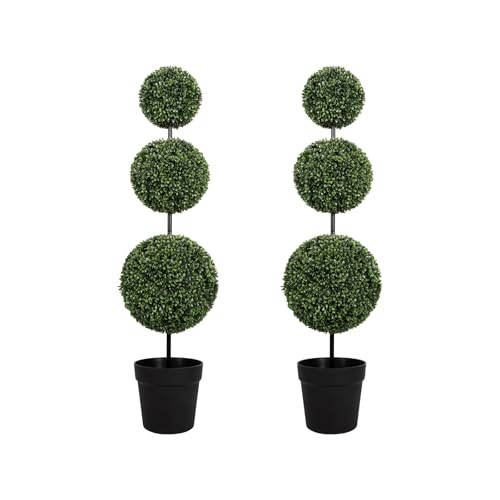
The silhouette sets the tone. Spiral topiary trees, including the VEVOR 4-foot pair, give a formal, sculpted feel that pairs well with symmetrical doorways. Triple ball designs, like the HWT 3-foot topiary or the HOMCOM 40-inch pair, layer horizontally and read well in mid-height planters. Single ball topiaries, such as the Sinromrich 25-inch pair or the BLONYUVC 27-inch pair, work as either flanking accents or standalone statements in smaller planters. Choosing the right silhouette first prevents you from compromising on height or proportions later.
Three measurements matter: overall height, canopy width, and pot or base footprint. A 56-inch Silk Tree Warehouse double ball silhouette commands a tall entryway, while a 23-inch Grooy ball topiary disappears against a large porch. Canopy width influences how dense the tree looks from a distance, and the pot or base footprint determines which decorative planters will hide it cleanly. Comparing these three numbers between models prevents mismatched installations.
Look for realistic foliage cues
Realism is driven by leaf density, color variation, and trunk material. The HWT topiary uses a real wood trunk with varied green tones layered into the canopy, while the Grooy ball topiary describes layered green tones and a wood-grain trunk. PE plastic leaves with staggered placement tend to look fuller than single-tone designs, and a nonuniform color palette helps the foliage mimic live boxwood. Trunk material is a subtle but important cue; natural or faux wood trunks add character against smoother pot bases.
Weigh UV and weather resistance carefully
If the tree will live outdoors, UV and weather resistance move up the priority list. The HOMCOM 40-inch triple ball, the BLONYUVC 27-inch ball bush, and the Sinromrich 25-inch pair all reference UV-protected materials in their listings. The VEVOR and HWT designs also describe UV-resistant materials for outdoor use. For covered porches or fully indoor placement, UV resistance is less critical, but for sun-exposed patios, it directly affects how long the green tones will last.
Decide on anchoring method
Anchoring matters more than most buyers expect. Nursery pots with cement soil, like the HOMCOM set, are designed for stability. Ground spike designs, found on the BLONYUVC, Grooy, and Sinromrich pairs, support direct planting in soil or loose planter mix. Removable pots, like the HWT base, allow you to swap in a decorative planter. Matching the anchoring method to your planter type prevents tipping and keeps the silhouette aligned over time.
Plan for assembly and shaping
Most artificial boxwood trees need some shaping after delivery, and a few require assembly. The VEVOR spiral topiary and the HWT triple ball both call out assembly needs, while the HOMCOM and COLORSPEC pairs are described as ready to use. Bendable branches and flexible stems, highlighted on the Nearly Natural 36-inch triple ball, let you adjust fullness to taste. Setting aside 15 to 30 minutes for shaping helps the tree look its best on arrival.
Choose between pairs and singles
Several listings ship as pairs, including the Silk Tree Warehouse, HOMCOM, Sinromrich, Grooy, BLONYUVC, and COLORSPEC models. Pairs are designed for symmetrical framing at doorways or along walkways. Single-tree models, like the HWT or Nearly Natural 36-inch topiary, offer flexibility for asymmetric layouts or tighter spaces but require ordering multiples for symmetry. Decide which approach fits your layout before choosing a model.
Final recommendation
HOMCOM 40-Inch Triple Ball Boxwood Topiary Pair ranks first overall in this specification-based comparison under the published weighted criteria.
The final choice among the best artificial boxwood trees depends on the documented features that match your intended use.
If you want a versatile, well-documented option for a porch or entryway, the HOMCOM 40-Inch Triple Ball Boxwood Topiary Pair is the first overall specification-based choice. Its 40-inch height, graduated triple ball layout, documented UV protection, and cement-soil nursery pot check the most practical boxes for indoor-outdoor use. For taller, sculptural drama, the Silk Tree Warehouse 56-Inch Double Ball Topiary pair stands out, while the HWT 3-foot triple ball offers a real wood trunk and a more compact footprint. Together, these top artificial boxwood trees cover the most common silhouette and size needs, and each is backed by clear specifications on materials, dimensions, and weather resistance so you can install with confidence.
Frequently Asked Questions
Among the best artificial boxwood trees, what is the best height for an artificial boxwood tree by a front door?
A 3 to 4-foot topiary, such as the HOMCOM 40-Inch Triple Ball or the HWT 3-foot triple ball, scales well with standard 80-inch door frames. This range keeps the canopy visible without crowding the frame, and pairs frame the doorway cleanly at this height.
Are spiral topiary trees harder to maintain than ball topiaries?
Spiral designs, like the VEVOR 4-foot pair, may need more careful shaping after delivery because the layered spiral lines show gaps when leaves shift. Ball topiaries, such as the Sinromrich 25-inch pair, tend to retain shape more easily because the silhouette is uniform on all sides.
Can I leave artificial boxwood trees outside year-round?
Models with stated UV resistance, such as the HOMCOM, BLONYUVC, Sinromrich, and VEVOR options, are documented for outdoor exposure. For longer life, placing them under a covered porch or rotating them during extreme weather can help preserve color and structure.
How do I keep artificial boxwood trees from tipping in planters?
Choosing a weighted base or a ground spike model helps. The HOMCOM topiary uses cement soil in its nursery pot for stability, and the BLONYUVC or Grooy ball topiaries use ground spikes that anchor into the soil. Pairing the chosen base with a sufficiently heavy planter adds a second layer of stability.
Are these top artificial boxwood trees safe for homes with pets or children?
Several listings highlight material documentation directly. The VEVOR spiral topiary is described as SGS certified, and the HOMCOM set uses UV-protected plastic designed for indoor and outdoor spaces. Checking each listing for material certifications and secure assembly connections helps confirm safe placement.