Buying Guide
The best brass disconnect terminals are selected by matching the connector’s physical interface and electrical limits to the circuit. “Brass” alone is not enough: the listing should also explain whether the terminal is a battery clamp, male or female spade, piggyback branch connector, insulated crimp terminal, or another format. Those designs are not interchangeable even when they share a brass or tinned-brass contact material.
This comparison uses public listing titles, feature statements, and technical specifications. It is not a hands-on test, and the rankings do not use customer sentiment or volatile marketplace signals. The editorial score emphasizes construction, fit, disconnect function, protection, and the usefulness of application data.
Choose the terminal design first
Battery quick-release terminals are intended for cylindrical top-post batteries. Ampper and LAINLOY document positive and negative post sizes, while XIOGZAXI identifies SAE or JIS-style cylindrical posts and includes extended M8 bolts. These products are useful when the entire battery connection needs to be removed or restored without taking a cable lug apart. Check the positive and negative post diameters before ordering; a terminal designed for one post profile may not clamp correctly on another.
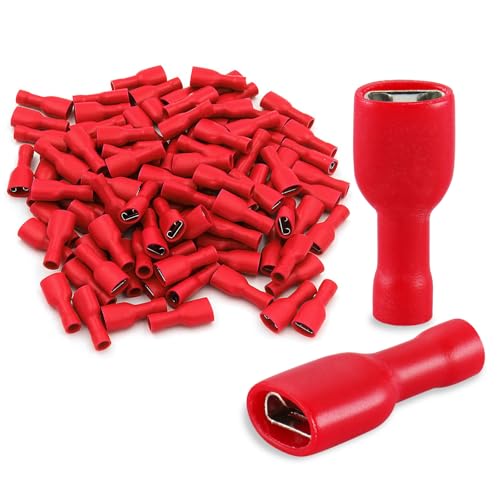
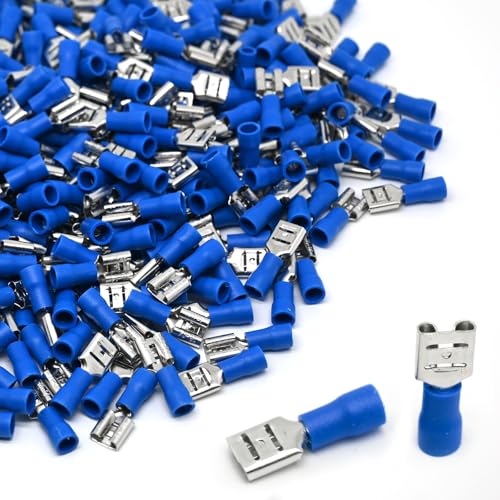
Standard spade terminals work differently. A female terminal slides over a male tab and is normally crimped to a wire. PAPUGA, AIRIC, 3M, CHANZON, and Spdtmhc document female formats, while HKS supplies male spades. A compatible male-female interface is therefore essential. Confirm tab width and thickness as well as wire gauge. A 6.3 mm or 1/4-inch tab is common, but the listed contact dimensions still vary.
Piggyback terminals add a branch point. ANCIRS documents a piggyback design for two wires and a 10 A maximum. This can simplify a branch connection, but the extra geometry may need more space than a basic female spade. Use this style only when the additional branch is part of the intended circuit layout.
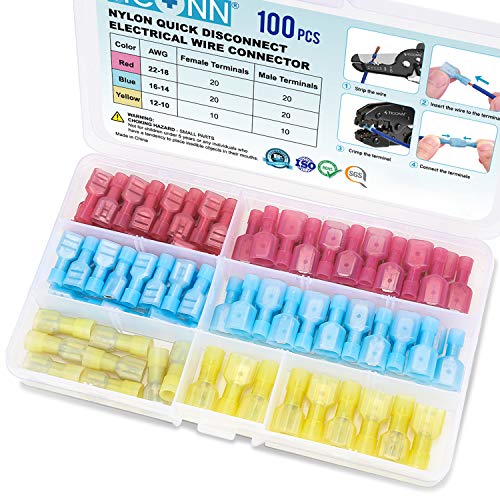
Wire range is one of the most important selection checks. The 3M and HKS options target 16-14 AWG wiring, while PAPUGA and AIRIC are intended for 12-10 AWG. CHANZON specifies 0.5-1.5 mm² cable, and ANCIRS lists 22-16 AWG. These ranges should be treated as product requirements, not general suggestions. A terminal that is too large may not crimp securely, while forcing a larger wire into a small barrel can damage the connection.
Current ratings also vary in how much detail the listing provides. Ampper lists 800 A continuous and 1,200 A surge at 12V for its battery connectors. LAINLOY lists 500 A continuous and 800 A inrush. AIRIC lists 48 A, PAPUGA lists up to 24 A and 600 V, Spdtmhc lists 15 A, and ANCIRS lists 10 A. HKS, 3M, CHANZON, and XIOGZAXI do not provide comparable current figures in the supplied evidence. Do not infer a rating for those products from brass construction alone.
For a complete installation, the terminal rating should be considered alongside wire gauge, fuse protection, the mating connector, insulation temperature, and the actual circuit load. A listing’s maximum is not a reason to exceed the limits of the rest of the wiring system.
Decide how much insulation you need
Insulated terminals cover the brass contact with PVC, nylon, vinyl, or another protective material. The covering can help reduce accidental contact and shorts, but it also affects the space available around the terminal. PAPUGA identifies yellow PVC with a 75°C limit. HKS describes flame-retardant PVC with resistance to heat, chemicals, and abrasion. 3M specifies blue nylon insulation, AIRIC uses a translucent nylon shell, and ANCIRS uses PVC around tinned brass inserts.
Semi-insulated designs, such as CHANZON, leave a different amount of the contact area protected than a fully insulated terminal. That may help with access or fit, but the exposed metal needs appropriate clearance. Battery terminals with covers, including Ampper and LAINLOY, use color identification to distinguish polarity and add a layer of protection around the connection area.
Check material and plating claims
Brass is useful in this category because the listings associate it with conductivity and mechanical utility. Tin plating appears on several selected products, including Ampper, PAPUGA, AIRIC, HKS, 3M, and Spdtmhc. The supplied evidence also describes corrosion resistance for several brass or tinned-brass designs. Still, plating does not eliminate the need to keep the connection clean, properly crimped, and protected from the conditions of the installation.
XIOGZAXI specifically combines brass terminals with anti-corrosion pads. Ampper uses tinned brass and includes covered terminals, while LAINLOY describes brass clamps with fixing caps. These features may be useful in battery compartments, but the listing data does not establish long-term performance in any particular environment.
Plan the installation
Disconnect power before working on wiring, and use a crimper appropriate to the terminal’s insulation and wire range. PAPUGA explicitly discusses insulated-terminal tools and warns against using the product with solid wire. HKS describes a strip, insert, and crimp process. Battery connectors should be installed on the correct positive and negative posts, with cables arranged so that the terminal is not forced sideways.
Before purchase, verify five items: connector gender or battery-post type, tab width and thickness, compatible wire range, insulation style, and the published current or voltage limit. Also check whether the pack contains a pair, a single terminal type, or a bulk quantity. Ampper and LAINLOY are positive-and-negative battery pairs; most spade products are one connector style intended to mate with another component.
Final recommendation
Ampper Brass Heavy Duty Quick Release Terminals ranks first overall in this specification-based comparison under the published weighted criteria.
Ampper Brass Heavy Duty Quick Release Terminals is the highest-scoring returned product and the first overall specification-based choice. Its combination of brass construction, positive and negative covers, top-post dimensions, wire range, and stated continuous and surge ratings gives it the most specification-aligned documented profile for battery quick-release use.
For large-gauge insulated spade wiring, PAPUGA is the clearest match because it identifies 12-10 AWG compatibility, a 1/4-inch tab, tin-plated brass, PVC insulation, and electrical limits. AIRIC is another strong large-wire choice, particularly where its translucent nylon shell and stated 48 A maximum are useful.
The best brass disconnect terminals for smaller or mid-gauge wiring depend more on interface details than brand. 3M and HKS cover 16-14 AWG formats, CHANZON addresses a 6.3 mm semi-insulated connection, and Spdtmhc provides a standard bulk female-spade format. ANCIRS is the specialist choice when a documented piggyback branch and 10 A limit fit the circuit.
Among the top brass disconnect terminals, battery clamps and crimp spades should not be treated as substitutes. Select the design that matches the battery post or mating tab, then confirm wire size and electrical limits before installation.
Frequently Asked Questions
Among the best brass disconnect terminals, are brass battery disconnect terminals the same as brass spade terminals?
No. Battery disconnect terminals clamp onto cylindrical battery posts, while spade terminals connect to flat male or female tabs on wires and equipment. Ampper, LAINLOY, and XIOGZAXI are battery-terminal products. PAPUGA, AIRIC, 3M, HKS, CHANZON, and Spdtmhc are spade-terminal formats. Their interfaces, installation methods, and sizing checks differ.
What should I check before buying a brass disconnect terminal?
Check the connector design, mating size, wire range, insulation type, and any stated current or voltage limit. For a battery pair, verify positive and negative post dimensions. For a spade, verify tab width and thickness as well as whether you need a male or female connector. Also confirm whether the listing supplies a pair or only one terminal style.
Are tinned brass disconnect terminals preferable for exposed wiring?
Tin plating is documented on several selected terminals and is described in the supplied listings as supporting corrosion resistance and conductivity. It can be a useful specification for wiring exposed to moisture or handling, but it does not guarantee a particular service life. Proper crimping, suitable insulation, clean contact surfaces, and appropriate circuit protection remain important.
Which selected terminal is suitable for a branch connection?
ANCIRS is the selected product that documents a piggyback design for connecting two wires at one point. Its listing specifies 22-16 AWG wire and a 10 A maximum current. That makes it a specialized option for lighter branch circuits rather than a general replacement for a standard female spade or a battery clamp.
Do brass disconnect terminals need to be insulated?
Not always, but insulation can help reduce accidental shorts and protect the crimp area. PAPUGA, AIRIC, HKS, 3M, and ANCIRS document insulated constructions, while CHANZON is semi-insulated. Choose the coverage that fits the available clearance and the electrical environment, and do not assume an insulated shell raises the terminal’s current rating.