Buying Guide
The best vinyl disconnect terminals are selected by fit first, not by pack size alone. A terminal must match the male tab it will slide onto and the wire gauge it is designed to accept. The products in this comparison are female quick disconnect or spade terminals with vinyl or PVC insulation, but their tab widths and wire ranges vary substantially.
Match the tab width
The selected products document two useful tab formats. The Conext Link QDVF-187R25 uses a 0.187-inch tab, while most of the remaining options use 0.250 inch, also described as 6.3 mm or 1/4 inch. These dimensions should not be treated as interchangeable assumptions. Check the mating male tab in the existing wiring or equipment before choosing a package.
A compact tab can be the correct solution for a space-limited connection, but it is not automatically preferable. The 0.187-inch Conext Link model is included specifically because its listed fit differs from the more common 0.250-inch designs. The Gardner Bender, Runseaway, HKS, XUGERIP, Spdtmhc, ATMLCOER, ANGSTROM, and Sherco-Auto listings document 0.250-inch or 6.3 mm formats.
Choose the correct wire range
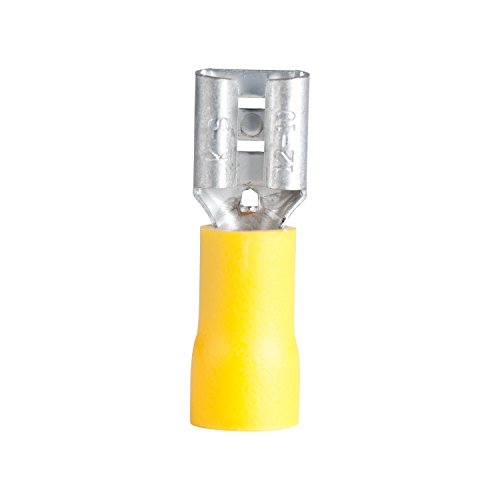
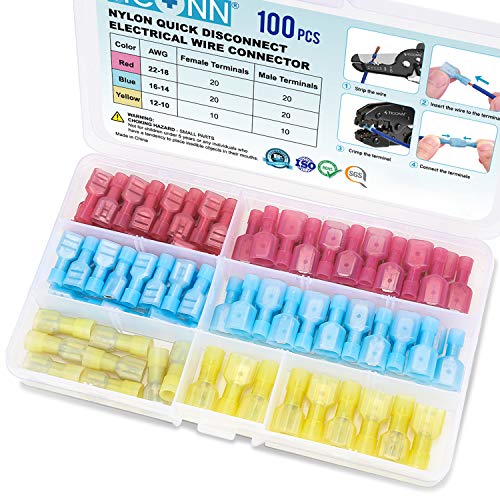
Color coding often helps identify the intended gauge family, but the written specification is more important. Red options in this group include 22-18 AWG or 22-16 AWG formats. Blue products generally cover 16-14 AWG, while yellow products cover 12-10 AWG. Sherco-Auto is the outlier, documenting an 8 AWG terminal.
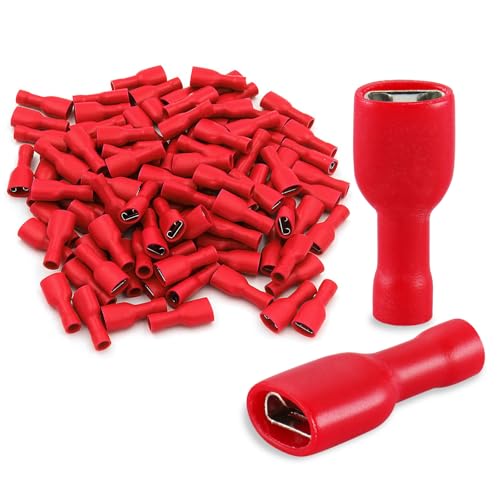
Do not force a wire into a terminal because the tab fits. A mismatch can produce an unsuitable crimp or leave the conductor poorly captured. For small-gauge work, the ANGSTROM FDD1.25-250 and ATMLCOER 500-piece red set document 22-16 AWG ranges, while Conext Link specifies 22-18 AWG. For 16-14 AWG, HKS, XUGERIP, and Spdtmhc provide directly comparable blue choices. For 12-10 AWG, Runseaway and the ATMLCOER yellow model are appropriate candidates from the supplied evidence.
Compare insulation details
Vinyl or PVC insulation is the defining construction feature in this category, but listings describe it at different levels of detail. Several products identify PVC sleeves, and some additionally mention flame-retardant properties. HKS describes PVC rigid insulated nylon sleeving. The ATMLCOER yellow, XUGERIP, and red ATMLCOER listings describe PVC insulation and flame-retardant protection. Gardner Bender identifies a vinyl-insulated barrel and UL listing.
These statements describe listed construction; they do not replace checking the requirements of a particular installation. The Sherco-Auto listing supplies a 105 C temperature rating, and Spdtmhc lists a maximum current of 15 A. Those figures are product-specific and should not be generalized to every terminal in this comparison.
Look at conductor material and plating
Material details can help distinguish otherwise similar spade terminals. Tinned copper is specified for Runseaway, HKS, XUGERIP, and both ATMLCOER products. Spdtmhc identifies a brass terminal body with tin plating, while the Conext Link model lists copper with tin plating. Tin plating is a documented construction detail, but the supplied listings do not provide a common test method for comparing conductivity or service life.
The absence of a material statement is also worth noting. ANGSTROM and Gardner Bender provide useful fit and insulation information, but the supplied fields do not identify their conductor material or plating. That does not establish poor construction; it simply gives those models less evidence for this comparison.
Size the pack to the job
Pack quantity ranges from 16 pieces for Gardner Bender and 25 pieces for the Conext Link model to 500 pieces for the red ATMLCOER set. A smaller pack may be sensible for one repair or a less common tab size. A 100-piece pack is common among Runseaway, ATMLCOER yellow, ANGSTROM, and Sherco-Auto. HKS supplies 150 pieces, and XUGERIP supplies 200.
Large quantities can reduce interruptions during repeated wiring work, but they also commit you to one tab width, color, and wire range. The 500-piece ATMLCOER set makes the most sense when many 22-16 AWG, 1/4-inch connections are expected. For occasional work, verify that the specialized Conext Link size or the smaller Gardner Bender package is actually what the project requires.
Consider the connection style
All selected products are female disconnect or spade terminals, so they are intended to mate with a male tab after the wire is crimped into the terminal. The listings describe standard crimp installation for several models. Runseaway specifically says a standard crimping tool can be used, while XUGERIP describes a serrated internal structure and ATMLCOER provides similar serrated-crimp detail.
Use an appropriate crimping tool and confirm that the insulation and conductor portions are captured as intended. The supplied evidence supports comparing listed construction and fit, not declaring a universal installation result. Also note that the selected products do not include a piggyback terminal design; that adjacent design was not used in this ranking because the comparison focuses on standard female disconnect terminals.
Final recommendation
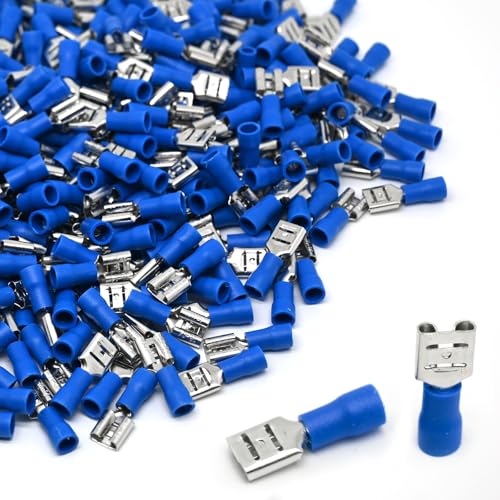
XUGERIP 200-Piece Blue FDD2-250 Terminals ranks first overall in this specification-based comparison under the published weighted criteria.
Sherco-Auto FDV8-250 is the first overall specification-based choice among these best vinyl disconnect terminals because it documents an 8 AWG range, 0.250-inch tab, 100-piece pack, vinyl insulation, and electrical ratings. It is the most specification-aligned fit when that heavy-gauge specification matches the project.
For 12-10 AWG work, ATMLCOER FDD5.5-250 and Runseaway S0272 provide the clearest combination of 6.3 mm fit, documented materials, and useful pack quantities. For common 16-14 AWG wiring, XUGERIP and HKS offer detailed construction information with larger packs, while Spdtmhc adds a listed 15 A maximum-current figure. For smaller or narrower connections, ANGSTROM covers 22-16 AWG and Conext Link provides a 0.187-inch alternative.
The top vinyl disconnect terminals are therefore not one universal size. Confirm the tab width, wire gauge, and any applicable circuit rating before ordering. Treat pack size as a secondary decision after electrical and mechanical compatibility are established.
Frequently Asked Questions
How do I choose the best vinyl disconnect terminals for a wire?
Start with the listed wire range, then match the terminal tab width. The selected red products cover 22-18 or 22-16 AWG, blue products cover 16-14 AWG, and yellow products cover 12-10 AWG. The 8 AWG Sherco-Auto option is intended for a heavier wire range. Color alone should not replace checking the written gauge specification.
Are 0.250-inch and 6.3 mm disconnect terminals equivalent?
The supplied listings use 0.250 inch and 6.3 mm to describe the same general tab format. Gardner Bender and Sherco-Auto list 0.250 inch, while Runseaway, HKS, XUGERIP, ATMLCOER, ANGSTROM, and Spdtmhc list 6.3 mm or 1/4 inch. Confirm the actual mating tab and product dimensions before purchasing, especially where fit is tight.
What makes a vinyl disconnect terminal different from an uninsulated terminal?
A vinyl or PVC sleeve covers the terminal area around the crimp and is described in the supplied listings as insulation. Some listings also specify flame-retardant properties. This construction can help separate the connection from accidental contact, but the exact protection depends on the product and installation. Do not assume that every model has the same voltage, temperature, or current rating.
Which best vinyl disconnect terminals have the largest packs?
The ATMLCOER red FDD1.25-250 set lists 500 pieces, followed by XUGERIP at 200 and HKS at 150. Several selected products list 100 pieces, while Gardner Bender and the Conext Link model have smaller packages. Choose the quantity only after confirming the correct tab size and wire range.
Do these terminals require crimping?
The listings describe these products as crimp terminals or identify crimp installation. Runseaway says standard crimping tools can be used, and several listings describe serrated internal structures intended to capture the wire. Use a tool appropriate for the terminal and wire range, and follow the connector maker’s installation guidance where available.