Buying Guide
Choosing among the best built-in burr coffee grinders starts with matching the grinder’s documented controls to the way you brew. Burr grinders use crushing and grinding surfaces rather than a blade, but the listings vary substantially in adjustment detail, dosing automation, hopper size, and cleanup design. The products above are ranked from supplied features and specifications, not from hands-on testing or customer sentiment.
Match the grind range to your brew methods
If you make espresso, pour-over, French press, and cold brew, a broad adjustment range gives you more starting points. KitchenAid lists 70 settings, while SHARDOR lists 100. Fellow takes a different approach with stepless adjustment, allowing continuous movement rather than fixed numbered stops. These features are useful when you want to make small changes, especially for espresso, but they do not guarantee a particular brewing result.
Several models list settings that span fine espresso to coarse French press or cold brew. The OXO Brew combines 15 primary settings with 43 micro-adjustments, and the AMZCHEF, Tuni G1, and KIDISLE models list 48, 48, and 51 settings respectively. A smaller setting count can still work for routine drip or French press use, but it gives you fewer documented positions to compare.
Decide how much dosing control you need
Dosing can mean selecting cups, setting a timer, using a portafilter holder, or weighing beans. Greater Goods is the clearest choice for integrated weighing because its built-in scale is designed to measure beans and stop at a target weight. That can appeal to users who want the scale and grinder combined in one step.
Timed controls are more common. SHARDOR specifies 0.1-second timing, while AMZCHEF, Tuni G1, and KIDISLE specify 0.5-second increments or a defined timer range. KitchenAid lists Smart Dosing Technology, and several other models use cup selectors. These systems differ, so check whether you prefer weight-based dosing, time-based dosing, or a simple manual start.
For espresso, a portafilter holder can reduce transfers between the grinder and machine. Fellow includes a catch cup compatible with 54 mm and 58 mm portafilters. Tuni lists a detachable holder for 54–58 mm portafilters, while Aromaster specifies a 51–53 mm holder. Measure your portafilter before relying on this feature; compatibility is not universal.
Consider hopper size and bean handling
A larger hopper suits households that grind several servings at a time. Tuni lists a 250 g hopper, Greater Goods lists 200 g, and KIDISLE lists 12.5 ounces. OXO lists 12 ounces, and AMZCHEF lists 10.6 ounces. These capacities are useful comparison points, but the ideal size depends on whether you store beans in the hopper or load only what you intend to grind.
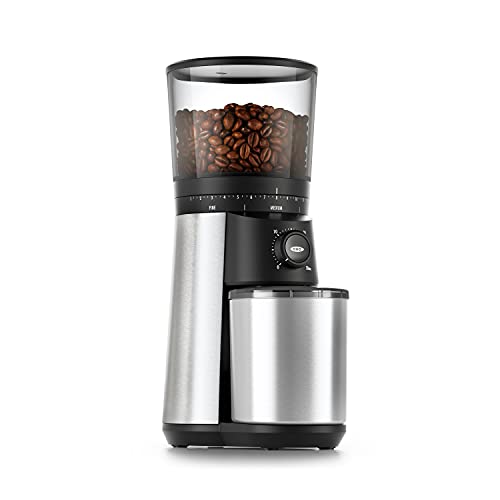
UV-blocking or UV-tinted hoppers appear on Greater Goods, AMZCHEF, and OXO. Their listings describe the tint as helping shield beans from light. A removable hopper can make refilling or changing beans easier; OXO, KitchenAid, Greater Goods, and AMZCHEF all document removable hopper features, though the exact mechanisms differ.
Prioritize cleanup features that fit your routine
Coffee grounds can cling to containers and surfaces, so anti-static features may be useful when minimizing scattered grounds is important. Fellow, SHARDOR, AMZCHEF, Greater Goods, Tuni, KIDISLE, and Aromaster document anti-static or related mess-control features. These claims describe design intent; they are not a measured comparison of cleanup performance.
Removable parts also matter. SHARDOR lists a removable magnetic discharge pipe, upper burr, and hopper. Aromaster lists a removable upper burr, hopper, and chamber.
Check countertop fit and controls
Height is especially important under kitchen cabinets. The selected models range from the compact Aromaster listing, which does not provide full dimensions, to taller units such as SHARDOR at 15.28 inches, KitchenAid at 15 inches, and OXO at 14.8 inches. Fellow lists a 10.49-inch height, but dimensions alone do not reveal the clearance needed to remove a hopper. Measure the available space above and around the grinder.
Control style is another practical distinction. Baratza uses a front pulse button and a separate on/off switch. OXO uses one-touch start and remembers the last setting. AMZCHEF uses an LED touchscreen, while SHARDOR uses LED display controls. Greater Goods focuses on weighing and automatic stopping. Choose the interface that fits your routine rather than assuming more controls will always be better.
What to verify before buying
Confirm the grinder’s voltage, especially when purchasing in the US. SHARDOR explicitly lists 120V-only operation. Also check portafilter dimensions, available counter height, hopper capacity, and whether the included collection method suits your brewer. Warranty information varies: Baratza lists one year, KitchenAid lists one year, OXO lists two years, Aromaster lists 12-month repair service, and KIDISLE does not provide a warranty period in the supplied specifications.
Final Recommendation
KitchenAid Burr Coffee Grinder KCG8433 ranks first overall in this specification-based comparison under the published weighted criteria.
Fellow Opus 2 is the highest-scoring returned product and the first overall specification-based choice among the best built-in burr coffee grinders. Its 48 mm conical burrs, stepless adjustment, anti-static design, automatic shutoff, near-zero retention, and two catch cups create the most specification-aligned balance for people who use several brewing methods.
KitchenAid is a strong alternative when a numbered adjustment scale matters, with 70 settings and Smart Dosing Technology. SHARDOR is the better fit for shoppers focused on 100 settings, flat burrs, and highly precise electronic timing. Greater Goods deserves attention when integrated weighing is more important than having many grind positions.
For a larger hopper, compare Tuni, KIDISLE, OXO, and Greater Goods using the capacities listed above. For direct espresso transfer, review the documented holder sizes on Fellow, Tuni, and Aromaster. These top built-in burr coffee grinders cover different priorities, so the best choice depends on your brewing methods, counter space, and preferred dosing workflow.
Frequently Asked Questions
What should I look for in the best built-in burr coffee grinders?
Start with burr type, adjustment range, dosing method, hopper capacity, and cleanup features. A broad range is useful for households that switch between espresso and coarse brewing. If you want repeatable dosing, look for a built-in scale, timer, cup selector, or Smart Dosing Technology. Also verify dimensions and voltage before purchase.
Are more grind settings always better?
Not necessarily. More settings provide more numbered positions, as seen on KitchenAid and SHARDOR, while Fellow’s stepless adjustment offers continuous control. The useful choice depends on whether you prefer fixed reference points or the ability to make very small changes. The listing data supports adjustment comparisons, but it does not establish which system will produce a better cup for every user.
Which selected grinder is best for espresso transfer?
Fellow, Tuni, and Aromaster document portafilter-holder options. Fellow lists compatibility with 54 mm and 58 mm portafilters, Tuni lists 54–58 mm compatibility, and Aromaster lists a 51–53 mm holder. Confirm your portafilter’s measured size because the listed ranges are not identical.
Is a built-in dosing scale useful?
It can be useful if you want the grinder to measure beans and stop at a target weight. Greater Goods specifically documents this function. Other selected models use timers, cup settings, or Smart Dosing Technology instead. Consider whether you prefer weight-based control or a time- and volume-based workflow.
How much counter space do these grinders need?
Check both height and width. The supplied listings show substantial variation, from Tuni’s 4.52-inch width to taller designs such as SHARDOR at 15.28 inches and KitchenAid at 15 inches. Measure the space beneath cabinets and allow room to remove the hopper, grounds container, or upper burr for the features you plan to use.