Buying Guide
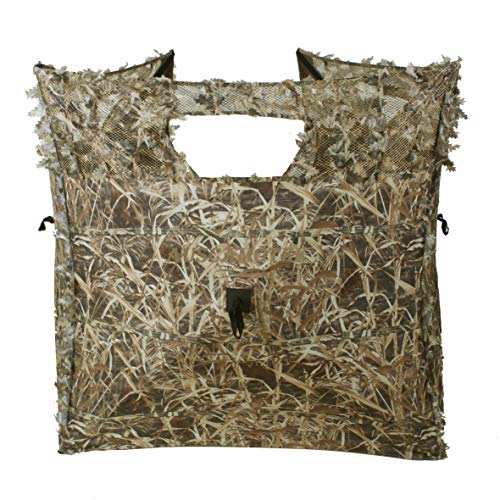
The best camouflage hunting blinds are not defined by camouflage print alone. A useful comparison starts with how the blind controls visibility, how much room it provides, and how easily it can be moved to a new location. The products above fall into several practical designs: enclosed pop-up hub blinds, solo chair blinds, structured single-person shelters, large group blinds, and open three-panel screens.
Match the blind to the hunting group
Capacity claims should be read with the floor dimensions. The selected 2-3-person models generally list floors around 58 inches square and heights near 66 inches. That is a compact footprint for two hunters and gear, but equipment placement can reduce usable elbow room. The TIDEWE offers a 2-3-person version with a 58.5-inch square floor, while HUNTSEN, FUNHORUN, and TLC Sport list similar dimensions.
For a larger party, the VEVOR 4-5-person blind lists a 70 by 70-inch footprint and approximately 81 inches of height. That extra room is the clearest choice when standing space and group capacity matter. Its trade-off is a listed weight of the current price, so the larger interior may require more planning when carrying the shelter to a distant setup.
Solo hunters have more specialized choices. The VEVOR single-person blind lists a 44 by 36 by 53-inch size, while the AUSCAMOTEK chair blind integrates seating into the shelter. The chair design may reduce the need to carry a separate seat, but the supplied listing does not provide full dimensions or a specific shell-fabric rating. The Rhino model sits between solo and group use with a documented two-person layout.
Choose the right viewing system
Viewing geometry affects how much surrounding movement can be observed without opening the blind. Four one-way see-through panels are specified on the HUNTSEN and both selected FUNHORUN models. These designs emphasize a 360-degree view and can be useful when movement may approach from several directions.
The TIDEWE uses three full see-through panels for a 270-degree view. Its listing also specifies three noise-free sliding windows and brush-in loops across the camouflage. That combination suits hunters who want broad observation while retaining a more conventional enclosed ground-blind layout. TLC Sport documents four high-visibility see-through panels and three quiet sliding windows, along with brush-in loops for adding natural cover.
The Rhino R100-MOC takes a different approach. It documents large front windows on two panels, three smaller rear windows, and a 270-degree window system with shoot-through mesh. This arrangement may be preferable when a hunter wants more control over selected directions instead of a full panoramic wall.
The AUSCAMOTEK three-panel model is the most open design in this comparison. It can be configured as a 150-inch screen or as a triangle, and its three panels provide flexible directional placement. Because it is a screen rather than a fully enclosed hub tent, it may offer easier movement and shooting access but less complete shelter around the hunter.
Consider entry and seating
Door layout matters when carrying bows, firearms, chairs, or other hunting equipment. HUNTSEN lists one full-opening door and one half-opening side door. The FUNHORUN 360-degree model specifies a full-opening door designed for wheelchair users or carts, making it the clearest choice when a wide entry is important. The VEVOR large blind uses a wide side door, while the single-person VEVOR uses a half-zipper front door.
The AUSCAMOTEK chair blind integrates a hunting seat, which can simplify a solo setup. By contrast, most of the 2-3-person pop-up blinds leave seating to the user. The FUNHORUN blind with floor mat adds a removable mat connected by a zipper and described as waterproof, a useful floor feature when the ground surface is damp or uneven.
Review setup and transport details
Portable ground blinds generally use pop-up or hub-style construction. HUNTSEN, TIDEWE, FUNHORUN, TLC Sport, and the AUSCAMOTEK chair blind all describe quick or simple setup. Carrying bags are listed with these models, although the supplied evidence does not establish identical packed sizes or setup times.
Weight is another practical filter. HUNTSEN lists the current price, the three-panel AUSCAMOTEK lists about the current price, and the selected FUNHORUN 360-degree model lists the current price. The larger VEVOR lists the current price. These figures are product-listing specifications, not independent measurements, but they help distinguish short-carry and long-carry candidates.
The three-panel design is especially portable because it uses lightweight panels and a shoulder-strap bag. Its open structure may be useful for waterfowl settings or locations where a full tent footprint is difficult to place. Enclosed hub blinds generally provide more surrounding coverage, but they can require additional room for their square floor and anchored walls.
Look for anchoring and weather details
A blind’s support and anchoring components are important specification points, even though listing data cannot establish field performance. TIDEWE identifies a metal hub, reinforced corners, resilient straps, and 10mm fiberglass support poles. HUNTSEN lists reinforced corners, metal hubs, and tough strapping. TLC Sport includes eight ground stakes and four tie-down ropes, and the FUNHORUN full-door model lists the same type of anchoring equipment.
The VEVOR models specify aluminum hubs, fiberglass tubes, and 150D waterproof fabric. The large model also lists a ground fabric section for concealment and light-blocking. The Rhino listing identifies shoot-through mesh and silent window attachments but provides fewer detailed frame specifications. Run the included components against the location: exposed, windy ground may make stakes and tie-downs more relevant, while a sheltered wooded site may place more emphasis on footprint and concealment.
How to use this comparison
This is a specification-based guide using supplied public listing information. It does not report hands-on testing, verified field concealment, customer sentiment, or independent weather performance. Treat marketing language such as quick setup or durable construction as a description of the listing, then confirm the current dimensions, included parts, and selected size before ordering. For the best camouflage hunting blinds for a particular hunt, prioritize the documented feature that solves your main constraint: panoramic visibility, group space, quiet window access, integrated seating, or lightweight transport.
Final Recommendation
HUNTSEN 360° See Through Hunting Blind ranks first overall in this specification-based comparison under the published weighted criteria.
The final choice among the best camouflage hunting blinds depends on the documented features that match your intended use.
TIDEWE 270° See Through Hunting Blind is the highest-scoring returned product and the first overall specification-based choice. Its balance of 270-degree viewing, sliding windows, brush-in loops, 2-3-person dimensions, carrying bag, and reinforced support details makes it broadly useful without requiring the footprint of the largest model.
The HUNTSEN is the stronger alternative when a 360-degree view and dual-door access matter most. Choose the FUNHORUN full-opening model when cart or wheelchair entry is central, or the FUNHORUN floor-mat version when a removable waterproof floor is more useful. For groups, the VEVOR 4-5-person blind is the clearest capacity pick. Solo hunters can choose between the structured VEVOR single-person shelter and the AUSCAMOTEK chair blind, while waterfowl hunters may prefer the flexible AUSCAMOTEK three-panel screen.
Together, these are the top camouflage hunting blinds in this comparison by documented viewing systems, layout, portability, access, and structural specifications. The right choice depends less on a universal ranking than on matching the blind’s design to the number of hunters, terrain, carry distance, and required entry width.
Frequently Asked Questions
What are the best camouflage hunting blinds for two or three people?
The TIDEWE, HUNTSEN, FUNHORUN, and TLC Sport models all document 2-3-person formats. TIDEWE is the most balanced choice for a 270-degree view and reinforced structural details. HUNTSEN is a strong fit for panoramic viewing and dual-door access, while the FUNHORUN models add either a full-opening door or a removable floor mat.
Which selected blind offers the widest documented view?
HUNTSEN, FUNHORUN, and TLC Sport document 360-degree viewing through one-way see-through panels. The VEVOR 4-5-person model lists 270- and 360-degree viewing options. A 360-degree design may provide broader observation, but the practical benefit still depends on placement, window use, and surrounding vegetation.
Which blind is best for a solo hunter?
The VEVOR single-person blind and AUSCAMOTEK built-in-chair blind are the most direct solo options. VEVOR lists a compact 44 by 36 by 53-inch shelter with a front window and mesh. AUSCAMOTEK combines a one-person see-through shelter with integrated seating, but its supplied specifications do not include complete dimensions.
Is a three-panel screen different from a pop-up ground blind?
Yes. The AUSCAMOTEK three-panel model is configurable as a long screen or triangle and provides open directional coverage. Enclosed pop-up blinds such as TIDEWE or HUNTSEN create a more complete tent-like shelter with defined floors, doors, and windows. A screen may be easier to carry and position, while an enclosed blind may provide more surrounding coverage.
What should I verify before buying a hunting blind?
Confirm the selected size, floor dimensions, height, viewing angle, door arrangement, included stakes or ropes, carrying equipment, and warranty terms. Also check whether the design supplies seating or a floor mat, and compare the listed weight with the distance you expect to carry it. These details are more useful for a specification-based choice than relying on camouflage pattern alone.