Buying Guide
Choosing among the best cable crimpers starts with identifying the connection, not with choosing the most powerful-looking tool. Battery lugs, insulated terminals, wire-rope sleeves, railing hardware, and Ethernet plugs use different dies and termination methods. A tool can be excellent for one job and unsuitable for another, so match the listing’s stated application and size range to the cable and connector in hand.
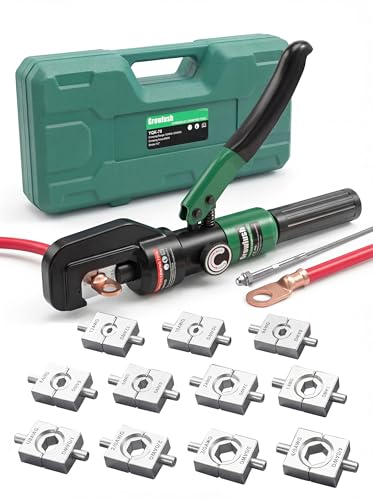
For battery, welding, solar, RV, and vehicle wiring, look for a lug crimper that lists AWG sizes and hex dies. The Growlush, YUZES, Cesilili, and IWISS models are documented for cable lugs, while the AMZCNC hammer model uses an indent approach for uninsulated connectors. These are distinct from tools for insulated terminals. The Klein Tools 3005CR is designed for insulated terminals on 10–22 AWG stranded copper wire and provides red, blue, and yellow cavities.
Wire-rope and railing work needs sleeve-specific dies. The Muzata CK12 is aimed at T316 stainless-steel cable railing hardware and 1/8-inch cable. The AMZCNC wire-rope kit covers 3/64 to 3/16 inch sleeves and lists railing, fencing, fishing, and similar uses. Do not assume a battery-lug hex die will produce the right result on a wire-rope ferrule.
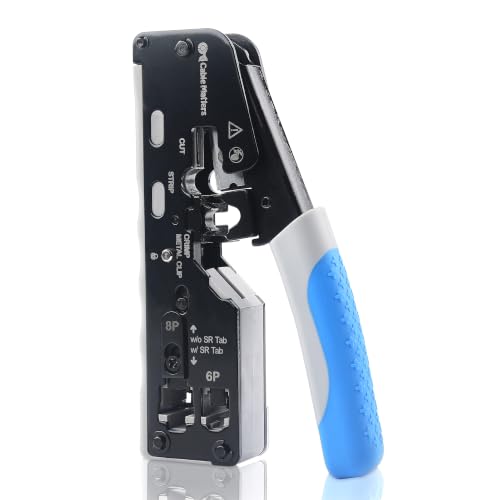
Ethernet termination is another separate category. Cable Matters’ all-in-one modular tool is listed for shielded Cat5 through Cat8 connectors and also supports RJ11, RJ12, and RJ45 formats. Its cutter, stripper, and crimper functions address network-cable preparation, but that design is not intended for power lugs.
Check the gauge or sleeve range
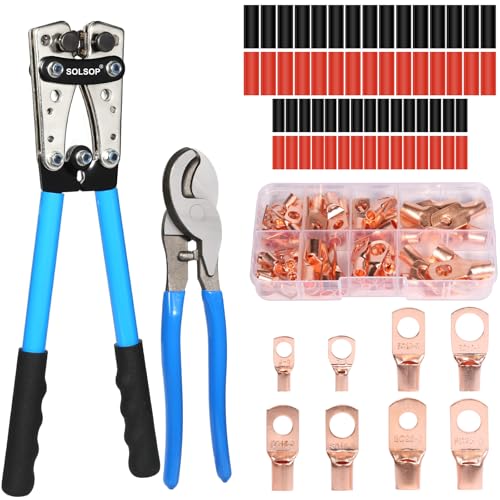
Range is one of the most important specifications. For small and medium battery wires, the Solsop kit covers AWG 10 through 1/0. The IWISS HX-50B covers 8 through 1/0, while the hydraulic YUZES and Cesilili tools cover 12 AWG through 2/0 AWG. Growlush extends from 12 AWG to 4/0 AWG, making it the broadest stated option in this comparison.
Large-cable users should confirm both ends of the range. The AMZCNC hammer crimper lists 8 AWG through 4/0 AWG, but its indent design and need for a hammer or vise create a different workflow from hydraulic tools. For wire rope, read the sleeve sizes rather than trying to convert them into electrical AWG. The AMZCNC wire-rope kit lists fractional-inch sizes, and Muzata specifies 1/8-inch railing cable.
Compare crimp control and die design
Die construction and the crimp shape influence how much control the tool provides. Several lug tools document hexagonal dies. IWISS specifies rotating EDM-cut dies and says the crimp can emboss a die-code number on the connector. Growlush lists US-standard hex dies, magnetic holders, and precision-machined profiles. These details help the user select and retain the appropriate die, but they do not replace checking the connector manufacturer’s requirements.
A ratcheting tool can help enforce a full cycle. Klein’s built-in ratchet is specifically described as ensuring full-cycle crimping, and its force dial adds adjustment. Hydraulic tools use a different operating method: Growlush and YUZES list 10-ton force, while Cesilili lists 6-ton force. These force ratings are specifications, not a guarantee that one tool will suit every terminal.
The AMZCNC hammer tool uses an indent crimp with a V-groove base. That can be useful for large uninsulated battery and welding connectors when the project has a stable work surface, but it is not the same connection style as the hex-crimp tools.
Consider access and operating method
Access matters when cables are already installed or space is limited. Growlush, YUZES, and AMZCNC’s hydraulic battery tool listings describe rotating heads. YUZES and AMZCNC specify 180-degree rotation, while Growlush lists a rotating head for confined spaces. Muzata’s C-style head also rotates 180 degrees for railing installation.
Manual tools can be simpler to position and maintain, but their operating requirements differ. The IWISS and Solsop tools use manual handles and rotating die arrangements. The hammer tool needs a sledgehammer or vise. Hydraulic models add pumping and pressure-release controls, with Growlush listing a quick-reset pressure relief valve and Cesilili listing a quick-release valve.
Look at the complete workflow
An integrated cutter can reduce the number of tools needed. IWISS includes a cutter rated for copper and aluminum cable up to 1/0 AWG, while the Solsop battery kit includes a cutter, ring terminals, and heat-shrink tubing. Muzata and the AMZCNC wire-rope kit also document cutting functions. Check limitations carefully: IWISS says its cutter is not for steel or ACSR cable, and the wire-rope listing says coated wire should be peeled before swaging.
For a ready-to-start battery project, the Solsop kit has the most extensive documented supply package among the selected manual battery tools. Supplied consumables are useful, but they should not outweigh connector compatibility.
Final recommendation
Growlush 10-Ton Hydraulic Crimper, 12 AWG–4/0 AWG ranks first overall in this specification-based comparison under the published weighted criteria.
Growlush is the highest-scoring returned product and the best cable crimpers choice when a broad heavy-cable range is the priority. Its 12 AWG to 4/0 AWG coverage, 11 dies, 10-ton hydraulic system, rotating head, and case give it the most specification-aligned specification mix for varied lug work. Choose IWISS instead when a manual hex-lug tool with a documented cutter and die-code embossing is more useful. For small insulated terminals, Klein Tools is the focused choice; for Ethernet, choose Cable Matters; for railing or wire rope, choose Muzata or AMZCNC’s swaging kit.
Among the top cable crimpers, the right pick depends on whether the project uses electrical lugs, modular plugs, or sleeves. Confirm the cable material, connector type, size, and required crimp profile before ordering. The supplied listings establish features and ranges, but they do not constitute hands-on testing or customer-opinion evidence.
Frequently Asked Questions
What should I check first when choosing the best cable crimpers?
Check the connector type and size range first. A battery-lug crimper, insulated-terminal crimper, wire-rope swager, and Ethernet crimper use different dies and are not interchangeable. Then compare the crimp profile, operating mechanism, and any cutter or supplies included.
Are hydraulic cable crimpers better for every job?
Not necessarily. Hydraulic models such as Growlush, YUZES, and Cesilili are documented for larger lug ranges and hydraulic force. A manual IWISS or Solsop tool may better suit a user who wants rotating dies and a simpler hand-operated workflow. A hammer tool may fit large uninsulated connectors when a vise or sledgehammer is available.
Cable Matters is the selected Ethernet option. Its listing identifies shielded Cat5, Cat6, Cat6A, Cat7, and Cat8 connectors, plus RJ11, RJ12, and RJ45 compatibility. It combines cutting, stripping, and crimping for modular network cable work.
Can a battery-cable crimper swage wire-rope sleeves?
Do not assume so. The wire-rope AMZCNC kit and Muzata CK12 list sleeve or cable-railing applications and fractional-inch sizes. Battery-cable tools in this comparison list electrical lug applications and AWG ranges. Use the tool whose supplied evidence matches the sleeve, cable, and connector system.
What does a rotating head help with?
A rotating head can provide positioning flexibility in confined spaces. Growlush lists a rotating head, while YUZES, AMZCNC’s hydraulic battery tool, and Muzata document 180-degree rotation. This feature may make alignment easier, but the correct die and connector range remain essential.