Buying Guide
Choosing the best wire crimpers starts with the connector, cable size, and working space—not with a general claim that one tool suits every job. The products in this comparison fall into four useful groups: fixed-jaw terminal crimpers, ratcheting heat-shrink tools, multifunction stripper-crimper pliers, and interchangeable-die systems. One selected tool is dedicated to large battery lugs, so large-cable work should be considered separately from ordinary electrical terminals.
Gauge coverage is the first filter. Several selected tools document the common 10–22 AWG range, including the Klein Tools 3005CR, Klein Tools 1005, Klein Tools 2005N, and WORKPRO 9.5-Inch Wire Cutter/Crimper. That range is useful for many insulated and non-insulated terminal jobs, but the stated connector type still matters. A tool can cover the right gauge without being documented for the terminal you have.
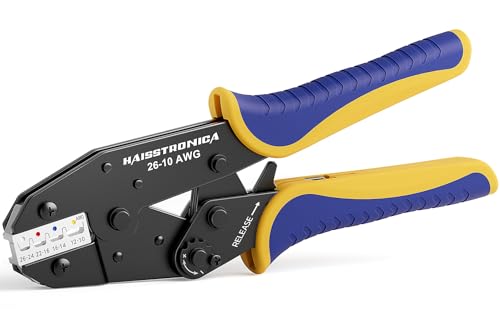
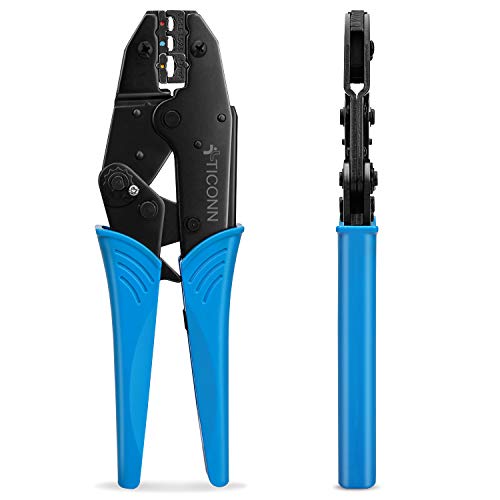
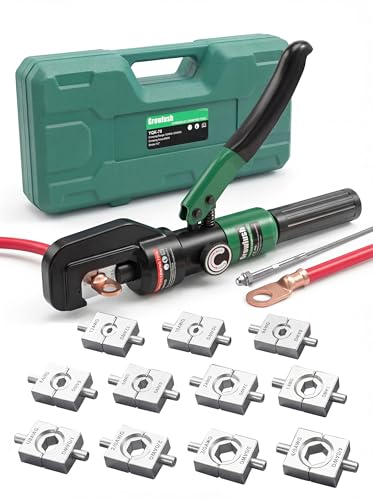
The haisstronica HS-8327 extends its listed heat-shrink range from AWG 26 through 10, while the TICONN 30C is specified for AWG 22–10 splices. For larger power cables, the IWISS iCrimp HX-50BI is in a different class: its documented die sizes run from 8 AWG through 1/0 AWG. Its long handles and heavier body are evidence of a large-cable format, not a reason to use it for small terminals.
Check connector compatibility
Connector compatibility separates a basic crimper from a more adaptable system. The Klein Tools 3005CR lists three cavities for red, blue, and yellow insulated terminals. The Klein Tools 1005 and 2005N explicitly cover insulated and non-insulated terminals. These fixed-jaw tools can be easier to understand when your connector type is consistent.
For mixed projects, the Vesmikit 6-Piece Ratchet Crimper Set and ELEAD 200-Piece Ratchet Crimper Kit document several interchangeable jaw types. Their listed applications include heat-shrink, insulated nylon, non-insulated terminals, ferrules, and open-barrel terminals. A multi-die tool may reduce the need for separate crimpers, but it also requires choosing and installing the correct jaw.
Even within the selected products, the evidence varies. The TICONN and haisstronica tools emphasize heat-shrink connectors, while the IWISS tool is built around battery lugs. Treat those descriptions as the boundary of documented use.
Decide whether you need a ratchet
A ratcheting mechanism can hold a connector while the wire is positioned and can require a complete handle cycle before release. The Klein Tools 3005CR, Vesmikit, haisstronica HS-8327, TICONN 30C, and ELEAD kit all document ratcheting features.
A ratchet is not automatically better for every task. A fixed-jaw tool such as the Klein Tools 1005 may be preferable when you want a simpler cutter-crimper with a tapered nose. A ratcheting tool can add bulk and a release step, while a traditional plier-style tool can be quicker for occasional terminal work. The best wire crimpers for a repair kit may therefore differ from the best choice for repeated connector assembly.
If you regularly prepare wire before crimping, an integrated stripper and cutter can save tool changes. The Klein Tools 2005N combines crimping, stripping, a hardened nose cutter, and a shear cutter. The Klein Tools 1001 adds stripping, two cutters, gripping functions, and bolt shearing.
The WORKPRO tool also adds gripping jaws and cutting to its crimping function. These combination tools are useful when portability matters, but their extra functions may make the head wider or their crimping design less specialized than a dedicated ratcheting tool. Check the documented stripping range separately from the crimping range: the 2005N strips 10–18 AWG stranded wire even though its crimping range is 10–22 AWG.
Evaluate access, grip, and storage
A tapered nose can help in confined spaces. The Klein Tools 1005 and WORKPRO tool both document tapered designs, while the Klein Tools 2005N is a relatively compact wire-service format. Handle information also matters for repeated work. The Klein Tools 3005CR has dual-material molded grips; the WORKPRO tool uses a bi-material anti-slip handle; and the ratcheting heat-shrink tools list cushioned or non-slip handles.
Storage is more important when you select interchangeable dies or a kit. The Vesmikit set includes a hard plastic case, and the ELEAD kit includes a storage case for its tool, jaws, and terminals. That organization may help transport, but the added pieces require more room than a single fixed-jaw crimper.
Use construction claims carefully
The supplied listings identify different construction details, including high-hardness heat-treated steel for WORKPRO, forged CR-V steel for the WORKPRO design, high-strength 40CR jaws for ELEAD, and chrome vanadium steel for the IWISS cutter. These details describe the stated materials and construction; they do not establish a hands-on durability result. Similarly, a warranty can add documented coverage, but it is not a substitute for matching the tool to the connector.
Final recommendation
Vesmikit 6-Piece Ratchet Crimper Set ranks first overall in this specification-based comparison under the published weighted criteria.
Klein Tools 3005CR is the highest-scoring returned product and the first overall specification-based choice among these best wire crimpers. Its 10–22 AWG insulated-terminal range, three marked cavities, full-cycle ratchet, adjustable force, and dual-material grips form the clearest all-around specification package for common insulated terminal work.
Choose the Vesmikit 6-Piece Ratchet Crimper Set when connector variety is more important than a fixed-jaw format. Choose the IWISS iCrimp HX-50BI for documented battery-lug sizes up to 1/0 AWG, and choose the Klein Tools 1005 or WORKPRO tool for a simpler cutter-crimper with common-gauge coverage. For wire preparation, the Klein Tools 2005N and 1001 add useful stripping and cutting functions. The haisstronica HS-8327 and TICONN 30C are focused heat-shrink options, while the ELEAD kit provides a documented multi-jaw system with organized storage. These are practical ways to narrow the top wire crimpers by task rather than by a single universal ranking.
Frequently Asked Questions
What should I check before buying the best wire crimpers?
Confirm the wire gauge and connector type first. A 10–22 AWG crimper may be suitable for common terminals, but the listing should also identify insulated, non-insulated, heat-shrink, ferrule, open-barrel, or battery-lug compatibility. Then check whether you need a cutter, stripper, ratchet, adjustable force, or interchangeable dies.
Are ratcheting crimpers suitable for every wiring job?
No. Ratcheting models are useful when you want a complete cycle, adjustable force, or the ability to hold a connector while positioning wire. Fixed-jaw tools can be more direct for occasional work, especially when they include a tapered nose or integrated cutter. Select the mechanism that matches the connector and working pattern documented for your project.
The IWISS iCrimp HX-50BI has the largest documented range, covering 8, 6, 4, 2, 1, and 1/0 AWG battery lugs. It uses rotating dies and a hex-crimp design. Its size and weight indicate a specialized large-cable tool rather than a general substitute for small-terminal crimpers.
They can combine several documented tasks, but the ranges may differ by function. The Klein Tools 2005N, for example, crimps 10–22 AWG terminals and strips 10–18 AWG stranded wire. Read each function’s stated range instead of assuming the crimping range applies to stripping or cutting.
What are the top wire crimpers for mixed connector types?
The Vesmikit 6-Piece Ratchet Crimper Set and ELEAD 200-Piece Ratchet Crimper Kit document interchangeable jaws for several connector families. They are the most adaptable selected options on paper, but you still need to match the installed die and connector style before use.