Buying Guide
Choosing among the best caddy napkin holders starts with the type of napkins you use and the other items you want nearby. The products in this comparison fall into three useful formats: upright dining-table organizers, rotating napkin-and-condiment caddies, and compartmentalized bar organizers. Each format solves a different tabletop problem, so the right choice is less about a universal winner and more about matching documented features to your setup.
Upright holders are a sensible fit for standard paper napkins used at everyday meals. Baajradu, Audmore, MZROO, and Decent Vrvege all describe vertical napkin storage, which keeps the napkins standing rather than spread across a flat tray. That arrangement can make individual napkins easier to pull and leaves room for seasonings or other tabletop supplies beside them.
Bar-style caddies are better suited to cocktail or beverage napkins. BARsics specifically documents a compartment for 5-by-5-inch napkins. Mifoci and Restaurantware also include dedicated cocktail-napkin sections. Before ordering, compare the holder’s stated napkin format with the size you normally buy. A caddy designed around beverage napkins may not be the best match for larger luncheon napkins.
Decide whether rotation helps
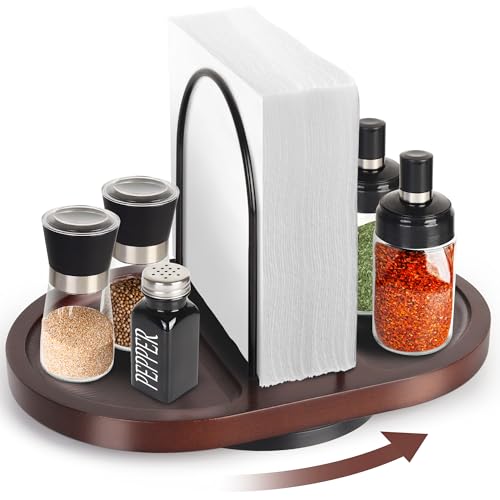
A rotating base can improve access when several people sit around a table. Baajradu, Primo Lines, and Gomyrod all document 360-degree rotation, allowing users to turn the napkins and condiments toward them instead of reaching across the table. This is especially useful for shared dining tables, gatherings, or a central kitchen island.
Rotation is not automatically necessary. A fixed metal or wood holder may take a simpler approach and can be easier to position against a wall or at the back of a counter. Audmore, Guijinga, and the bar caddies are better considered when direct placement and compartment layout matter more than access from every angle. Also check the available footprint: rotating organizers can occupy more surface area than a flat or compact two-section holder.
Match companion storage to your routine
A caddy becomes more useful when its extra compartments match the items you actually keep on the table. Audmore, MZROO, and Decent Vrvege are oriented toward salt, pepper, spices, or condiments. Guijinga goes further with a silverware compartment and included shakers, making it suitable for meals where cutlery needs to travel with the napkins.
For beverage service, Mifoci and Restaurantware provide six compartments, with two larger napkin areas and four smaller sections. Those smaller sections can organize straws, stirrers, toothpicks, skewers, or spices, depending on the documented design. BARsics has a more restrained two-compartment layout, which may be preferable when you need only napkins plus a small accessory area.
Compare materials and surface protection
The selected products use wood, metal, stainless steel, plastic, acrylic, or combinations of those materials. Baajradu combines bamboo and metal; Primo Lines and Gomyrod use wood with metal; MZROO and Decent Vrvege specify acacia wood; and Guijinga combines an acacia base with an iron frame. These materials create a more traditional or farmhouse-oriented appearance, but the wood listings generally call for wiping rather than machine washing.
Audmore, BARsics, and Mifoci use metal or stainless steel, while Restaurantware uses plastic. Metal and plastic can be appealing for a service area where a straightforward wipe-down is important. Mifoci’s listing specifically identifies 304 stainless steel but also cautions that metal items may bend if squeezed. That qualification is worth considering when handling or transporting the caddy.
Protective feet or pads are useful details for hard tabletops. Audmore lists four soft cushions, Gomyrod lists soft foot cushions, Primo Lines lists a non-slip bottom pad, and Guijinga lists a non-slip silicone pad. These features are documented for surface protection or stability, but they should not be treated as proof that a holder cannot move under every condition.
Consider carrying and setup
Handles are helpful when the napkin holder moves between the kitchen, dining table, patio, or picnic area. MZROO, Decent Vrvege, and several broader caddy designs document handles or portable use. Guijinga is described as ready to use without installation, while Baajradu also requires no assembly. Primo Lines, Gomyrod, and Audmore involve assembly according to their listings, so factor that into your setup preference.
A portable design may be worthwhile for parties, outdoor meals, or buffet service, but portability should be balanced against stability. A heavier wood base or metal body may feel more planted on a table, while a lighter holder is easier to move. The supplied listings do not provide standardized real-world stability testing, so use the stated materials, pads, and dimensions as comparison points rather than guarantees.
Check dimensions before buying
Measure the intended surface before selecting among the best caddy napkin holders. Several dining-table organizers have footprints around 9 to 10 inches in one direction, while BARsics is listed at 6.5 by 5 by 5 inches. Mifoci and Restaurantware are longer because they provide multiple compartments. A larger organizer may consolidate more supplies, but it can crowd a small café table or kitchen counter.
Height also affects placement. Upright holders can make napkins easy to see and reach, whereas a low flat format may work better under cabinets or on a narrow buffet. The supplied products in this final selection emphasize upright and compartmentalized designs; choose based on clearance, napkin size, and whether the holder will sit in the center of a shared table.
Final recommendation
Baajradu Rotating Napkin and Condiment Caddy ranks first overall in this specification-based comparison under the published weighted criteria.
Baajradu is the highest-scoring returned product and the first overall specification-based choice among the best caddy napkin holders. Its rotating base, bamboo-and-metal construction, vertical napkin slot, divided condiment storage, and no-assembly setup provide the broadest documented mix of everyday table features.
The top caddy napkin holders are not identical. Choose Primo Lines or Gomyrod if rotating access is the priority, MZROO or Decent Vrvege for a portable wood organizer, and Audmore for a compact metal format. Guijinga is the most suitable selected option when silverware belongs with the napkins. For bars, coffee stations, and service counters, Mifoci offers the most compartmentalization, BARsics favors a compact two-section layout, and Restaurantware provides a commercial-oriented plastic alternative.
Frequently Asked Questions
What makes the best caddy napkin holders different from a basic napkin tray?
A caddy generally combines a napkin compartment with storage for related tabletop items. In this selection, those extras include salt and pepper shakers, condiments, spices, silverware, straws, stirrers, and toothpicks. A basic flat holder may be preferable when you need only napkins, while a caddy is more useful when consolidating several dining supplies is the goal.
Are rotating napkin caddies worth considering for a dining table?
They can be useful when several diners need access from different sides. Baajradu, Primo Lines, and Gomyrod document 360-degree rotating bases. Rotation may reduce the need to reach across the table, but these designs can require more surface area and may involve assembly. Measure the table and check whether the added condiment storage is useful for your routine.
Which selected caddies are suited to cocktail napkins?
BARsics specifically identifies a 5-by-5-inch napkin compartment. Mifoci and Restaurantware also document sections for cocktail napkins. If you use larger luncheon or casual napkins, compare their dimensions with the product listing before choosing a bar-style caddy. MZROO also states that it accommodates cocktail or beverage napkins in addition to other listed formats.
Which materials are represented in this comparison?
The selected products include bamboo and metal, solid wood and metal, acacia wood, iron, stainless steel, and plastic. Wood-oriented models support farmhouse or rustic décor, while stainless steel and plastic suit bar or service areas. Material alone does not establish performance; review the stated cleaning instructions, protective pads, dimensions, and intended use together.
Do these holders include napkins, shakers, or other supplies?
Most listings describe the holder as an organizer and note that napkins or shakers are not included. Guijinga is the selected exception that states salt and pepper shakers are included. Check the individual listing contents before purchase, especially if you need a complete tabletop set rather than an empty caddy.