Buying Guide
The best metal napkin holders differ by how they manage access, stack control, footprint, and setting. A holder for a sheltered kitchen counter can be slim and upright, while a patio holder may need a weighted arm or raised base. This is a specification-based comparison using supplied public listing data, not a hands-on test or a summary of customer opinions.
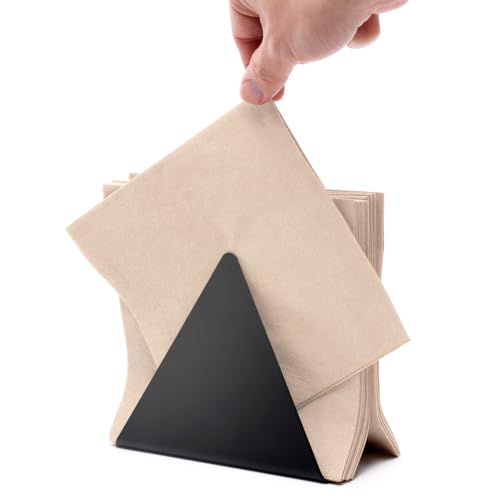
Upright holders are generally the most space-conscious choice. WIVKFML, LAIHIFA, xympo, LWSFF, Umbra, and NBPUJ use vertical or standing formats documented for countertops or dining tables. Their narrow dimensions can help when other tableware already occupies much of the surface. Upright designs make the visible stack easy to identify, although most listings do not give a numerical capacity.
Flat holders place napkins horizontally in a tray-like frame. ROLHABIK, GMFINE, and hiwafifi use weighted arms to keep the stack organized. This format can suit large stacks or breezy outdoor service, but the square footprints listed for these products take more room than the narrowest upright options. Flat designs are worth considering when quick access and stack control matter more than minimizing depth.
New Star Foodservice is a commercial-style option. Its stainless steel body, two compartments, and spring-loaded release make it appropriate for organized service rather than purely decorative use. Check the listed footprint against the available counter.
Match capacity and napkin size
Capacity is not consistently documented, so do not infer that a visually large holder has a specific count. ROLHABIK explicitly states an 80-standard-napkin capacity. GMFINE lists standard, luncheon, cocktail, coffee, and wedding napkins, while hiwafifi names dinner, cocktail, guest-towel, and buffet napkins. New Star Foodservice uses two compartments, which may help separate napkin types.
For the other upright models, the evidence supports paper-napkin organization but does not provide a reliable numerical capacity. xympo specifically emphasizes standard paper napkins. If you use thick luncheon napkins, folded guest towels, or multiple formats, prioritize a listing with explicit compatibility rather than assuming all holders are interchangeable.
Consider access and refill behavior
A weighted arm can keep a flat stack from shifting while allowing removal. GMFINE’s arm is described as removable and adjustable, and ROLHABIK and hiwafifi document weighted arms. These features are relevant for outdoor tables or busy serving areas. The trade-off is that the arm adds a moving component and the broad flat form needs more room.
Upright holders provide a different access pattern. New Star’s spring-loaded release is the most specifically described dispensing feature. xympo emphasizes a self-adjusting design and wide opening for refilling. For shared tables, look for direct evidence about retrieval and refill behavior rather than relying on appearance alone.
Check stability and protect the surface
Surface contact is an important distinction among the best metal napkin holders. WIVKFML and GMFINE list silicone pads, while New Star Foodservice lists nonslip rubber feet. LWSFF uses an elevated circular base, and ROLHABIK’s selected flat model uses raised spherical feet. These details can help separate a holder from a damp surface or reduce movement, but the listings do not establish performance under every table or weather condition.
Weighted arms help manage the stack, not necessarily the holder itself. A broad base can be useful, while a lightweight narrow holder may be easier to carry. Choose the stability feature that matches the use case: pads for surface contact, raised feet for separation, or an arm for holding napkins down.
Compare construction and finish
New Star Foodservice specifies stainless steel and resistance to rust and corrosion. ROLHABIK, LAIHIFA, WIVKFML, and other models specify iron or metal construction. xympo lists powder-coated steel, while LWSFF lists a rust-resistant finish. These descriptions can inform maintenance expectations, but they are not equivalent to an independent durability or corrosion test.
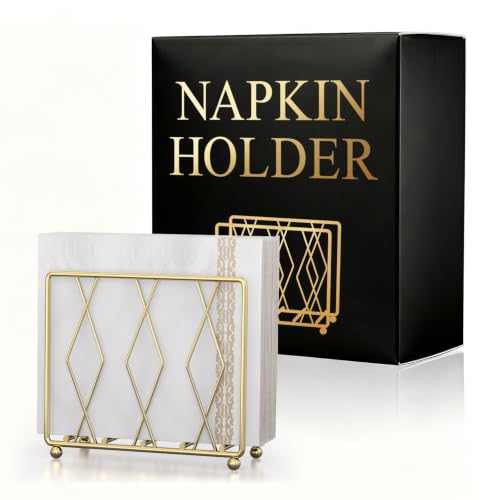
Finish affects the visual match. Black models such as ROLHABIK, xympo, LAIHIFA, hiwafifi, Umbra, and NBPUJ suit modern, industrial, or farmhouse settings. LWSFF adds a gold accent, and New Star Foodservice provides a stainless-steel appearance. NBPUJ combines matte-black metal with a wood base for a warmer mixed-material look.
Measure the available surface
Small spaces favor narrow upright designs. WIVKFML lists a 2.75-inch width, LAIHIFA 2.16 inches, xympo 2.4 inches, and LWSFF 2.13 inches. NBPUJ lists a 1.97-inch depth, making it particularly shallow on paper. By contrast, ROLHABIK and GMFINE list 7-by-7-inch dimensions, and hiwafifi lists a 7.1-by-7.1-inch format.
Account for access space around the holder, not just the published dimensions. A dispenser against a backsplash may be difficult to refill, and a flat holder near a plate may interfere with serving. The measurements here come from the supplied listings; allow additional clearance where practical.
Final recommendation
New Star Foodservice Tall Stainless Steel Dispenser ranks first overall in this specification-based comparison under the published weighted criteria.
The final choice among the best metal napkin holders depends on the features that match your intended use. New Star Foodservice is the first specification-based choice for stainless steel construction, dual compartments, a spring-loaded mechanism, and nonslip feet. It fits organized home-office, café, or restaurant service better than a purely decorative table.
For outdoor use, ROLHABIK Flat Holder with Weighted Arm and GMFINE Flat Napkin Holder with Weighted Arm are the most directly documented options because both use weighted arms. ROLHABIK also states an 80-napkin capacity, while GMFINE lists multiple napkin sizes. For tight counters, WIVKFML, LAIHIFA, xympo, LWSFF, and NBPUJ offer compact upright or shallow profiles. Umbra is a design-led choice when an integrated divider and carrying handle matter. These are the top metal napkin holders in this comparison based on documented specifications, not customer sentiment or hands-on testing.
Frequently Asked Questions
Start with the napkin format and available surface. Choose a documented weighted arm for outdoor or breezy use, explicit multi-size compatibility for mixed napkins, or a narrow upright profile for a crowded counter. Also check whether the listing specifies feet, pads, an elevated base, or another surface-contact feature.
Are flat or upright napkin holders better for patios?
A flat holder with a weighted arm is the more directly documented patio-oriented format in this selection. ROLHABIK, GMFINE, and hiwafifi describe indoor-outdoor use, and their weighted arms help keep the stack in place. An upright holder may still be portable, but the supplied evidence does not establish equal wind performance for every design.
Which selected holder is best for mixed napkin sizes?
GMFINE provides the clearest compatibility statement, listing standard, luncheon, cocktail, coffee, and wedding napkins. Hiwafifi also names dinner, cocktail, guest-towel, and buffet napkins. These claims come from the product listings, so confirm the dimensions of your own napkins before ordering.
Which option takes the least counter space?
NBPUJ lists a 1.97-inch depth, while LWSFF, LAIHIFA, and WIVKFML list narrow dimensions around 2.13 to 2.75 inches in one direction. Actual placement depends on orientation and the clearance needed for removal and refilling.
Is stainless steel necessary for a home napkin holder?
Not necessarily. Stainless steel is specifically documented for New Star Foodservice, while other selected products use iron or metal with finishes such as powder coating, matte coating, or a rust-resistant treatment. The right choice depends on appearance, placement, napkin format, and documented stability features rather than material alone.