Buying Guide
The best spirulina supplement capsules differ most clearly in serving disclosure, ingredient scope, and quality documentation. Start by deciding whether you want standalone spirulina or a broader algae-and-greens blend. Then compare the amount stated per serving, the number of capsules required, dietary exclusions, and the quality claims that are specific enough to verify from the listing.
Choose standalone spirulina or a blend
Standalone formulas keep the ingredient decision simple. Nutricost, BulkSupplements.com, Nautical Elements, HCL Herbal Code Labs, Complete Natural Products, NOW Foods, and Nature’s Way are presented as spirulina-focused products. That format makes it easier to compare the stated spirulina amount directly.
Teaveli adds chlorella in a documented 50:50 blend, while Snap Supplements adds chlorella, alfalfa, and wheatgrass. These are not interchangeable with a standalone product: they may fit a routine built around several green ingredients, but the supplied information does not identify as much standalone spirulina in each capsule.
Compare the stated serving amount
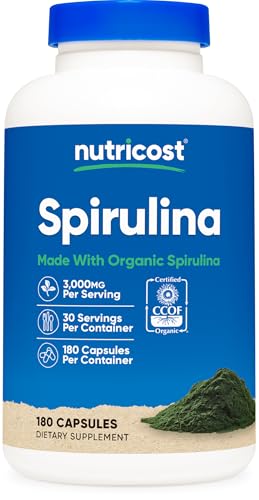
A label that gives an amount per capsule or serving is more useful than a general nutrient description. Nutricost and HCL Herbal Code Labs state 3,000mg per serving. BulkSupplements.com describes a 3,000mg formulation and six capsules per serving. Nautical Elements lists 3,000mg, 240 capsules, and 40 servings. These details help show how the bottle count relates to daily use.
Other products use lower or undisclosed amounts. Complete Natural Products identifies 470mg capsules, and NOW Foods identifies 500mg capsules. Nature’s Way provides directions based on two capsules but does not state the spirulina weight in the supplied listing. For Teaveli, the 600mg figure applies to the combined spirulina-and-chlorella powder, not spirulina alone. Snap Supplements does not provide an individual amount for spirulina.
Review capsule and dietary details
Vegetarian or vegan positioning matters if you avoid animal-derived capsule materials or ingredients. Nutricost is vegetarian; HCL Herbal Code Labs describes veggie capsules; NOW Foods and Nature’s Way list vegetarian or vegan suitability; Teaveli and Snap Supplements are described as vegan. The supplied listings do not consistently identify whether every capsule shell is made from a particular plant material, so do not infer that detail where it is absent.
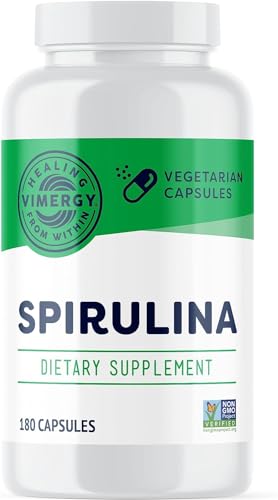
Also check exclusions. Nutricost lists gluten-free and non-GMO attributes. Vimergy lists vegan, kosher, gluten-free, paleo-friendly, and no fillers, binders, sugar, colors, or flavors. Nature’s Way excludes wheat, corn, soy, dairy, gelatin, and artificial colors, flavors, or preservatives. Snap Supplements lists major-allergen exclusions and gluten-free positioning. These claims are useful for narrowing choices, but they do not replace advice from a qualified clinician about individual dietary or health needs.
Weigh certification and testing language
Quality evidence is most specification-aligned when the listing names a certification, testing program, or manufacturing standard. Nutricost identifies CCOF certification and third-party testing. BulkSupplements.com cites third-party testing and cGMP-compliant production. NOW Foods describes GMP quality assurance and ISO/IEC accredited laboratory testing. Micro-level distinctions matter: a general phrase such as laboratory tested conveys less detail than a named certification or testing standard.
Nautical Elements makes an important qualification by saying its powder is organic while the finished capsules are not certified organic. Complete Natural Products describes USA manufacturing and quality testing but gives limited method detail. HCL Herbal Code Labs refers to certificates of analysis and production testing without naming a certifying body in the supplied evidence. Treat each statement according to what it actually documents.
A focused formula can be preferable when you want to track spirulina separately from other greens. A blend can be appropriate when you intentionally want multiple algae or plant ingredients, but the amount of each component should be clear. Teaveli provides a 50:50 ratio, which is more transparent than an unnamed blend. Snap Supplements names four green ingredients but does not provide their individual amounts.
Capsule count also affects routine planning. The selected products range from 100 to 240 capsules, with some listings giving serving counts and others giving only bottle counts. Do not assume that a larger bottle means fewer daily capsules. Use the stated serving directions and amount together, and confirm the current label before using any supplement.
How this comparison was made
This is a specification-based comparison using the supplied public listing data. Products were screened for a genuine capsule format containing spirulina, then assessed on capsule usability, disclosed spirulina amount, ingredient and dietary information, testing or quality evidence, and formula focus. The ranking does not represent hands-on testing or customer-opinion analysis. Product claims are reported cautiously and only where the supplied listings provide support.
Final Recommendation
Nutricost Spirulina 3,000mg, 180 Capsules ranks first overall in this specification-based comparison under the published weighted criteria.
Nutricost Spirulina 3,000mg is the first overall specification-based choice among these best spirulina supplement capsules because it pairs a clear serving amount with CCOF organic certification, third-party testing, and a focused vegetarian formula. BulkSupplements.com is a close alternative when testing and cGMP information are priorities, while Vimergy is appealing for its additive-free positioning and broad dietary fit.
Choose Nautical Elements if a 240-count bottle and 3,000mg serving are useful, but note its finished-product certification qualification. NOW Foods and Nature’s Way provide established-looking specification detail in different ways: NOW Foods supplies a richer nutrient and laboratory description, while Nature’s Way gives especially clear directions and exclusions. Complete Natural Products and HCL Herbal Code Labs suit shoppers comparing specific origin, non-irradiated, or serving claims.
For the top spirulina supplement capsules that also include other green ingredients, Teaveli is the more transparent blend because it states a 50:50 ratio. Snap Supplements is broader still, with four named green ingredients, but its individual spirulina amount is not disclosed. In every case, compare the current label with your dietary requirements and ask a healthcare professional about suitability, especially if you have allergies, take medication, or are pregnant or nursing.
Frequently Asked Questions
What should I look for in the best spirulina supplement capsules?
Look first for a clearly stated amount per capsule or serving, capsule count, dietary compatibility, and specific quality evidence. A named certification, third-party testing statement, or manufacturing standard is more informative than broad promotional wording. Also decide whether you want standalone spirulina or a blend with chlorella and other greens.
Are spirulina and chlorella capsules the same as standalone spirulina capsules?
No. Teaveli documents a 50:50 spirulina-and-chlorella blend, and Snap Supplements combines spirulina with chlorella, alfalfa, and wheatgrass. Those products may fit a multi-green routine, but their listings do not present them as equivalent to a standalone spirulina capsule. Compare the formula scope and any stated ratios before choosing.
How many spirulina capsules should an adult take?
The answer depends on the product label. Nature’s Way lists two capsules three to four times daily with food, while other products provide different serving structures, such as 30 or 40 servings per bottle. Do not transfer directions from one product to another. Follow the current package instructions and seek professional guidance when health conditions or medications are involved.
Does organic on the ingredient mean the finished capsules are certified organic?
Not necessarily. Nautical Elements specifically states that its powder is organic but the finished capsules are not certified organic. When certification matters, look for wording that applies to the finished product or the relevant ingredient, and distinguish that from a general organic sourcing statement.
Can the capsules be opened and mixed into a drink?
Some listings say they can. Vimergy describes opening its capsules and combining them with water, juice, or a smoothie, and Nautical Elements similarly mentions mixing its powder into juice or smoothies. Other products in this comparison do not provide that instruction, so follow the product’s own label rather than assuming every capsule should be opened.