Buying Guide
The best vegan spirulina supplements are not interchangeable even when each listing names spirulina as the main ingredient. The practical differences are the physical format, stated amount, source information, processing exclusions, and quality documentation. Use those details to narrow the list rather than relying on broad wellness language.
Choose tablets, capsules, or powder
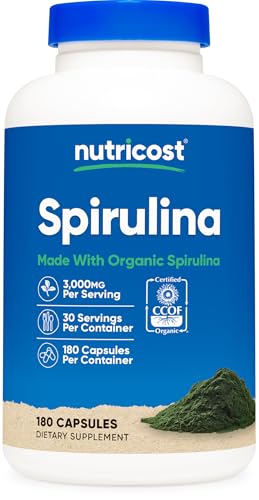
Tablets and capsules are the simplest choices when you want a pre-portioned format. Nutrex Hawaii provides 500 mg tablets, while NOW Foods states 1,000 mg per tablet. Carlyle lists 3,500 mg per serving, and Micro Ingredients gives 3,000 mg per serving but does not say how many tablets make that serving. These distinctions matter: a serving number is more useful when the listing also explains the number of units involved.
Capsules can be practical for travel and avoid the need to mix a powder. BulkSupplements.com lists six capsules per serving, and Organic Veda lists 120 vegan capsules but does not provide a numeric spirulina amount in the supplied evidence. Check the serving directions on the package before comparing capsule products by count alone.
Powder is better suited to smoothies, juice, food, or baking. Nutrex Hawaii directs users to take one teaspoon in food or beverages. Vimergy names water, juice, and smoothies, while Yupik specifically mentions smoothies, shakes, and baking. BulkSupplements.com gives a 3-gram serving for its 1-kilogram organic powder. Powder lets you adjust how it is mixed, but it requires a scoop or measuring spoon and may be less convenient than a finished tablet or capsule.
Compare ingredient and sourcing disclosures
Look for a listing that identifies spirulina clearly and states whether the formula contains fillers, binders, flavors, or other ingredients. Vimergy says its powder is made without anti-caking agents, fillers, binders, sugar, colors, or flavors. Organic Veda describes 100% pure Spirulina platensis with no fillers or additives.
Source information can also distinguish otherwise similar products. Nutrex Hawaii identifies cultivation in Kona and lava-filtered Hawaiian aquifer water. That is more specific than a general statement about where a product is packaged. By contrast, a listing that only says “made in USA” should not be treated as proof that the raw spirulina was grown domestically. Micro Ingredients states made in USA, while its supplied evidence does not identify the cultivation location.
Spirulina listings commonly mention protein, amino acids, chlorophyll, vitamins, minerals, phycocyanin, or beta-carotene. These are useful clues about what the seller discloses, but they are not a substitute for a complete Supplement Facts panel. Micro Ingredients lists 3,000 mg per serving and describes protein, vitamins, minerals, amino acids, and prebiotics. NOW Foods highlights beta-carotene, vitamin B-12, and naturally occurring GLA. Yupik identifies protein and iron without presenting a full quantified panel.
If a particular nutrient is important to you, confirm its amount on the current package label. Do not infer that two products with the same tablet count provide the same serving amount, and do not assume a broad nutrient description establishes a clinically meaningful dose.
Quality documentation varies considerably. Micro Ingredients states third-party lab testing for purity and safety. BulkSupplements.com refers to third-party testing and a cGMP-compliant facility for both its capsule and organic powder listings. NOW Foods provides GMP quality assurance and says its in-house laboratories are ISO/IEC accredited.
A claim such as “laboratory tested” is less informative when the listing does not say what was tested or who performed the testing. Compare the exact wording, and check whether the package or manufacturer provides a current certificate or testing explanation. The absence of supplied testing details does not prove a product lacks testing; it simply gives you less public evidence for comparison.
Check vegan and certification wording
NOW Foods explicitly states vegan/vegetarian and USDA Organic. Carlyle uses “vegetarian formula,” so shoppers who require an explicit vegan statement should verify the current label rather than treating those terms as identical.
Also check whether the certification applies to the ingredient, the finished product, or the manufacturing process. A clean free-from list can be useful, but it does not automatically establish an organic certification. Match the product’s stated documentation to your own dietary requirements.
Make the serving fit your routine
Start with the product’s label directions rather than copying the amount from another listing. Tablet counts can range from 120 to 1,000, while powder sizes range from 8.8 ounces to 1 kilogram in this comparison. A larger container is not automatically a better fit if you use spirulina occasionally or prefer a portable format.
For powders, consider how you will mix them and whether the listing identifies a flavor or food application. For tablets and capsules, review the number of units per serving and the tablet or capsule form before deciding.
Final Recommendation
NOW Foods Organic Spirulina 1000 mg Tablets ranks first overall in this specification-based comparison under the published weighted criteria.
Nutrex Hawaii Pure Hawaiian Spirulina Tablets is the first overall specification-based choice among these best vegan spirulina supplements because it combines detailed Hawaiian sourcing, a defined tablet format, vegan and non-GMO positioning, and a no-filler statement. Its 500 mg tablets suit shoppers who prefer a solid format and want the cultivation origin described in the listing.
Micro Ingredients Organic Spirulina 720 Tablets is the better fit for a large-count tablet routine with a stated 3,000 mg serving and third-party lab-testing disclosure. Nutrex Hawaii Pure Hawaiian Spirulina Powder is the leading powder-format alternative for shoppers who want specific origin information and a one-teaspoon food-or-beverage direction. NOW Foods Organic Spirulina 1000 mg Tablets stands out for named organic and laboratory-quality information.
Among the top vegan spirulina supplements, the right selection still depends on how you take it. Choose powder when smoothies, juice, or recipes are already part of your routine; choose tablets or capsules when portability and pre-portioned use matter more. Before using any supplement, read the current label and consider whether its ingredients and serving directions suit your needs.
Frequently Asked Questions
What should I compare in the best vegan spirulina supplements?
Compare the format, stated serving amount, ingredient simplicity, source information, testing details, and dietary certifications. A product with a large count may not have the same amount per serving as another product with a smaller count. Also distinguish explicit vegan wording from vegetarian wording when that matters to your diet.
Are spirulina tablets or powder easier to use?
Tablets and capsules generally require less preparation, while powder is designed to be mixed into food or drinks. Nutrex Hawaii gives a teaspoon direction for its powder, Vimergy mentions water, juice, and smoothies, and Yupik lists smoothies, shakes, and baking. The most suitable format is the one that matches your established routine and the label’s directions.
Does organic spirulina always include third-party testing?
No conclusion like that is supported by the supplied listings. NOW Foods provides organic and laboratory-quality details, Micro Ingredients states third-party lab testing, and BulkSupplements.com describes third-party testing for its selected products. Other listings may identify organic status without supplying the same testing detail. Check the current product documentation for the exact certification and testing language.
How much spirulina should I take?
Follow the serving directions on the current product label rather than applying one amount to every product. The selected listings include 500 mg tablets, 1,000 mg tablets, 3,000 mg servings, 3,500 mg servings, and powder directions measured by teaspoon or grams. These figures are not interchangeable, and the supplied evidence does not establish a universal dose.
Are all products in this comparison single-ingredient spirulina?
No. The selected products focus on spirulina, but the listing language differs. Organic Veda describes 100% pure Spirulina platensis, while other products emphasize additional naturally occurring nutrients or broader formula exclusions. Read the ingredient panel if you need a strictly single-ingredient product, and verify the current label because public listing details can change.