Buying Guide
Choosing among the best cast aluminum door closers starts with the door rather than the finish. Confirm the door’s width, weight, swing direction, frame geometry, traffic level, and whether the opening is part of a fire-door assembly. A closer that looks suitable on a storefront may be unnecessarily powerful for a residential interior door, while a light-duty unit may be a poor fit for a busy public entrance.
Match the closer to door size and traffic
Door-closer power is commonly expressed by a spring or power size. Adjustable size 1-6 models, including the HISAFE DC-9 and Norton 8501-689, offer the widest documented adjustment range in this comparison. They can be useful when the exact opening specification is uncertain or when one closer platform will serve several door sizes. The trade-off is that proper adjustment still depends on the installer and the door condition.
Fixed or narrower settings can be appropriate when the application is known. The Dynasty 8500 is listed as size 3, while the Lawrence LH303 is a size 3, power 3 closer for doors up to the current price. These products are better considered for their stated application ranges rather than treated as universal replacements for higher-power commercial units.
Traffic matters as much as weight. The LYNN DC5003 is described for light-traffic areas, while the LYNN DC6003 is intended for medium-traffic areas. The Norton 1601, Norton 8501, Hager 5300M16ALM, and Dynasty 8500 have stronger commercial-duty evidence. Avoid sizing solely by brand or body material; compare the actual door requirements with the listing.
Select the mounting style before ordering
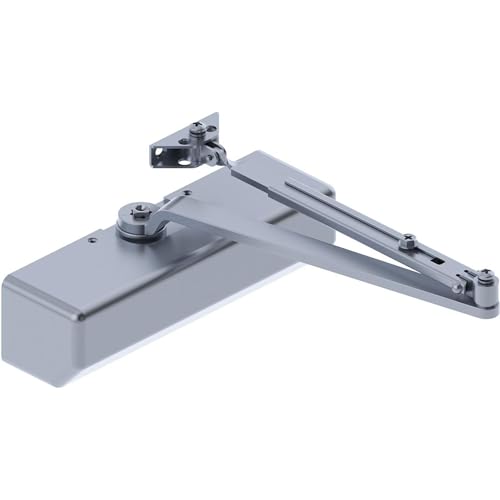
The most versatile products in this guide support regular-arm, top-jamb, and parallel-arm installation. That flexibility is documented for the HISAFE, Norton 1601, Norton 8501, Hager, Dynasty 8500, both LYNN models, and CLG closer. A tri-pack can reduce the risk of ordering the wrong arm arrangement, but it does not eliminate the need to check frame clearance and mounting templates.
Regular-arm mounting is commonly considered when the closer body and arm can be installed on the pull side. Top-jamb mounting places the body above the frame and may need enough frame face or ceiling clearance. The Norton 8501 listing specifically notes clearance considerations and a top-rail requirement for its top-jamb application. Parallel-arm mounting can present a cleaner appearance on many surface-mounted openings, but it requires the appropriate bracket or arm hardware.
The Lawrence LH303 is different: its supplied evidence describes a surface-mount design but does not document the same three-way mounting package. That can still be suitable for a straightforward interior installation, provided the mounting pattern and door geometry match.
Check control valves and backcheck
Closing speed controls how quickly the door moves through much of its travel, while latching speed affects the final portion. The LYNN DC5003 and Lawrence LH303 document closing and latching adjustment. The HISAFE, Hawaminent, Dynasty 8500, LYNN DC6003, and CLG models add documented backcheck or a third control function. Backcheck can help manage uncontrolled opening, but the listing evidence should not be interpreted as a guarantee that every installation will behave identically.
Independent valves are useful when the opening needs separate fine-tuning. The Hager listing adds a different practical detail: its adjustment valves are staked to help prevent accidental removal. When comparing products, look for the controls you actually need rather than assuming every closer provides the same adjustment layout.
Verify fire and accessibility documentation
If the door is in a required fire-door assembly, verify the closer’s listing and the complete door assembly requirements before purchase. The Norton 1601, Hager, Dynasty 8500, HISAFE, Hawaminent, LYNN DC5003, LYNN DC6003, and CLG listings provide UL or UL/cUL fire-related evidence. The Lawrence listing also states that the closer is fire-rated. Certification language is product-specific, so confirm the exact model and installation configuration.
Several products document ADA compliance, including Norton 1601, Dynasty 8500, HISAFE, Hawaminent, and both LYNN medium and light-duty models. ADA suitability can depend on the complete opening and installation, so treat the listing as a specification to verify rather than a substitute for project requirements.
Consider durability and installation evidence
Durability information varies considerably. Norton 1601 and Norton 8501 list more than 25 million cycles, while the LYNN models state more than one million cycles. The HISAFE and Hawaminent listings describe two million or more cycles. These figures are useful comparison points, but they are supplied claims rather than independent test results.
Installation support also differs. Dynasty 8500 includes fasteners, a template, and instructions for wood and metal doors. The HISAFE listing describes compatibility with wood, metal, and glass doors and includes adjustable spring power. Before installation, compare the hole pattern, arm clearance, included brackets, door material, and frame conditions. A closer’s body material alone does not confirm that its fasteners or mounting pattern fit an existing opening.
Final recommendation
Norton 1601-689 Series Door Closer ranks first overall in this specification-based comparison under the published weighted criteria.
The HISAFE DC-9 is the first overall specification-based choice among the best cast aluminum door closers in this comparison. Its documented size 1-6 adjustment, broad door range, three mounting options, backcheck, and commercial certifications give it the most adaptable specification profile.
The Norton 1601-689 is the stronger alternative when long-cycle evidence, Grade 1 certification, and a 25-year limited warranty are priorities. Hawaminent is worth considering for larger doors, while the Hager 5300M16ALM and Dynasty 8500 are practical commercial options with flexible mounting formats. For lower-traffic openings, the LYNN DC5003 and Lawrence LH303 provide more appropriately focused specifications. These are the top cast aluminum door closers here, but final selection should follow the actual door and frame requirements.
FAQ
Frequently Asked Questions
What are the best cast aluminum door closers for a commercial entrance?
The HISAFE DC-9, Norton 1601-689, Norton 8501-689, Hager 5300M16ALM, and Dynasty 8500 have the most specification-aligned combination of commercial application evidence, mounting flexibility, control adjustment, and certification documentation. Check the required door size and fire-door assembly details before selecting among them.
Do cast aluminum door closers work on left- and right-hand doors?
Several selected models are explicitly non-handed, including the HISAFE, Norton 1601, Norton 8501, Dynasty 8500, Hager, LYNN, and CLG models. Non-handed construction can simplify selection, but the mounting instructions and arm arrangement still need to match the opening.
Is a size 1-6 door closer always the best choice?
No. A size 1-6 closer provides broad adjustment, but a fixed size 3 model may be more appropriate when the door’s weight and traffic level are already known. The Lawrence LH303, for example, is specified for lighter interior and commercial doors, while the HISAFE and Norton models cover a broader range.
What is the difference between regular-arm, top-jamb, and parallel-arm mounting?
They describe where the closer body and arm attach relative to the door and frame. Regular-arm, top-jamb, and parallel-arm layouts can require different clearances and brackets. Products such as the Hager 5300M16ALM and Dynasty 8500 document multiple configurations, while the Lawrence LH303 listing describes surface mounting without the same tri-pack detail.
Should I use a light-duty closer on a busy door?
The supplied evidence suggests caution. The LYNN DC5003 is described for light-traffic areas, whereas the LYNN DC6003 is described for medium traffic and several Norton, Hager, Dynasty, HISAFE, and Hawaminent models provide stronger commercial-duty evidence. Match the closer to the expected use instead of relying only on its cast aluminum body.