Buying Guide
Choosing the best heavy-duty door closers starts with the door, frame, traffic level, and code requirements rather than the product label alone. The products above are surface-mounted hydraulic closers or closely related commercial door-control units. The comparison uses supplied listing claims and specifications only; it does not represent hands-on testing, independent certification verification, or customer-opinion research.
Match the closer to the door
Start with the door’s weight and width. A closer with a documented capacity of up to the current price, such as the LYNN HARDWARE DC9016, Boomerang D9016, or FORTSTRONG FS-7600, gives a clearer starting point for large commercial doors. The Dynasty 8500 lists coverage from 30 to the current price, while the Dynasty 1636 lists 85 to the current price. These ranges are useful because they connect the closer to a stated application rather than relying only on a “heavy-duty” product name.
Adjustable spring sizes provide another way to match door conditions. Hager’s 5300 series documents adjustment from Size 2 to 6. The NUK3Y 9000, SOPHIA DK8000, and several other selected models document Size 1-6 adjustment. A broad range may help when one closer must accommodate different doors, but it does not replace checking the manufacturer’s installation chart. Door width, weight, frame condition, opening force, and mounting position all affect suitability.
Check the required certifications
For commercial, public, or fire-door applications, certification language deserves careful attention. Several selected products document ANSI/BHMA A156.4 or Grade 1 references. The LYNN HARDWARE DC9016, Boomerang D9016, NUK3Y 9000, Dynasty 8500, and SOPHIA DK8000 also include ADA and UL-related claims in their listings. The Hager 5300 documents UL/cUL listing for up to three hours and BHMA certification.
Treat these statements as listing evidence, not as a substitute for confirming the exact product configuration and local code requirements. Fire-door assemblies can depend on the complete opening, including the door, frame, hinges, closer, and other hardware. If accessibility is important, verify the required opening force and installation position before ordering. The NUK3Y listing specifically references a five-pound ADA opening-force requirement, while other listings use broader ADA-compliance language.
Compare adjustment controls
At minimum, look for independent sweep and latch-speed adjustment. Sweep controls the main closing movement; latch control affects the final portion of travel. The Dynasty 8500, Dynasty 1636, FORTSTRONG FS-7600, and POWAWINI P-324 document these basic controls.
Backcheck can slow the door during forceful opening. That feature appears in the LYNN HARDWARE DC9016, Boomerang D9016, NUK3Y 9000, Dynasty models, OAKMOORE 12000, and POWAWINI P-324. It may help limit contact with nearby walls or hardware, but the supplied evidence does not establish a specific performance result in any particular installation.
Delayed action is useful when users need additional time to pass through a doorway. The LYNN HARDWARE DC9016, Boomerang D9016, and POWAWINI P-324 document delayed-action functionality. Five-valve designs provide more separate adjustment points than dual-valve models, but more controls can also require more careful setup. Adjust slowly and follow the supplied instructions rather than changing several valves at once.
Select a mounting configuration
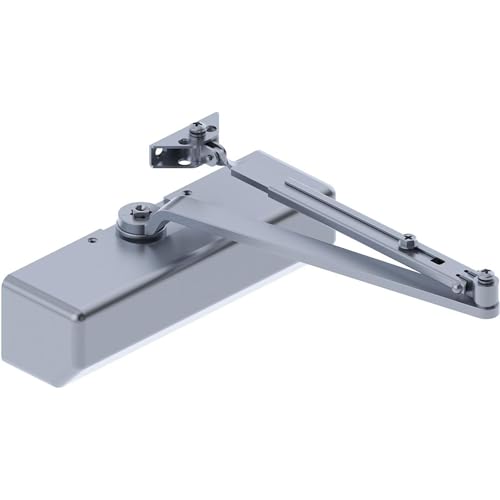
Mounting flexibility matters when the frame or door layout limits where the closer can sit. Regular-arm, top-jamb, and parallel-arm options are documented for the LYNN HARDWARE DC9016, Boomerang D9016, Hager 5300, NUK3Y 9000, Dynasty 8500, SOPHIA DK8000, and Dynasty 1636. A tri-pack or included brackets can be helpful because the needed arrangement is available without sourcing a separate arm package.
Confirm whether the installation is pull-side or push-side, and check left- or right-hand requirements. Non-handed designs, including those documented for LYNN HARDWARE, Boomerang, Dynasty, and SOPHIA units, can simplify selection. However, compatibility still depends on the frame, soffit, clearances, and hole pattern. Use the supplied template and compare it with existing mounting holes before removing an old closer.
Consider construction and package contents
Construction descriptions can help distinguish a full commercial unit from a lighter product. The LYNN HARDWARE and Boomerang D9016 listings describe cast-iron bodies, wrought-steel arms, and heat-treated pistons. The SOPHIA DK8000 lists a precision cast-aluminum body and forged-steel arm. Hager documents double-heat-treated steel springs, while POWAWINI lists a steel arm, steel spring, heat-treated piston, and steel gears.
A finish is mostly a fit-and-appearance decision, though the listings also mention powder-coated or sprayed finishes on several models. Check the selected color and dimensions against the door and surrounding hardware. The Dynasty 8500 is described as compact and low profile; the Dynasty 1636 also has a compact body. In contrast, the LYNN HARDWARE unit is a more substantial closer, which may be appropriate for larger doors but less suitable where clearance is tight.
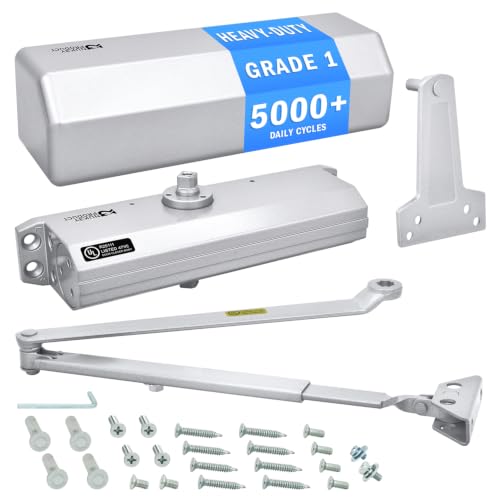
Look at what comes in the box. Templates, fasteners, arms, brackets, thru-bolts, and instructions are documented across the comparison. The Hager 5300’s multi-mount package, NUK3Y 9000’s tri-pack, and SOPHIA DK8000’s mounting hardware are particularly relevant when the installation configuration is not yet settled. Hardware availability does not guarantee that every frame will accept the closer, so inspect the substrate and fastener requirements first.
Plan the installation
A hydraulic closer should be installed squarely and adjusted after the door and frame are in their normal operating condition. Verify that hinges are aligned and that the door is not dragging before blaming the closer for slow or uneven movement. Use the product template, select the correct arm arrangement, and avoid forcing adjustment valves beyond their intended range.
For a fire-rated opening, accessibility-controlled entrance, or high-traffic public facility, professional installation may be appropriate. The listing evidence identifies certifications and features, but it does not provide a universal installation method for every door assembly. Confirm the closer’s documentation, the door manufacturer’s requirements, and applicable US building or fire codes.
Final recommendation
LYNN HARDWARE DC9016 Extra Heavy Duty Closer ranks first overall in this specification-based comparison under the published weighted criteria.
The final choice among the best heavy-duty door closers depends on the documented features that match your intended use.
LYNN HARDWARE DC9016 is the highest-scoring returned product and the first overall specification-based choice. It documents a 330-pound, 60-inch door capacity, five separate adjustment valves, three mounting options, ADA and UL 3-hour fire-rating references, and testing beyond 2 million cycles. Those specifications make it a strong fit for large, busy commercial entrances, provided its physical size and mounting pattern suit the opening.
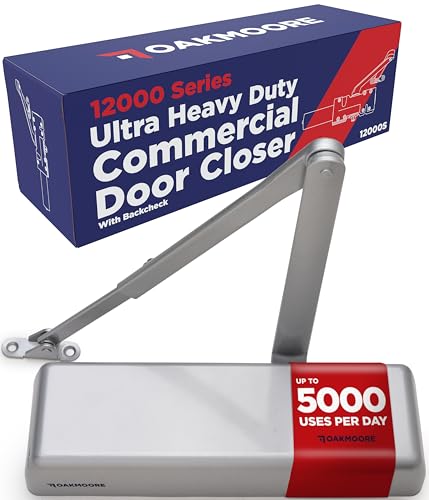
The top heavy-duty door closers are not interchangeable in every installation. Choose Boomerang D9016 when you want similar high-capacity coverage and five-valve control; choose Hager 5300 or NUK3Y 9000 when mounting and spring-size flexibility are priorities. Dynasty 8500, SOPHIA DK8000, and Dynasty 1636 offer balanced commercial packages, while FORTSTRONG FS-7600 is useful when a clear 99- to 330-pound range and broad material compatibility matter. OAKMOORE 12000 is notable for its documented high-cycle claim, and POWAWINI P-324 adds delayed action and backcheck.
Before buying, confirm door weight, width, frame type, mounting side, required opening force, fire-door documentation, and available clearance. That final compatibility check is more important than choosing a closer solely because its listing uses an extra-heavy-duty label.
Frequently Asked Questions
What should I measure before choosing the best heavy-duty door closers?
Measure door width and weight, identify the door and frame materials, note the hinge side and swing direction, and inspect the available mounting surface. Compare those details with the product’s documented capacity and mounting options. The FORTSTRONG FS-7600, for example, lists a 99- to 330-pound range, while the Dynasty 1636 lists 85 to the current price. If a listing does not provide a weight or width range, obtain the installation information before ordering.
Are all commercial door closers adjustable from Size 1 to 6?
No. The NUK3Y 9000 and SOPHIA DK8000 document Size 1-6 adjustment, while Hager’s 5300 series documents Size 2-6. Dynasty 8500 is listed as Size 3, and Dynasty 1636 as Size 4. A fixed or narrower size range may still suit a known door, but it offers less flexibility for changing conditions. Confirm the correct spring setting rather than assuming every commercial closer has the same range.
When is backcheck useful?
Backcheck slows the door during forceful opening and may help reduce contact with a nearby wall, frame, or hardware. It is documented on products including LYNN HARDWARE DC9016, Boomerang D9016, OAKMOORE 12000, and POWAWINI P-324. It is not a replacement for a wall stop or a guarantee against damage. The appropriate adjustment depends on the door, traffic pattern, surrounding clearance, and installation instructions.
Do three mounting options make installation universal?
No. Regular-arm, top-jamb, and parallel-arm options expand compatibility, but the frame, soffit, door construction, hole pattern, and clearance still determine whether a configuration works. Products such as Hager 5300, NUK3Y 9000, and SOPHIA DK8000 document multiple mounting choices. Use the included template and confirm the configuration before drilling or reusing existing holes.
When should a closer with delayed action be considered?
Delayed action may be useful where people need extra time to move through the doorway, such as busy entrances or certain accessibility-oriented applications. LYNN HARDWARE DC9016, Boomerang D9016, and POWAWINI P-324 document delayed-action features. Verify the intended opening, required closing behavior, and applicable fire and accessibility requirements because delayed action is not appropriate for every door.