Buying Guide
Picking the best ceramic condiment pots comes down to matching the right combination of capacity, lid style, and included accessories to the way you actually season food. Below is a practical walk-through of the design choices that separate the entries in this roundup, framed around the specifications each listing documents.
Material and Finish
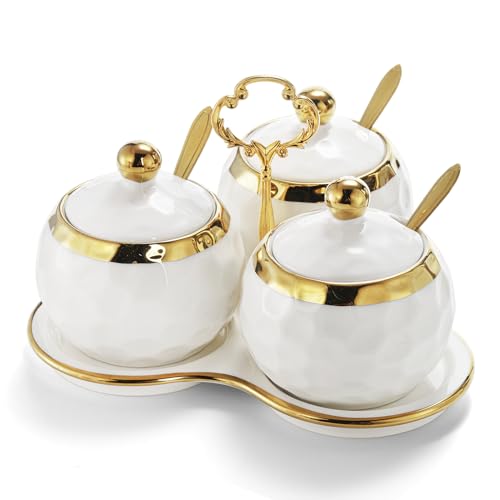
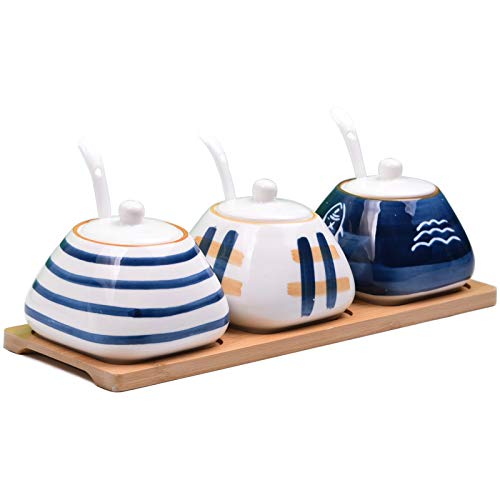
Every entry in this guide is built from porcelain or ceramic, which gives a smooth, non-reactive surface that does not absorb odors. The Foraineam set adds a gold trim finish, the Orkim set features a hand-painted yellow-flower motif, and the ANQIA set ships with black-and-white patterned jars. Glazed porcelain is also easy to wipe clean, and several listings call out dishwasher-safe bodies even when the lids require separate care.
Capacity per Jar
Single-jar formats range from the very compact Magnitt jar near 2 inches across to the Lunavita salt cellar at roughly 14 oz or 400 g. For three-jar sets, capacity per jar ranges from 7 oz in the ANQIA set to 300 ml (about 10 oz) in the DGVR and Orkim sets, with 8 fl oz jars common in the Lucky Goddness June Sky and Foraineam sets. Two-jar formats like the shuqiao set sit at 280 ml per jar, while the MOLADRI single jar offers about 11 oz (330 ml). Smaller jars suit a tight coffee bar, while larger jars are better for households that go through sugar, salt, or spices quickly.
Lid and Seal Design
The lid is one of the most variable features across these ceramic condiment pots. Bamboo flip lids appear on the Lucky Goddness June Sky set, MOLADRI, and Lunavita, while porcelain lids show up on the Magnitt and WINRIOO jars. The Foraineam and ANQIA lids are designed with a notch that holds the serving spoon between uses, the shuqiao set ships with acrylic lids featuring silver-bead handles, and the WINRIOO listing emphasizes tight-fitting lids meant to block moisture and dust. Choosing the right lid style depends on whether you want a tight seal for storage or a spoon-ready lid for serving.
Included Accessories and Tray
Most of the multi-jar sets ship with matching spoons and a serving tray that doubles as a base. The Lucky Goddness June Sky, Foraineam, WINRIOO, DGVR, ANQIA, Orkim, and shuqiao sets each include a tray with grooves or slots sized for the jars. Single-jar formats usually ship with a bamboo lid and one spoon, as seen in the MOLADRI and Lunavita listings. A tray matters if you plan to carry the set to the table, while a single spoon works fine for a dedicated sugar or salt station.
The compact WINRIOO set has the smallest tray footprint at roughly 28 cm, which is helpful on narrow counters, while wider sets like the DGVR and Orkim entries span closer to 11 to 12 inches across for a broader presentation. The shuqiao two-jar set measures about 8.1 by 4.3 inches, which is a useful middle ground between single-jar and three-jar formats. Several listings explicitly call out versatility for sugar, salt, pepper, spice, coffee, tea, ghee, honey, and even chili oil, so a single set can usually cover multiple condiments.
Care and Durability
Ceramic bodies are typically dishwasher safe, but lids often are not. The MOLADRI listing states the ceramic body is dishwasher safe while the piece is not microwave safe, and the Lunavita listing is explicit that the ceramic body is dishwasher safe but the bamboo lid is not. Bamboo components on the Lucky Goddness, MOLADRI, Lunavita, DGVR, and shuqiao sets should be wiped rather than soaked, and the acrylic lids on the shuqiao set call for gentler cleaning than the porcelain jars. Ceramic products in general are shipped with extra protective packaging because they are fragile.
Final recommendation
Orkim Kitchen Ceramic Condiment Jars With Yellow Flower ranks first overall in this specification-based comparison under the published weighted criteria.
The final choice among the best ceramic condiment pots depends on the documented features that match your intended use.
The MOLADRI Ceramic Sugar Bowl with Bamboo Lid and Spoon stands out as the first overall specification-based choice in this guide thanks to its 11 oz capacity, bamboo lid design, and dishwasher-safe ceramic body that pairs well with a single-jar setup. For a multi-jar presentation, the Orkim Kitchen Ceramic Condiment Jars and the DGVR Porcelain Condiment Jar Set both bring a generous 300 ml per-jar capacity with included trays and spoons, while the Foraineam set offers a more decorative gold-trim look for serving. Together with the shuqiao two-jar set for smaller counters, these options cover most of the top ceramic condiment pots configurations buyers tend to compare, from compact single jars to full table-ready sets.
Frequently Asked Questions
Among the best ceramic condiment pots, what size ceramic condiment pot should I buy for daily sugar and salt?
For daily sugar and salt, a single jar in the 11 to 14 oz range, like the MOLADRI or Lunavita entries, holds a typical bag of sugar or a large box of salt without needing frequent refills. If you want separate jars for sugar, salt, and a third seasoning, a three-jar set with 8 to 12 oz per jar covers most households.
Are bamboo lids on ceramic condiment pots safe around moisture?
The listings that include bamboo lids, including Lucky Goddness, MOLADRI, Lunavita, and DGVR, generally recommend wiping the lid rather than soaking it or running it through the dishwasher. The ceramic bodies remain dishwasher safe in most cases, but the bamboo components should be kept dry to avoid splitting over time.
Do ceramic condiment pots keep spices fresh?
Ceramic itself is non-reactive and does not absorb odors, and several listings, including WINRIOO and DGVR, describe their lids as tight-fitting or dust-resistant. For long-term spice storage, sealed lids offer the most protection, while looser or open-top designs work better for active serving on a dining table.
Can I use one set of ceramic condiment pots for sugar, salt, and spices?
Yes. The Lucky Goddness, Foraineam, WINRIOO, ANQIA, Orkim, DGVR, and shuqiao listings all explicitly mention sugar, salt, and spices as intended uses, with several also listing coffee, tea, creamer, honey, and ghee. Choosing a set with at least two jars makes it easier to assign one jar per seasoning.
Are ceramic condiment pots better than glass or stainless steel for a kitchen counter?
Ceramic and porcelain offer a smooth, decorative surface that hides fingerprints better than stainless steel and resists staining better than many clear glass jars. The trade-off is weight and fragility, since ceramic jars are heavier than empty plastic containers and can chip if dropped, which is why several listings emphasize protective packaging in transit.