Buying Guide
Choosing the best color lab oscilloscopes starts with matching the instrument to the signals you expect to inspect. A scope for classroom demonstrations or basic audio checks does not need the same bandwidth as a bench instrument used for faster digital or electronic signals. The products in this comparison range from the two-channel Rigol to pocket-sized and multifunction handheld designs. This is a specification-based guide built from supplied public listing information, not hands-on testing or customer-opinion summaries.
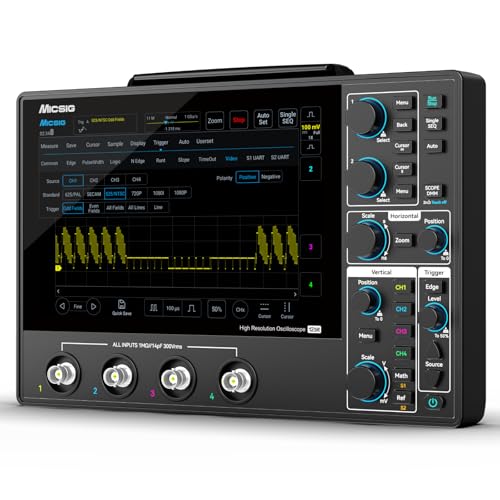
A bench scope is usually suitable when the instrument will stay in a laboratory or electronics workspace. The Rigol DS1202Z-E has two channels, a 7-inch color TFT LCD, 200 MHz bandwidth, and 1 GS/s sampling. That combination provides the largest display and broadest documented core capture specifications in this selection, although the listing does not describe a built-in battery.
Handheld scopes are more convenient when measurements move between a workbench, vehicle, classroom, or service location. The OWON HDS2102, SKYCENX ET202D, XEAST XE-703S, and Hilitand models all document portable designs. SKYCENX and Hilitand each state approximately eight hours of battery-related operation, while XEAST describes a 3,400mAh rechargeable battery. JYETech DSO112A uses a pocket format with an integrated lithium-ion battery.
Compare bandwidth and sampling
Bandwidth describes the frequency range the scope is designed to pass, while sampling rate describes how frequently it captures signal points. Consider them together. Rigol DS1202Z-E lists 200 MHz bandwidth and 1 GS/s sampling. SKYCENX ET202D and Hilitand each list 120 MHz bandwidth, while OWON lists 100 MHz and 500 MSa/s. These figures make those products more suitable for faster signal work than the lower-bandwidth choices.
XEAST provides 50 MHz bandwidth and 280 MSa/s real-time sampling. FTVOGUE ZT-701 lists 5 MHz bandwidth and 48 MS/s sampling. GOYERRNES is more limited at 250 kHz bandwidth and 2.5 MS/s. Those lower figures may still suit basic, low-frequency waveform checks, education, or repair tasks, but they are not direct substitutes for faster models.
Decide whether two channels matter
Two channels are useful when you need to compare two points or signals during the same capture. Rigol DS1202Z-E, OWON HDS2102, XEAST XE-703S, and NooElec JYETech WAVE2 explicitly document two-channel operation. That can help with timing comparisons, input-versus-output checks, and demonstrations.
Single-channel products can be simpler and smaller. Hilitand and FTVOGUE identify single-channel designs. JYETech DSO112A and VISLONE do not provide channel-count details in the supplied evidence, so confirm channel capability before purchase if simultaneous comparison is important.
Consider multifunction instruments
A scope is not always the only tool needed at a repair bench. OWON adds a True RMS, 20,000-count multimeter with voltage, current, resistance, diode, capacitance, and continuity testing. XEAST adds a 25,000-count multimeter and DDS generator. FTVOGUE also combines a scope with a 9999-count True RMS multimeter.
SKYCENX ET202D includes a DDS signal generator and lists 12 measurement types. NooElec JYETech WAVE2 includes a two-channel function generator and reports voltage and frequency measurements. JYETech DSO112A includes a square-wave generator for testing and calibration. Choose a multifunction design when signal generation or routine meter work is part of the workflow; choose a scope-focused bench model when display size and core waveform capability matter most.
Review triggers and storage
Trigger controls help place a waveform consistently on the screen. Auto, normal, and single modes appear across several selected products. Single triggering is relevant when an event is not repetitive, while automatic adjustment can help users reach a readable display more quickly.
Storage is another practical difference. SKYCENX ET202D and Hilitand each list storage for up to 2,500 waveforms. XEAST supports saved images or CSV waveforms through its Type-C computer connection. NooElec JYETech WAVE2 can output captured data to a computer, and FTVOGUE supports data saving and USB analysis. These features help when measurements need later review, but saved data should not be treated as an accuracy guarantee.
Match the display and connections
Rigol DS1202Z-E has the largest documented display in this selection at 7 inches. OWON uses a 3.5-inch color LCD, while XEAST and FTVOGUE list 3.5-inch and 3.2-inch IPS displays. Smaller 2.4-inch displays appear on SKYCENX, Hilitand, NooElec JYETech WAVE2, JYETech DSO112A, and VISLONE.
A larger screen can make multiple readouts easier to inspect, while a smaller screen supports portability. Check the connection type as well. USB appears on Rigol and FTVOGUE, while Type-C charging or data functions appear on OWON, SKYCENX, XEAST, and Hilitand. NooElec JYETech WAVE2 specifically lists a serial connection for computer output. Included probes also matter: NooElec JYETech WAVE2 provides two 10x probes, and JYETech DSO112A includes MCX-to-clip probes.
Final Recommendation
XEAST XE-703S 3-in-1 Handheld Oscilloscope ranks first overall in this specification-based comparison under the published weighted criteria.
XEAST XE-703S 3-in-1 Handheld Oscilloscope is the first overall specification-based choice in this comparison.
For users prioritizing two channels, 200 MHz bandwidth, 1 GS/s sampling, and a large color display, Rigol DS1202Z-E is a suitable bench-oriented option among the best color lab oscilloscopes. It fits a fixed workspace and offers broad documented core capture specifications.
For mobile work, OWON HDS2102 is a capable scope-and-meter option, while SKYCENX ET202D stands out for 120 MHz bandwidth, waveform storage, a DDS generator, and a rechargeable handheld design. XEAST XE-703S is practical when oscilloscope, multimeter, and generator functions are all needed in one device.
The top color lab oscilloscopes are not interchangeable. Select Rigol DS1202Z-E for a fixed workspace and broader documented capture specifications; choose OWON HDS2102, SKYCENX ET202D, XEAST XE-703S, or Hilitand when portability is central. NooElec JYETech WAVE2 and JYETech DSO112A are compact learning-oriented choices, while GOYERRNES GR-US-250K, FTVOGUE ZT-701, and VISLONE DSO are better matched to more limited signal-analysis requirements.
Frequently Asked Questions
What should I check first when choosing the best color lab oscilloscopes?
Start with bandwidth, sampling rate, channel count, and the type of signals you need to view. Rigol DS1202Z-E, OWON HDS2102, SKYCENX ET202D, and Hilitand offer substantial documented bandwidth figures in this selection. If you need to compare two signals at once, select a model that explicitly lists two channels, such as Rigol, OWON, XEAST, or NooElec JYETech WAVE2.
Are handheld oscilloscopes suitable for laboratory work?
They can be suitable for portable lab testing, education, repair, and on-site measurements, depending on signal requirements. SKYCENX ET202D, Hilitand, OWON HDS2102, and XEAST XE-703S document features such as rechargeable batteries, color displays, and portable housings. A bench design like Rigol DS1202Z-E may be preferable when a larger screen, fixed setup, or higher documented bandwidth matters more than mobility.
Is a multifunction oscilloscope better than a scope-only model?
It depends on the workflow. OWON, XEAST, and FTVOGUE combine oscilloscope and multimeter functions, while OWON, XEAST, SKYCENX, NooElec JYETech WAVE2, and JYETech DSO112A also document signal-generation features. These combinations may be convenient for repair and education, but a scope-focused model can offer a clearer emphasis on channels, display area, and waveform capture.
Why do color display size and resolution matter?
A color display can make waveform traces and measurement readouts easier to distinguish, while size affects how much information is visible at once. Compact 2.4-inch models trade viewing area for portability, so choose according to whether the scope will remain on a bench or travel frequently.
Storage lets you retain captures for later review or transfer, subject to the product’s stated connection method and file support. SKYCENX ET202D and Hilitand each list storage for up to 2,500 waveforms. XEAST supports saved images or CSV waveforms through Type-C, while NooElec JYETech WAVE2 and FTVOGUE list computer-related data output or storage functions. Verify the exact export workflow before relying on it for documentation.