Buying Guide
Choosing among the best ceramic salt mills is mainly a matter of matching the mill’s mechanism, adjustment method, reservoir, and cleaning requirements to your routine. The products here are not presented as hands-on-tested winners. They are ranked from the supplied public listing information, so a feature is included only when the listing documents it.
Why choose a ceramic mechanism?
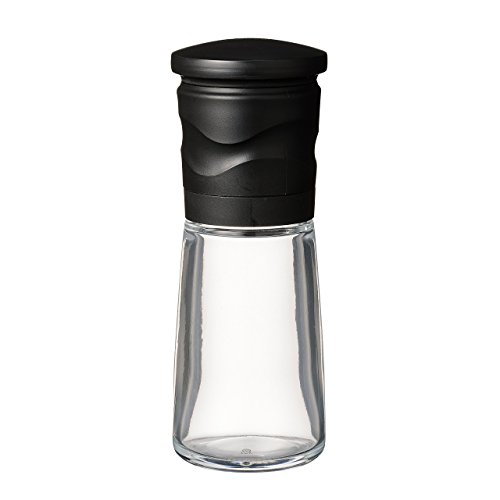
Ceramic is useful in a salt mill because several listings describe it as non-corrosive, rustproof, or non-reactive. Salt can be demanding on metal components, so a ceramic grinding core is a relevant specification rather than a decorative detail. The OXO listing also says its ceramic grinder will not absorb flavors or odors, while the Kyocera listing describes an advanced ceramic mechanism intended for salt, spices, and herbs.
Mechanism material alone does not establish identical results across products. The listings do not provide a common laboratory measure for grind consistency, output speed, or service life. For that reason, this comparison scores whether the ceramic mechanism is clearly documented and whether the surrounding design supports salt use, not an unverified performance claim.
How much grind control do you need?
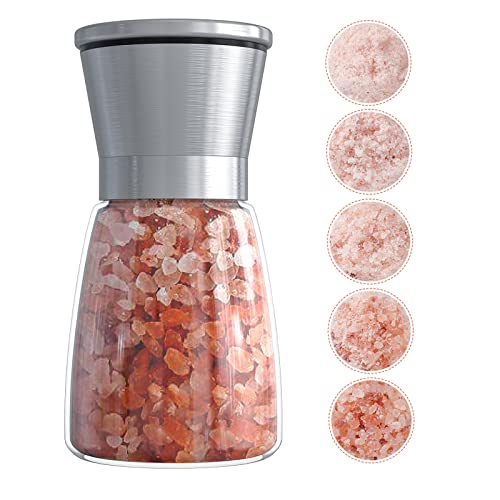
Adjustability is important if one mill must handle both cooking and finishing. Most selected products describe a control that moves from fine to coarse. The Kyocera uses an adjustable dial, the OXO uses a sliding tab, and the Aurevit provides five external levels. The HOME EC and Vucchini models also describe top adjustment for salt, pepper, or other spices.
Look for a control that is easy to identify and unlikely to be confused with the operating section. External controls can be convenient because they let you change coarseness without opening the reservoir. The Aurevit is particularly explicit about this arrangement. However, the supplied evidence does not establish that one adjustment system is objectively smoother or more precise than another.
Compare reservoir size and refill access
Capacity affects how often you will refill. The LessMo set lists 8-ounce reservoirs, Aurevit lists up to 7.94 ounces, and HOME EC lists 6 ounces per mill. The Vucchini bamboo-lid set lists 5.7-ounce glass bottles, while the Kyocera lists a smaller 2.6-ounce container. These figures are useful for comparison, but they are listing specifications rather than independently verified measurements.
A wide opening or removable jar can matter as much as capacity. Aurevit describes a wide opening, Dzmbv describes a wide refill opening, and Kyocera uses a removable glass jar. OXO takes a different approach: it rests flat while upside down for refilling. If you refill from large bags or coarse crystals, favor an opening and body shape that give you enough control during filling.
Consider storage and moisture protection
A salt mill should have a sensible place to rest. Top-dispensing OXO is designed to keep the grinding end above the counter, while Kyocera has an upright cap that is described as helping keep spices dry. HOME EC and Vucchini describe sealed caps, and LessMo includes a standing tray with the pair. LARS NYSØM uses bottom caps that the listing says help prevent residue.
These features address cleanliness and storage, but they do not make a mill maintenance-free. The HOME EC listing specifically says to keep its ceramic mechanism away from water and wipe it with a dry cloth. Other listings state that certain glass bodies or complete units can be washed, but the exact care instructions vary. Always separate a washable reservoir from a ceramic mechanism when the listing distinguishes them.
Manual or electric operation?
The selected comparison emphasizes manual ceramic mills because they provide direct control without batteries or charging. Manual designs include the OXO, Kyocera, Aurevit, LessMo, and LARS NYSØM models. The Dzmbv listing explicitly states that its set needs no batteries or charging. That can simplify storage and avoid maintaining a power source.
An electric ceramic mill can still be a legitimate category option when convenience is the priority, but it brings different specifications to assess, including charging and controls. The supplied LARS NYSØM electric set is rechargeable by USB and includes an LED light. It was not selected because this ranking prioritizes the most specification-aligned documented manual salt-mill comparison, not because electric operation is invalid.
Single mill or matched set?
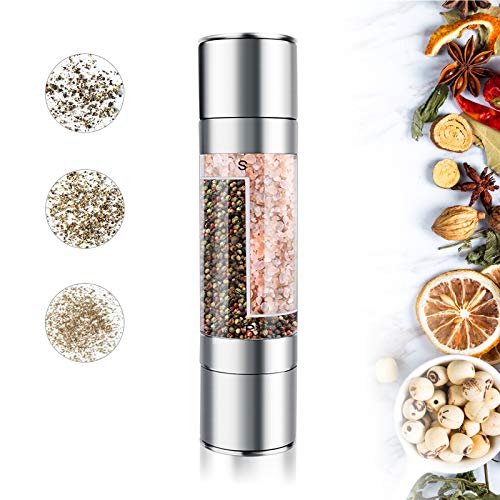
A single mill is useful when salt is the only seasoning you want to grind or when counter space is limited. OXO and Aurevit are dedicated single-mill choices in this list. A matched set is more suitable if you want salt and pepper together. HOME EC, Vucchini, LessMo, Dzmbv, Haomacro, and LARS NYSØM provide two-mill formats.
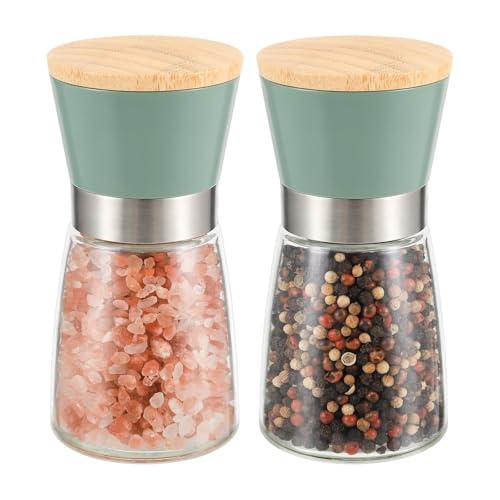
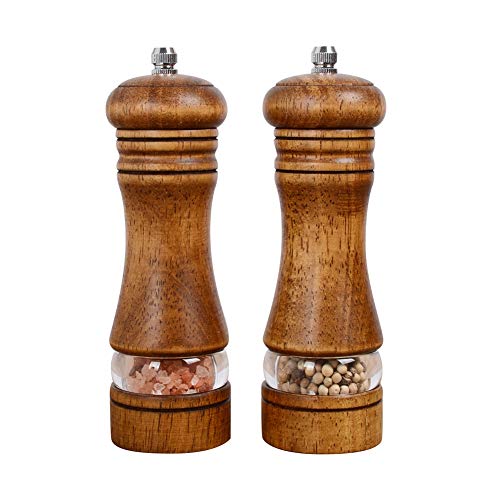
Sets can improve identification when they use different finishes, clear windows, or organized storage. Haomacro uses visible acrylic windows, while Dzmbv combines clear chambers with a wooden tray. The Vucchini bamboo-lid set uses a green finish and sealed lids. Remember that a set’s second mill may be designed for pepper as well as salt, so check the stated compatibility before filling it.
Final recommendation
LessMo Mill Set with Wooden Standing Tray ranks first overall in this specification-based comparison under the published weighted criteria.
OXO Good Grips Contoured Salt Grinder is the first overall specification-based choice among these best ceramic salt mills. Its top-dispensing layout, adjustable slide, non-corrosive ceramic mechanism, upside-down refill position, and non-slip knob address the most important daily-use concerns without depending on customer sentiment or volatile marketplace information.
For a larger dedicated reservoir, Aurevit is the clearest alternative, with up to 7.94 ounces and five external settings. Choose LessMo if a tray and 8-ounce pair are more useful. Kyocera is a sensible compact option when a removable dishwasher-safe glass jar matters. Among the top ceramic salt mills for paired table presentation, Vucchini bamboo-lid, HOME EC, and LARS NYSØM offer distinct storage and styling approaches.
Frequently Asked Questions
The supplied listings commonly describe ceramic mechanisms as non-corrosive, rustproof, or non-reactive. That makes ceramic a relevant material choice for salt, but the listings do not provide controlled comparisons proving that every ceramic mill performs better than every metal mill.
Should I buy a single salt mill or a salt-and-pepper set?
Buy a single mill if you mainly season with salt or have limited counter space. Choose a set if you want matching salt and pepper tools. OXO and Aurevit are single-mill choices here, while HOME EC, LessMo, Dzmbv, and Haomacro provide paired formats.
Which of the best ceramic salt mills has the largest stated capacity?
LessMo lists an 8-ounce reservoir for each mill. Aurevit lists up to 7.94 ounces for its single salt mill, and HOME EC lists 6 ounces per mill. These are supplied listing claims, not independently measured capacities.
Are ceramic salt mills dishwasher safe?
Care instructions differ. Kyocera describes its removable glass jar as dishwasher safe, and Vucchini describes the entire pepper grinder as dishwasher safe. HOME EC instead instructs users to keep the ceramic mechanism away from water and wipe it dry. Check the specific product guidance before washing any mill.
Do ceramic salt mills work with spices besides salt?
Several selected listings say their mills can handle pepper, herbs, or other dry spices. Kyocera, Vucchini, and Haomacro explicitly describe broader spice use. However, flavor transfer and particle size can vary, so dedicating one mill to salt may be preferable when the listing does not provide detailed compatibility guidance.