Buying Guide
The best stainless steel salt mills are defined by the complete mechanism and refill design, not simply by a silver-colored exterior. A useful comparison starts with the parts that contact the seasoning, the way the grind is adjusted, and how easily the chamber can be filled without spills.
Check the grinding mechanism
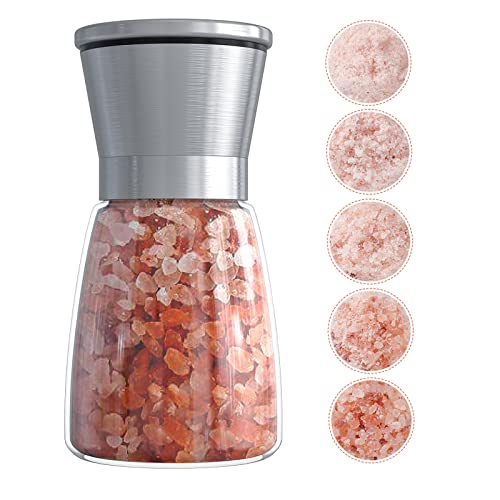
Ceramic mechanisms appear throughout the selected products. They are described as non-corrosive or rust-resistant and are commonly paired with salt, pepper, and other solid seasonings. The Ebaco, Benicci, M JINGMEI, Home EC, Willow & Everett, and Herda listings all identify ceramic grinding components. Ceramic does not automatically describe a particular grind quality, so this guide does not claim that one mechanism produces a superior texture without hands-on testing.
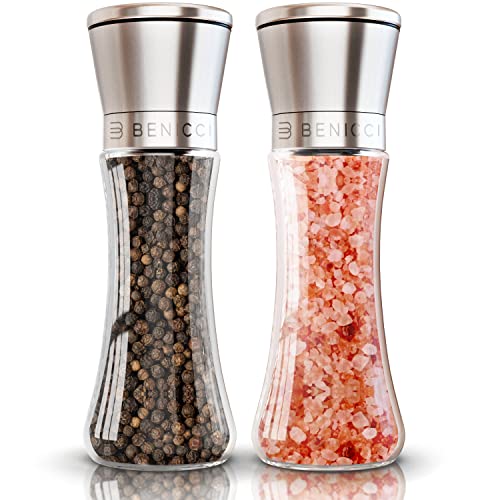
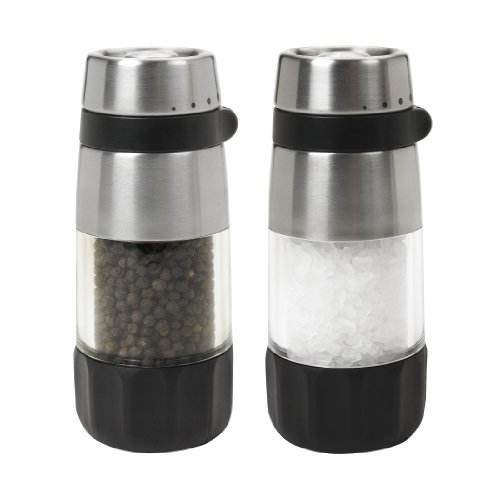
Adjustment range is more useful than a vague claim of flexibility. Benicci’s selected models document five settings, while Ebaco documents five adjustable coarseness levels. Other mills describe fine-to-coarse adjustment without giving a number. If repeatable settings matter to you, favor a listing with a stated count. Twist knobs are common, but the Jung Ford set uses a thumb button instead, and the OXO set uses rotating tabs.
Match the mill to your salt
The selected listings mention sea salt, Himalayan salt, rock salt, kosher salt, or solid-grain seasonings. That evidence supports use with those types, but it does not establish that every salt grain or moisture level will work equally well.
A dedicated salt mill can be useful when you want to keep salt separate from pepper. Sets such as OXO, HOME EC, Benicci, M JINGMEI, Willow & Everett, and Herda provide two mills, although several are described as interchangeable rather than permanently labeled.
Compare capacity and refill visibility
Capacity affects how often you need to open a mill. Benicci specifies five or six ounces depending on the model, while OXO uses clear bodies but does not provide a numeric chamber volume in the supplied evidence.
Clear glass or acrylic lets you see the remaining seasoning. Glass appears in many selected designs, including borosilicate glass on Willow & Everett and BPA-free glass on M JINGMEI and HOME EC. Acrylic is used by Jung Ford and OXO. This is a material distinction rather than a performance ranking. Consider whether you prefer the documented visibility, the stated material, or the compact format.
Refill access also matters. Wide openings, removable caps, and twist-off tops are documented on multiple models. A funnel is included with M JINGMEI, Benicci’s selected models, and HOME EC’s sets. These accessories can help guide loose salt into a narrow opening, but the supplied evidence does not establish how mess-free any design is in actual use.
Decide between manual and powered operation
All products selected here are manual. Manual mills avoid batteries, charging, and motor controls, but they require physical grinding. Push-button designs such as Jung Ford offer a different hand position from twist-operated models. For a conventional manual format, look at the shape, height, adjustment control, and whether the grinding mechanism is mounted at the top.
Top-mounted mechanisms are documented on OXO, M JINGMEI, HOME EC, Willow & Everett, and Herda. Their stated design purpose is to reduce residue on the counter when the mill is stored. That is a useful feature claim, but it should not be expanded into an unverified cleanliness guarantee. Bottom-mounted designs may have a different storage routine, so check the product’s stated orientation before choosing.
Consider height, grip, and storage
Tall mills can look suited to table presentation and may provide roomier chambers, but they need adequate cabinet or shelf clearance. M JINGMEI, Benicci’s six-ounce model, HOME EC’s diamond-pattern set, Willow & Everett, and Herda are around seven to seven-and-a-half inches tall. OXO is listed at 5.5 inches, while Ebaco is 5.3 inches. The Jung Ford set is approximately six inches tall.
Grip details vary. OXO lists soft, non-slip grips; Willow & Everett describes a tapered glass shape; M JINGMEI identifies an ergonomic bottle. These are documented design features, not tested comfort results. If counter space is limited, a single mill such as Ebaco may be simpler than a pair.
Review cleaning and protection details
Maintenance information is uneven across listings. Ebaco describes a removable ceramic rotor and easy disassembly. Benicci’s five-ounce model says the parts are hand-wash only, and the other Benicci listing says the grinders are not dishwasher-safe. OXO also specifies hand washing. Do not assume dishwasher compatibility unless the product documentation says so.
Sealed caps are frequently described as barriers against moisture, dust, or residue. This can be especially relevant for salt, which may be affected by moisture, but the supplied listings do not provide laboratory data or a guarantee against clogging. Store the mill according to its instructions and select a design with a cap if covered storage is important.
Final Recommendation
Ebaco Original Stainless Steel Salt Grinder ranks first overall in this specification-based comparison under the published weighted criteria.
Ebaco Original Stainless Steel Salt Grinder is the first overall specification-based choice among these best stainless steel salt mills. Its documented five settings, ceramic rotor, three-quarter-cup capacity, sealed lid, glass body, and removable grinding assembly give it a complete single-mill feature profile in this comparison.
Choose OXO if clean countertop storage, soft grips, and separate salt and pepper mills matter most. Willow & Everett is the better fit for shoppers who want a stand and large stated chambers. For a tall pair with a funnel, M JINGMEI is a practical alternative. Benicci’s two selected models are worth considering when a defined five-setting range and included cleaning accessories are priorities.
These top stainless steel salt mills differ in format as much as finish. Before choosing, confirm whether you want one mill or two, whether the chamber size is stated, how the grind is adjusted, and whether hand washing is required. The best stainless steel salt mills for your kitchen will be the model whose documented controls, refill process, and dimensions fit your routine.
Frequently Asked Questions
Among the best stainless steel salt mills, what makes a stainless steel salt mill different from a pepper mill?
A salt mill should have evidence supporting salt use and a mechanism suitable for the intended seasoning. In this comparison, selected listings specifically mention sea salt, Himalayan salt, rock salt, kosher salt, or solid spices. Stainless steel may describe the exterior, cap, or internal parts, so check the complete construction rather than relying on the title alone.
Are ceramic grinders suitable for salt?
The selected listings commonly describe ceramic grinders as suitable for salt. Ceramic components are also described as non-corrosive or rust-resistant. However, the evidence does not establish performance for every salt type or moisture condition. Follow the product instructions and avoid treating a general salt-compatibility statement as a tested result.
Is a set of two mills better than one mill?
A two-piece set lets you keep salt and pepper available at the same time. OXO, HOME EC, Benicci, M JINGMEI, Willow & Everett, and Herda provide two-mill formats. A single mill may take less space and can be preferable if you mainly season with salt. The right format depends on your counter space and whether simultaneous access matters.
How much capacity should a salt mill have?
There is no single required capacity. Several selected products state three-quarter-cup chambers, while Benicci lists five- or six-ounce sizes. Larger chambers may reduce refill frequency, but they can also make a mill taller or heavier. Use the stated dimensions and capacity together, especially if cabinet clearance is limited.
Should a salt mill be stored with the grinder on top?
Several selected designs, including OXO, M JINGMEI, HOME EC, Willow & Everett, and Herda, place the grinding mechanism at the top. Their listings associate that arrangement with reducing residue on the counter. It is a design preference, not a universal requirement. Check the specific product’s cap and storage guidance before deciding.