Buying Guide
Clamp meat grinders are manual food grinders designed to attach to the edge of a table or counter. They use a hand crank rather than electricity, so the most important buying questions concern fixation, grinding hardware, construction, included accessories, and cleanup. The best clamp meat grinders are not necessarily the largest models; they are the ones whose documented specifications match the work surface and food-preparation tasks you actually have.
Start with the clamp and your counter
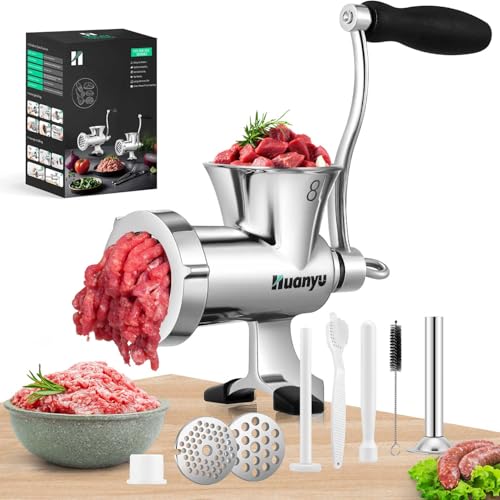
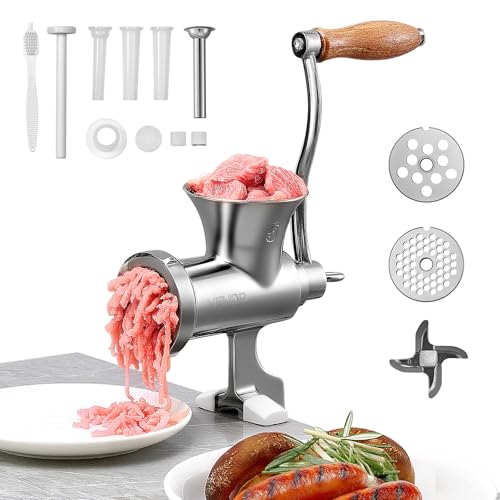
A clamp is only useful if it fits the work surface securely. Check the listed opening range or maximum lip thickness before choosing a grinder. Huanyu specifies an adjustable range of 0.39 to 1.9 inches, while VEVOR’s stainless #5 model lists 0.4 to 1.8 inches. Those ranges suit a variety of tables, but the fit still depends on the shape and accessible edge of your counter.
Other models provide a maximum rather than a range. The LEM stainless #10 is documented for surfaces up to 1.25 inches thick, and the LEM cast iron model accepts a lip of 1.75 inches or less. A wide-opening clamp can be useful on thicker surfaces, but buyers should still confirm that the counter has a suitable lip. The LHS model adds a suction cup to its stainless clamp, creating a double-fixation design, though its description says the surface should be smooth and water-free.
Protective pads are another practical detail. CAM2 lists rubber pads for delicate work surfaces, and Huanyu and VEVOR describe non-slip pads. These features are documented as part of the mounting design, but they do not remove the need to tighten the clamp correctly or place the grinder on a compatible surface.
The size designation gives a rough indication of the grinder format, but included plates are often more useful for comparing texture options. A fine plate can support smaller mince, while a coarse plate produces larger pieces; the supplied listings document plate dimensions for some products but do not establish a universal output standard across brands.
Huanyu includes 4.5mm and 8mm plates. VEVOR’s cast iron #8 model supplies 5mm and 8mm plates, while CAM2 and LEM’s stainless #10 models list coarse 3/8-inch and fine 3/16-inch plates. FUJIDENSO has the widest documented selection, with 4.5mm, 6mm, and 12mm plates. That range may be useful when one grinder must handle different recipes, although the larger #10/#12 format may be less convenient to store.
Some models emphasize simplicity. Winco lists one 3/16-inch plate, a knife, feeder table, and stomper. The LEM cast iron model lists one 8mm plate and a stainless knife. These can still suit buyers who already know the grind size they want, but they offer less documented flexibility than models with two or three plates.
Compare construction materials
The selected grinders use cast iron, stainless steel, tin-plated cast iron, or a plastic body with stainless blades. Stainless steel models such as Huanyu, VEVOR, CAM2, and LEM are documented as rust resistant or resistant to oxidation. CAM2 specifically uses 304 stainless steel for the grinder and 420 stainless steel for its blades. Stainless construction can be appealing when cleanup and corrosion resistance are priorities, but the listings do not establish identical durability across these products.
Cast iron models offer a traditional heavy-duty design. VEVOR, CucinaPro, LEM, and FUJIDENSO use cast iron in their documented construction. The LEM and FUJIDENSO models add tin plating intended to help prevent rust or corrosion. LHS takes a different approach with a heavy-duty plastic body and stainless blades, which helps keep the design compact but is a different material trade-off from a metal grinder.
Follow the care instructions for the specific material. VEVOR recommends thoroughly drying its cast iron grinder, LEM specifies hand washing and complete drying for its cast iron model, and CAM2 cautions against prolonged exposure to alkaline liquids. These details matter because manual grinders have removable parts, blades, plates, and auger components that need to be cleaned and stored appropriately.
Look at sausage and accessory support
Many clamp grinders also function as sausage stuffers, but the accessory package varies. Huanyu includes a sausage tube, VEVOR’s stainless model includes four tubes, and LEM’s stainless model includes three tubes plus a stuffing plate. FUJIDENSO also lists three plastic stuffing tubes. These choices are useful when you want to prepare more than ground meat, but tube count alone does not indicate a particular stuffing result.
LHS is the most multifunctional listing in this group, with a cookie attachment in addition to grinding and sausage accessories. VEVOR’s cast iron model includes three plastic sausage tubes, and CucinaPro states that its grinder can be used as a sausage maker. By contrast, Winco’s supplied evidence focuses on grinding components and does not list sausage tubes, so it is better matched to buyers who want a basic grinding setup.
Plan for cleaning and storage
Detachable construction simplifies access to the blade, plate, body, and auger. Huanyu describes tool-free disassembly and top-rack dishwasher-safe components. VEVOR’s stainless model says all parts can be cleaned in a dishwasher, while LHS says most parts detach and its blades are dishwasher safe. These are useful distinctions for frequent prep.
Other products call for hand washing or careful drying. LEM’s cast iron model is listed as hand wash only, and the cast iron VEVOR model recommends thorough drying before storage. A grinder with more plates and tubes may support more recipes but also creates more parts to wash. Consider whether you have room to dry and store the components, especially with larger #10 and #12 designs.
Portability also varies. The stainless VEVOR, Huanyu, and LHS descriptions specifically mention compact storage or outdoor use. Larger cast iron and #10 models can be better suited to a dedicated counter or work area. Manual operation avoids the need for electricity, but the hand crank still requires a stable mounting position and enough clearance for the handle.
Final Recommendation
Huanyu 304 Stainless Steel #8 Clamp Grinder ranks first overall in this specification-based comparison under the published weighted criteria.
Huanyu 304 Stainless Steel #8 Clamp Grinder is the first overall specification-based choice among these best clamp meat grinders. Its 304 stainless construction, adjustable clamp, two plate sizes, sausage tube, detachable components, and documented dishwasher-safe parts give it the broadest evidence-supported balance of features.
Choose VEVOR’s stainless #5 if compact storage, outdoor use, and cleanup are central priorities. LEM’s stainless #10 is a better fit for buyers who want a larger format and a complete sausage-accessory package. CAM2 is notable for its two 420 stainless blades and surface-protecting pads, while FUJIDENSO offers the widest documented plate range in the top clamp meat grinders group.
For a traditional metal design, the cast iron LEM, VEVOR, CucinaPro, and FUJIDENSO models are credible options, with different plate and clamp details. LHS is the attachment-heavy alternative, and Winco is the simpler #10 configuration. Before ordering, compare the clamp specification with your counter edge, then decide whether stainless, cast iron, or plastic construction best matches your cleaning and storage routine.
Frequently Asked Questions
What should I check before buying one of the best clamp meat grinders?
Confirm that the clamp can fit your counter or table, that the handle has room to turn, and that the included plate sizes match your preferred grind. Also check whether the listing calls for hand washing, drying, or dishwasher cleaning. If sausage making matters, verify the number and type of stuffing tubes rather than assuming every grinder has the same accessories.
Are stainless steel or cast iron clamp grinders better?
Neither material is universally better from the supplied specifications. Stainless models such as Huanyu, VEVOR, CAM2, and LEM emphasize rust resistance or stainless components. Cast iron models such as CucinaPro and LEM emphasize a traditional heavy-duty construction, while tin-plated versions are described as helping resist corrosion. Use the stated care instructions and choose based on the material and maintenance routine you prefer.
Do all selected grinders make sausage?
No. Several selected products explicitly include sausage tubes or state sausage-maker use, including Huanyu, both VEVOR models, LEM’s stainless model, LHS, CucinaPro, and FUJIDENSO. Winco’s supplied details list grinding accessories but do not document sausage tubes. Check the included parts for the exact model before relying on it for stuffing.
Is a #10 grinder suitable for a small kitchen?
It may be, but format and storage space should be considered. The LEM stainless, CAM2, LEM cast iron, Winco, and FUJIDENSO listings use #10 or related larger formats. Smaller options such as VEVOR’s #5 and the #8 models may be easier to store, while the larger grinders can provide a more substantial manual setup. The evidence does not establish a universal capacity or speed comparison.
How should a clamp grinder be cleaned and stored?
Disassemble the removable parts according to the product instructions, clean the blade and plates, and dry components thoroughly when the listing calls for it. VEVOR’s cast iron model and LEM’s cast iron model specifically emphasize drying, while Huanyu and VEVOR’s stainless model document dishwasher-compatible components. Store the grinder only after the parts are clean and dry.