Buying Guide
The best lightweight die grinders are not defined by weight alone. A useful comparison also considers whether the tool is straight or angled, how it is powered, which collets it accepts, and how speed is controlled. The products above include air-powered pencil, straight, and right-angle formats plus one cordless right-angle model. That range matters because access and shop infrastructure can change the better choice more than a small difference in listed weight.
Start with the power source
Pneumatic grinders dominate this comparison. They require an air compressor, hose, and appropriate lubrication, but their listings commonly describe continuous operation through compressed air. Before choosing one, verify that your compressor can support the tool’s stated pressure and air demand. The WORKPRO listing specifies 90 PSI and 85.5 liters per minute, while the SHALL listing specifies 90 PSI and 4 CFM. Those figures are useful setup checks, but they should not be treated as interchangeable measurements.
The Milwaukee M12 FUEL is the cordless exception. Its listing documents a brushless motor, a four-mode speed control system, and a variable-speed trigger. It may be more convenient where an air hose is awkward, although its listed 1.65-pound weight is not as low as the lightest pneumatic options. A cordless choice also depends on having the compatible battery system; the supplied evidence identifies the tool but does not establish runtime.
Choose straight, pencil, or right-angle access
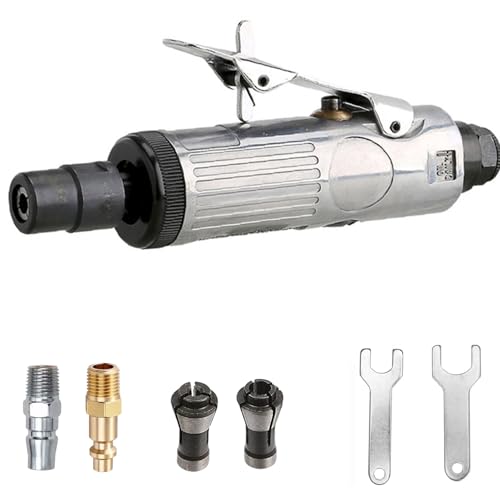
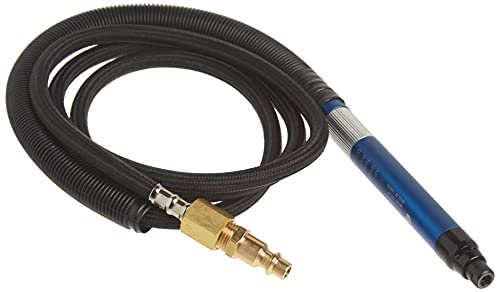
A straight grinder keeps the collet and body aligned, which can be useful for direct access along an open workpiece. The WORKPRO, Ingersoll Rand 308B, and Astro Pneumatic 218 use straight or pencil-style formats. Pencil designs are especially compact in the supplied listings: the Astro 218 is described as a pencil type, while the NEIKO has a 5-1/4-inch pencil body. These shapes favor detail work, small parts, and controlled positioning.
A right-angle grinder turns the working end toward the surface. That can help around corners, recesses, hubs, and other obstructions. The Milwaukee, Ingersoll Rand 301B and 302B, Chicago Pneumatic CP875, CILEONBE, and SHALL document angled or right-angle designs. The angle does not automatically make a grinder better; it makes a different access strategy possible. Match the head orientation to the areas you expect to reach.
Extended shafts can also change access, but the supplied extended-shaft candidate weighs the current price and was not selected for this lightweight comparison. This illustrates why reach and portability should be considered together rather than separately.
Match collet capacity to accessories
A 1/4-inch collet is a common choice for general die-grinder accessories. Several selected models use that size alone, including the Milwaukee, Ingersoll Rand models, and CP875. The Astro 218 and NEIKO are 1/8-inch-focused pencil grinders, which can suit smaller accessories but offer less size flexibility.
Dual-collet tools are more adaptable when your work alternates between accessory sizes. The CILEONBE, WORKPRO, and SHALL listings document both 1/4-inch and 1/8-inch collets. Confirm the accessory’s shank size before use and follow the tool maker’s instructions. The presence of two collets does not by itself establish that every accessory is compatible.
Compare speed and control features
Listed free speed ranges from 20,000 RPM on the SHALL to 56,000 RPM on the Astro Pneumatic 218. Higher speed may suit certain small-part finishing applications, but RPM alone does not describe torque, material removal, or suitability for a particular wheel or bit. Use the product’s stated applications as a guide: the Astro and NEIKO emphasize small-part cleaning, finishing, and polishing, while the Milwaukee lists metal cleaning, surface preparation, and cutting.
Control features are equally important. The Astro has a twist throttle, the NEIKO has a textured variable throttle, and the WORKPRO has a latch attached to the trigger mechanism. Several pneumatic models document self-locking throttles or safety levers. The Milwaukee lists four-mode RPM control and a responsive variable-speed trigger. These features provide documented ways to regulate operation, but the supplied evidence does not support claims about actual vibration, noise, or handling results beyond the listed descriptions.
Consider weight and ergonomics together
The lightest listed tools are not automatically the best match. The NEIKO lists the current price, the WORKPRO the current price, the CILEONBE the current price, and the Astro 218 the current price. These specifications favor maneuverability, especially for one-handed or detail work. The Ingersoll Rand 301B, Ingersoll Rand 308B, and CP875 remain near one pound while offering angle or straight configurations suited to broader shop tasks.
Grip design can influence how a tool fits a job. Milwaukee documents an ergonomic barrel grip, the 302B and 308B describe ergonomic composite housings, and SHALL documents a rubber, anti-slip texture. The CP875 lists a comfortable grip, while the Astro 218 lists a positive-grip body. Treat those as design descriptions rather than proof of reduced fatigue in actual use.
Check what is included
A bare tool may be preferable when you already own compatible accessories. The NEIKO includes a hose, nipple, and wrenches. The SHALL includes sanding discs, lubricant, connectors, and chuck keys. The Milwaukee listing documents a spindle lock, which can simplify accessory changes with one wrench. Included items can reduce setup work, but inspect the supplied accessory specifications before using them for a specific material or speed.
Final Recommendation
CILEONBE Mini 1/4-Inch Air Die Grinder ranks first overall in this specification-based comparison under the published weighted criteria.
The Milwaukee M12 FUEL 1/4-Inch Right-Angle Die Grinder is the first overall specification-based choice among these best lightweight die grinders. Its cordless format, brushless motor, right-angle access, work light, spindle lock, and multiple speed modes give it the broadest documented utility, even though several pneumatic tools weigh less.
For the lowest listed weight, the NEIKO 10649A is the clearest pick, with a 0.25-pound specification and 54,000 RPM pencil format. The Astro Pneumatic 218 is another strong detail-work option when its 1/8-inch capacity fits your accessories. For a lightweight dual-collet tool, the WORKPRO and CILEONBE offer straightforward specifications and low listed weights.
Choose the Ingersoll Rand 301B or Chicago Pneumatic CP875 when right-angle access is central to automotive or metalworking tasks. The Ingersoll Rand 308B is the better straight-format alternative when its 25,000 RPM and 0.33-horsepower motor fit your air setup. The SHALL is the practical kit choice because it documents dual collets and a broad set of included discs. These top lightweight die grinders should be compared against your compressor, accessory sizes, and workpiece access before purchase.
Frequently Asked Questions
What are the best lightweight die grinders for tight spaces?
The best lightweight die grinders for tight spaces are usually the right-angle or pencil-style models in this comparison. The Milwaukee, CP875, Ingersoll Rand 301B, CILEONBE, and SHALL document angled heads, while the Astro 218 and NEIKO use compact pencil-style bodies. Select the orientation that matches the direction from which you can reach the work.
Is a pneumatic or cordless die grinder easier to use?
Neither power source is universally easier. Pneumatic models need a compressor, hose, and regular lubrication, but the listings describe continuous air-powered operation. The Milwaukee is cordless and documents a brushless motor, variable trigger, and four speed modes, which may simplify mobility where a hose is inconvenient. The supplied evidence does not establish runtime or hands-on ease for either type.
Do all lightweight die grinders accept 1/4-inch accessories?
No. The Astro Pneumatic 218 and NEIKO listings focus on 1/8-inch capacity. The Milwaukee, Ingersoll Rand models, and CP875 list 1/4-inch collets. CILEONBE, WORKPRO, and SHALL document both 1/4-inch and 1/8-inch collets. Check the exact collet and accessory shank before operating the tool.
What RPM should I look for?
Choose RPM according to the accessory and task rather than selecting the highest number automatically. The listed products range from 20,000 RPM to 56,000 RPM. The Astro and NEIKO emphasize small-part cleaning and finishing, while other models list grinding, cutting, polishing, or surface preparation. Always follow the accessory and tool instructions for permitted speed.
Are included discs and hoses important?
They can be useful if you are building a setup from scratch. NEIKO includes a hose and fittings, while SHALL includes sanding discs, lubricant, connectors, and keys. A kit may reduce the number of separate items needed, but included accessories should still be checked for size, material suitability, and rated operating speed.